October 15, 2025
Alumni Spotlight: Matt Bass ‘19L
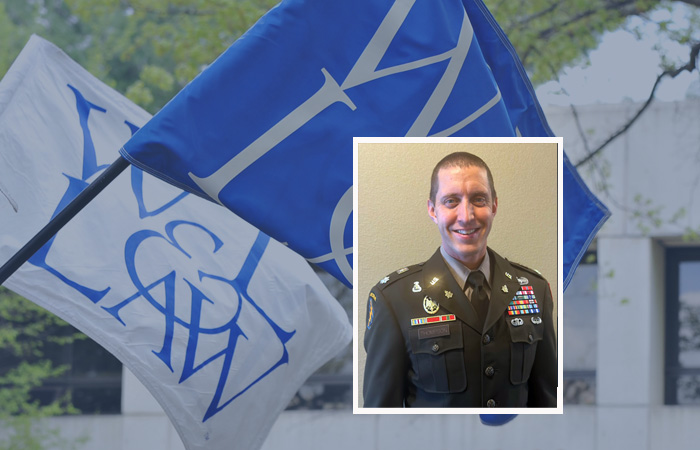 David Thompson ’19L
Lieutenant Colonel J. David Thompson ’19L was born in Salem, Virginia, and raised in Charlotte, North Carolina. He earned a B.S. in economics (2008) and an MBA in leadership (2014) from Liberty University. Before attending Washington and Lee University School of Law, David served as a U.S. Army Special Operations Civil Affairs officer, deploying to Afghanistan (2009-2010, 2014) and the Hashemite Kingdom of Jordan (2015-2016). During his time at W&L, David interned with organizations such as Physicians for Human Rights – Israel, the Department of Defense Office of Legal Counsel, and the United Nations Refugee Agency. He also volunteered with the World Bank on gender-based violence research in Jordan, served as a Director with Service to School, and led initiatives with Veterans for American Ideals.
After graduating from W&L Law, David returned to the Army as a Civil Affairs officer, deploying to Jordan (2020) and Iraq (2021-2022) while also working in Ghana, Côte d’Ivoire, Senegal, and Germany (2022-2025). Currently, he serves as an instructor at the U.S. Army Command and General Staff College and is pursuing a Ph.D. in Philosophy from King’s College London. Outside of work, David enjoys spending time with his family, reading, writing, and staying active.
Discuss your career path and how you have served in the U.S. Army.
When I first joined the Army, my plan was simple: serve for four years, then head to law school. But plans change. I discovered a deep sense of purpose in public service, and my first deployment to Afghanistan revealed how much I enjoyed the challenges and camaraderie of deployment life. During that tour, I worked alongside British SAS, psychological operations teams, and civil affairs units. While all of these roles were fascinating, I found myself drawn to the work of civil affairs.
Civil affairs officers operate at the intersection of military and civilian efforts, often working to build relationships, solve complex problems, and support local populations. To join this community, I had to pass a rigorous selection process that tested my ability to lead under pressure, work as part of a team, and endure physical and mental stress. After being selected, I completed language training, survival school, and other specialized courses.
I returned to Afghanistan as a civil affairs officer, working with the 7th Special Forces Group and later with Naval Special Warfare. During my second deployment, I decided to pursue law school. I spent what little free time I had reviewing LSAT flashcards and planned to take a prep course after returning home. However, I was selected for another deployment within a couple weeks of returning, so I ended up taking the LSAT with minimal preparation.
My next assignment took me to Jordan, where I served as a civil-military planner at the U.S. Embassy. This was one of the most rewarding roles of my career. While there, I came across a report produced by the W&L Law Human Rights Practicum that addressed access to education for refugee girls forced into early marriages—a challenge I was working on in Jordan. That report sparked my interest in W&L, and after speaking with a friend and alumnus, Nick Ramos, I decided to apply. Shortly after returning from that deployment, I attended an admitted students’ event at W&L. The kindness and professionalism of the community made my decision easy.
My (now) wife and I discussed the possibility of returning to active duty when I completed law school. With her support, I applied to return to the Army, and six months later, we were back at Fort Bragg, North Carolina.
In 2020, I served as an operations chief overseeing a special operations task force across the Levant. When COVID-19 struck, our mission shifted dramatically. My teams worked with partner militaries in Jordan, Lebanon, and Egypt to provide medical training, safety equipment, and information to combat the pandemic. It was a rewarding experience, and I’m thankful for everyone that was a part of it.
In late 2021 through the middle of 2022, I deployed to Iraq, where I commanded a small special operations company and directed a joint effects group as part of a special operations task force. I got to work with some exceptional people (much like the W&L community).
From 2022 to 2025, I transitioned from working in the Middle East to U.S. Africa Command in Stuttgart, Germany, where I focused on security issues in Africa. This was a dream assignment for me, as I had always been fascinated by the continent. I worked in Ghana, Côte d’Ivoire, and Senegal, where I was struck by the warmth and hospitality of the people. Living in Germany was also a blessing, as my wife and son are dual U.S.-German citizens, and we were able to spend time with family and explore Europe.
Currently, I am an instructor at the U.S. Army Command and General Staff School. My role is similar to that of a university professor but with an Army mission, teaching military officers from the U.S. and allied nations. It’s a privilege to help shape the next generation of military leaders.
What sort of legal issues do you handle on a day-to-day basis?
While I’m not a practicing attorney, my legal education from W&L is invaluable in my current and previous roles. The ability to “think like a lawyer”—to research, analyze, and write clearly—has been a tremendous asset.
At U.S. Africa Command, for example, I worked on crafting strategy within a legal framework. Understanding authorities, permissions, and international law was critical to ensuring our operations were both effective and compliant.
Additionally, my Ph.D. research at King’s College London focuses on the philosophy foundational to international humanitarian law. My studies at W&L, particularly in international human rights and humanitarian law, laid the groundwork for this research.
How did going to W&L Law shape your current and future military experience?
W&L Law taught me how to approach complex problems with clarity and precision. The emphasis on critical thinking, persuasive writing, and ethical decision-making has been instrumental in my military career.
In previous assignments I spent a lot of time communicating with lawyers and policy types. The background and understanding in law gave me an advantage, and I was able to further multiple initiatives by being better prepared. While this helped me professionally, what’s most important, is that it furthered U.S., allies, and partner efforts specific to security and prosperity.
W&L’s focus on public service also resonated deeply with me. My experiences with the Transnational Law Clinic, Washington and Lee Veterans Advocates (now the National Security and Military Law Society), and serving on the board of the Women Law Students Organization (WLSO) while also working through internships with organizations like the United Nations gave me a broader perspective on global issues—perspectives I’ve carried with me into my military roles.
What do you like about your current job?
I love teaching and mentoring. As an instructor at the U.S. Army Command and General Staff School, I have the opportunity to work with some of the brightest and most dedicated officers in the military. Seeing them grow as leaders is incredibly rewarding.
For the first ten years of an officer’s career, the Army primarily wants them from their neck down. Over the next ten years, the Army primarily wants them from their neck up. I love seeing officers transition to think of neck up solutions.
Another highlight from the past year was working with international officers. Their diverse perspectives enrich our discussions and remind me of the importance of collaboration in addressing global challenges.
What are some practices you have in your daily life to maintain wellness?
While I’m not a practicing attorney, life as a military officer comes with its own set of challenges, and maintaining wellness is critical to staying effective. Over the years, I’ve developed a few routines that help me stay grounded and focused.
One of my daily practices is something I call TIME, where each letter represents a key part of my morning routine:
During particularly hectic periods, I’ve relied on another framework I call FREST:
These practices have been invaluable in maintaining balance and resilience, whether I’m deployed overseas or working in a classroom setting.
Which W&L classes and/or experiences do you think were most helpful in preparing you for this job?
Several classes and experiences at W&L Law stand out as instrumental in preparing me for my career.
Any class or engagement with Mark Drumbl was a highlight. His expertise in international law and his ability to connect complex legal concepts to real-world issues were invaluable. Mark is also a great mentor and friend, and I’m fortunate to still keep in touch with him regularly.
David Eggert’s Torts class may not have been directly applicable to my work (thankfully, I don’t deal with torts in my day-to-day), but his passion for teaching and his ability to bring out the best in his students left a lasting impression.
Margaret Hu’s Constitutional Law class was another standout. She had a remarkable ability to break down intricate legal principles into a clear and logical process, which has been incredibly helpful in my work.
Finally, Russ Miller set the gold standard for deep analysis. His line-by-line approach to dissecting legal opinions taught me how to think critically and methodically. I recently had the privilege of guest lecturing in one of his classes, which was a full-circle moment for me.
Each of these professors not only shaped my understanding of the law but also modeled the kind of intellectual rigor and professionalism I strive to bring to my own work.
What advice do you have for prospective law students who are coming from a military background?
For everyone, I recommend defining your own success. Law school has a very narrow definition of success—law review followed by big law. That wasn’t appealing to me even though I was really interested in the study of law and developing the associated skills. So, I had to create my own definition of success. That led me to do things differently as a student. I didn’t compete for law review, and the internships I took didn’t set me up for a job in big law. But I think I was successful on my own path.
For veterans or active-duty service members considering law school, my first piece of advice is this: your military experience is a tremendous asset. The discipline, leadership, and problem-solving skills you’ve developed will set you apart and serve you well in the classroom and beyond.
That said, transitioning from the military to law school can come with its own unique challenges. One of the biggest adjustments for me was figuring out how seriously to take class. Coming from the military, where life-and-death decisions are part of the job, I initially struggled to see the urgency in academic work. No one was shooting at me, so I wasn’t stressed. My grades were fair, but I realized there were things within my control that I wasn’t taking full advantage of—whether it was better preparation, deeper engagement with the material, or simply asking more questions. Over time, I learned to take class more seriously while still maintaining a sense of humor and not taking myself too seriously. Striking that balance helped me stay focused without losing perspective.
Another piece of advice is to lean on your network. Whether it’s reaching out to professors, classmates, or alumni, you’ll find that the W&L community is incredibly supportive. Veterans, in particular, tend to look out for one another, so don’t hesitate to ask for guidance or mentorship.
Be prepared for a shift in mindset as well. The military often emphasizes decisiveness and action, while law school requires patience and a willingness to explore multiple perspectives. Embrace the challenge. It will make you a more well-rounded thinker and leader.
Finally, stay true to your values. The transition from the military to law school can be daunting, but your commitment to service, integrity, and virtue will guide you through. Law school is an opportunity to build on the foundation you’ve already established in the military, and it can open doors to new ways of serving others.
If you know any W&L alumni who would be great profile subjects, tell us about them! Nominate them for a web profile.
Hobby
I have a young son, and spending time with him is my favorite way to unwind. Beyond that, I enjoy reading, writing, and staying active through exercise.
Book/Podcast Recommendation
For podcasts, I’ve been hooked on “Philosophize This!” for the past few years—it’s a fantastic way to explore complex ideas in an accessible format. I also listen to the BBC World Service daily to stay informed. During law school, I couldn’t get enough of the “More Perfect” podcast, which dives into the history and impact of Supreme Court decisions.
For books, I love reading. I must shout-out anything by David Whetham, Christian Braun, and Michael Walzer. I also love reading Helen Frowe, Adil Haque, James Turner Johnson, Pauline Shanks Kaurin, and more. I also read the classics: Aristotle, Epictetus, Marcus Aurelius, Seneca, Hugo Grotius…I’m currently on a Byung-Chul Han kick.
I guess I should mention a fiction, so you don’t think I’m completely unsufferable. I think I’ve read all of V.S. Naipaul’s work. He does a great job at capturing sentiments of post-colonial societies.
Most adventurous thing you have done
Where to begin? I once took Partnership Tax Law at 8 a.m.—that was an adventure in itself. But perhaps the most daring thing I’ve done was calmly attempting to explain to my (then pregnant and hungry) wife why I thought she was being irrational. Let’s just say I learned a lot that day.

You must be logged in to post a comment.