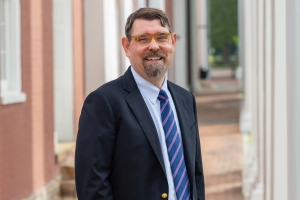
Erich Uffelman to Deliver Provost’s Lecture The annual address that celebrates W&L faculty for excellence in scholarship and teaching will be held at 5:30 p.m. on Sept. 17 in University Chapel.
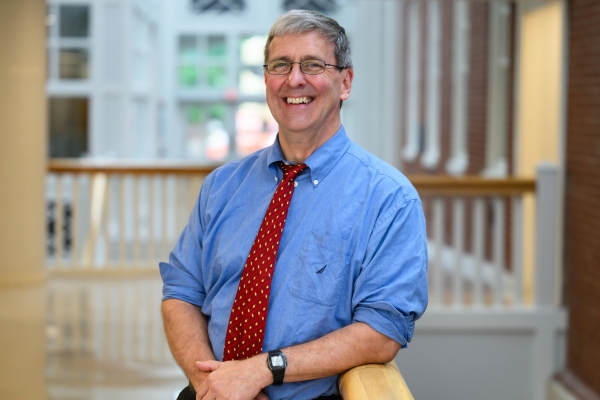 Erich Uffelman, Bentley Professor of Chemistry
Erich Uffelman, Bentley Professor of Chemistry at Washington and Lee University, will deliver the 2025 Provost’s Lecture at 5:30 p.m. on Wednesday, Sept. 17, in University Chapel. The talk is free and open to the public, and a reception will be held prior to the talk in the Washington Hall foyer at 4:30 p.m.
“The Provost’s Lecture celebrates one faculty member each year whose research or creative work rises to the top of a scholarly or artistic field,” said Lena Hill, university provost and professor of English. “We also use this honor to recognize the faculty member’s outstanding teaching and academic citizenship. I am excited that members of the W&L and local Lexington community will have an opportunity to learn from Professor Uffelman.”
Titled “Scientific Adventures with Art History and Cultural Heritage,” Uffelman’s lecture will examine the use of modern technology to study old artwork and cultural artifacts without damaging them. In essence, scientists have developed ways to “see” inside paintings, sculptures and other art pieces, using techniques similar to medical imaging. This allows researchers to peek beneath the surface of a painting to see what the artist originally painted, discover if the artist made changes while working or determine the materials and techniques used in its production.
“The past 20 years have seen a revolution in non-invasive methods for examining cultural heritage, and the results have been transformative in art history and art conservation,” said Uffelman. “This talk will provide examples of how we can understand artists’ intent, artists’ techniques and issues of attribution using various scientific techniques. The talk will be geared to a general audience — anyone who understands they get a sunburn in bright sunlight and that convenience store hotdogs are kept warm with heat lamps will be able to understand the lecture.”
In addition to teaching traditional chemistry courses, Uffelman instructs the Arth 356 class titled Technical Examination of 17th-Century Dutch Paintings, an interdisciplinary course for non-science majors at the intersection of chemistry, physics, analytical instrumentation, history, economics and religion. The course takes students abroad to the Netherlands for four weeks during Spring Term.
“Professor Uffelman’s research and teaching represent the best of liberal arts studies at W&L,” said Hill. “His trailblazing scholarship leads to invitations from museums across the nation and the world, and he translates these relationships into research opportunities for his students. Whether ‘Dr. U’ is teaching General Chemistry, analyzing Dutch painting, or taking his lab out for ice cream, he is always mentoring and encouraging students. The intellectual curiosity, good humor and excellence that color all he does make me particularly proud to honor Professor Uffelman.”
Uffelman joined the W&L faculty in 1993 and served as department head for the Department of Chemistry and Biochemistry from 2019-2023. He recently finished serving 20 years as University Parliamentarian and has served on numerous committees during his tenure. Uffelman has authored or coauthored 51 peer-reviewed publications and patents and has received external funding from the National Science Foundation, American Chemical Society-PRF, Research Corporation, Hewlett Packard, Associated Colleges of the South and the Kress Foundation.
Uffelman was awarded the Outstanding Faculty Award from the State Council of Higher Education in Virginia in 2009, and in 2017 he was selected as the Advisor of the Year by the W&L student body. Additionally, he has been awarded the Washington and Lee University Class of ’65 Excellence in Teaching Award four times. From 1991-1993 he was a National Institutes of Health Postdoctoral Fellow at Stanford University after having earned a Ph.D. in inorganic chemistry as a National Science Foundation Predoctoral Fellow at the California Institute of Technology. He also holds a Bachelor of Science degree in chemistry from Bucknell University.
Related Stories

You must be logged in to post a comment.