October 22, 2025
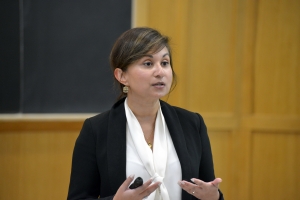
Kish Parella Lectures as Visiting Scholar in Singapore
 Prof. Kish Parella
Washington and Lee law professor Kish Parella, along with Carla Reyes of SMU Deadman School of Law, has published an article in the Seattle University Law Review. In the article, titled “Global Supply Chain Resilience in Emerging Technologies: A Case Study of Bitcoin Mining,” Professors Parella and Reyes explore the supply chains for new technologies, such as blockchain technology, artificial intelligence, and quantum computing, where the U.S. has a strong national security interest. They note that achieving this national security goal depends on the resilience of two types of supply chains within the Bitcoin mining industry: analogue supply chains (hardware components) and data supply chains (software components).
The authors provide insights into key risks that could lead to disruption in analogue supply chains or damage to software data supply chains, including environmental, geopolitical, operational, and reputational risks. They also present suggestions for corporate governance, asset management and disclosure requirements, which has important implications for market actors, investors, and policymakers.
“[B]ecause critical and emerging technologies are central to preserving U.S. economic and national security advantages, the resilience of their supply chains is itself a matter of national security. Yet ensuring this resilience often falls to private market actors. Analyzing these supply chains, therefore, requires a bi-directional perspective: On one side, the technologies’ national security significance shapes how firms approach risk management. On the other, the degree to which firms succeed in managing their supply chain risks will in turn determine the security of the nation. This Article’s framework equips private actors to meet this challenge by distinguishing among supply chain types; identifying risks within each; describing the reciprocal relationship between national security and corporate supply chain management; and accounting for the unique features of these supply chains—particularly that they extend beyond physical components to include layered data networks,” write the authors.
The article is part of the publication from the Seattle University Law Review that includes symposium submissions for “Berle XVII: International Business Transactions in a Fragmented World: National Security, Geopolitics, and Corporate Governance,” an event that Professor Parella organized last year. This prestigious corporate law symposium was hosted March 21-22, 2025 by the Berle Center on Corporations, Law, and Society at the Seattle University School of Law and brought together experts from the academy, policy and practice and crosses several disciplines, including national security, commercial law, corporate governance, trade, and antitrust law, among others. The event explored foundational questions in international business transactions including its scope, disciplinary methodology, current practice and future trends.
The full article is available online at the W&L Law Scholarly Commons. The complete symposium publication is available online at the Seattle University Law Review website.
If you know a W&L faculty member who has done great, accolade-worthy things, tell us about them! Nominate them for an accolade.


You must be logged in to post a comment.