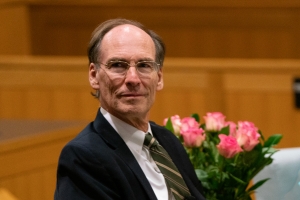
Murch Exits the Stage Professor Brian Murchison will retire from full-time teaching at the end of the academic year.
As a two-hour Torts class wrapped up one morning last fall, a student approached a visitor who had been sitting quietly in the back row of Lewis Hall’s Classroom A.
“What did you think of the class?” she asked.
The visitor said he’d been struck by the lively Socratic exchanges between students and the professor as they debated the rescue doctrine and implied assumption of risk.
“Well,” she replied, “that’s Professor Murch. He’s a legend.”
After 43 years, the legend will retire at the end of the academic year. To say that Brian Murchison, the Charles S. Rowe Professor of Law, will be missed is to understate the impact of a career that has shaped generations of W&L law students. In addition to his teaching and scholarship on administrative law, mass media law, jurisprudence, and torts, he has served as interim dean, director of the Frances Lewis Law Center, and co-founder of the Black Lung Clinic, to name only a few high-profile activities.
But Murchison’s influence has reached beyond the walls of Lewis Hall. He has touched virtually every corner of the university — from teaching undergraduate courses to serving on presidential search committees, from chairing the Commission on Institutional History and Community to directing the Mudd Center for Ethics.
In short, he has been a defining presence at W&L.
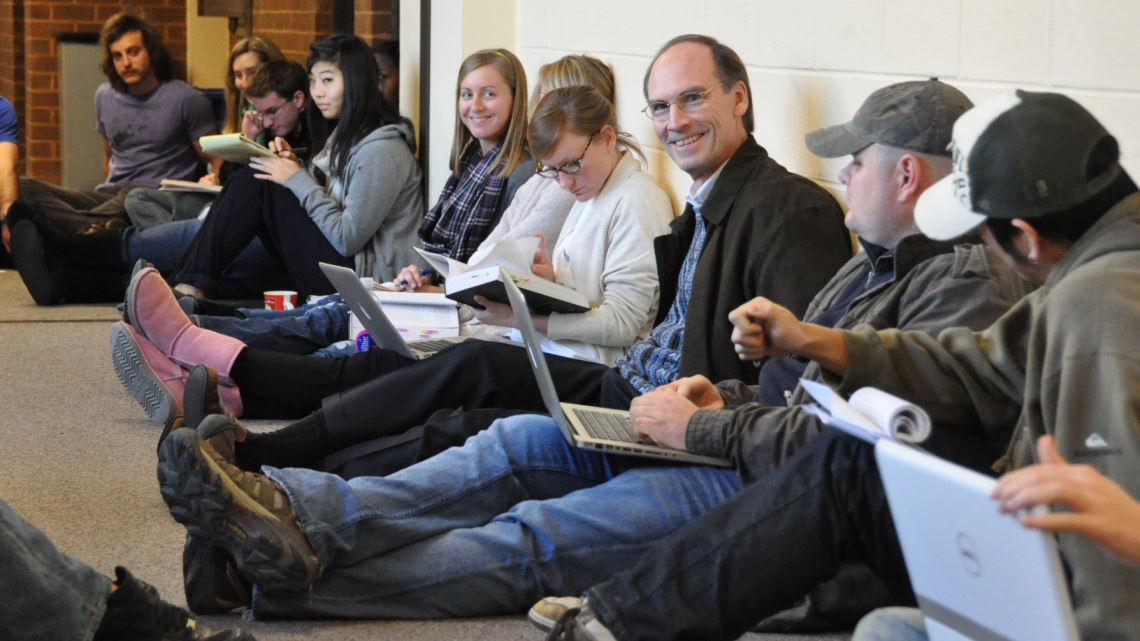
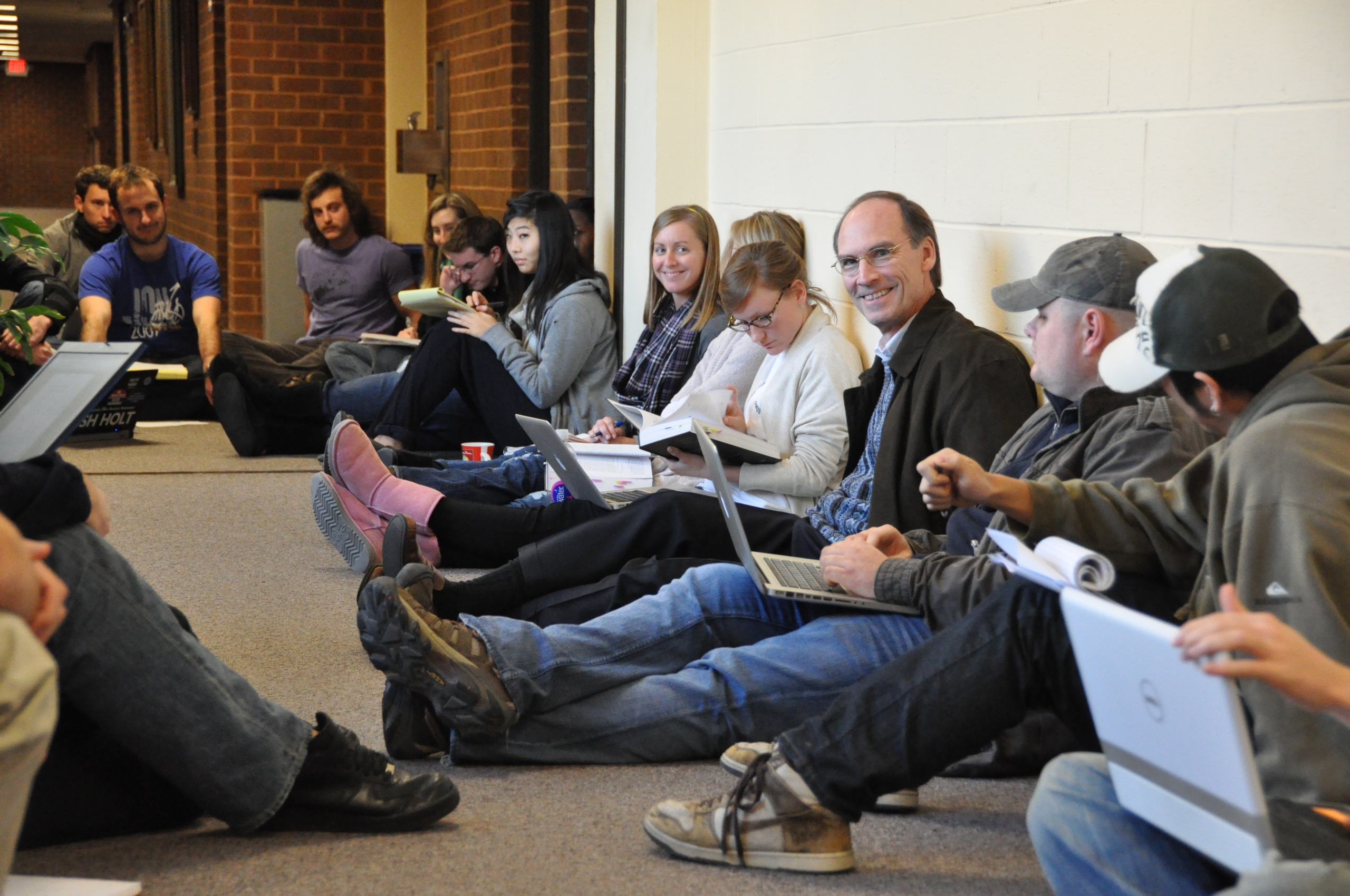 Students gather outside Murchison’s office for one his many hallway exam review sessions.
When Murchison, his wife Ann, and their 2-year-old daughter rolled into Lexington in the summer of 1982, he wasn’t thinking about a four-decade career. Mostly, he wondered how he and his young family would adjust after leaving Washington, D.C., where he’d grown up and was working at a law firm.
At Hamel, Park, McCabe & Sanders, he was on the fast track, practicing administrative law and especially enjoying work for broadcasters — “hapless broadcasters,” as he calls them — and other media clients who tangled with the Federal Communications Commission.
Then a “fluky thing,” as he puts it, occurred. One of his sister’s friends told him about a faculty opening at Washington and Lee’s law school and suggested he apply. He was hesitant.
“One, I liked what I was doing. And two, I didn’t think I was qualified to be a law professor,” Murchison said. “I did not clerk for a federal judge, and my impression was that was a prerequisite for getting a teaching job.”
He did, however, have teaching experience. Between graduating from Yale University and his enrollment in Yale Law School, he spent three years in the Peace Corps teaching English in Benin, West Africa. “Maybe that’s why my sister’s friend suggested I consider it,” he said.
Despite his reservations, Murchison sent a letter of application to Rick Kirgis, then chair of the appointments committee. Kirgis, who later served as dean from 1983 to 1988, replied that the hiring season had ended. “I thought it was his polite way of confirming that I wasn’t qualified,” said Murchison.
When hiring season began again the following year, Murchison’s phone rang. It was Kirgis, telling him it was now time to apply. Murchison remained skeptical. He assumed W&L was simply expanding its pool and that Kirgis, a Yale grad, was extending a courtesy call to a fellow Yalie. But he applied, received an offer, and faced a decision.
He could envision staying at the law firm and continuing to work in mass media law, which he loved. He’d also had fleeting thoughts of a journalism career. He was an editor of the Yale Daily News as an undergrad and had worked one summer during law school as a Metro reporter at the defunct Washington Star.
“After my second year of law school when you’re supposed to be finding a permanent job in a law firm, I was somewhat disillusioned and applied to the Star,” Murchison said.
He earned several front-page bylines, even scooping the rest of the media on the disappearance of a 12-year-old boy from his home in Vienna, Virginia. Although his reporting impressed the Star editors, they discouraged him from switching paths. Quite the opposite, in fact. “They said, ‘Are you crazy? We don’t make any money. You’ve got to go back to law school,’” Murchison said.
He took their advice, returned to Yale for his final year, and was settled in as associate at the law firm when Kirgis called. This time he took a chance and accepted the offer.
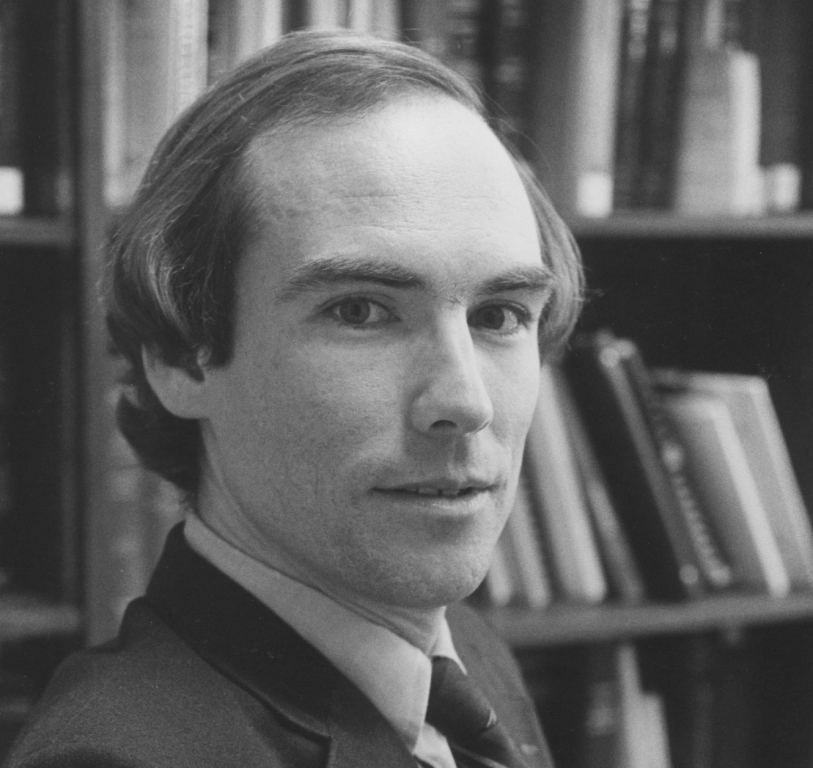 Murchison in 1988
Murchison said his transition to life as a law school professor was relatively smooth because W&L fit him so well. “I seemed to be happily in sync,” he said. “When I came here the ethos was small and personalized, and there was equality among the professors. It was the luckiest thing that could possibly have happened to me.”
In his first week, senior faculty member Lewis (Lash) Larue appeared in his doorway carrying a massive book manuscript. “It was about this thick,” Murchison said, spreading his hands a foot apart. “’Could you read this over the weekend and give me some helpful notes?’ Lash asked. I remember saying to Ann, I’m used to hierarchy in the law. This brilliant man just asked me to read his manuscript and comment on it. I thought, ‘How wonderful is that?’ It shows that this is an incredible place.”
He praised the mentoring he received from faculty colleagues like Larue, Roger Groot, Joe Ulrich, and Uncas McThenia. “These men were a generation older than I was and were great to me,” he said.
The students welcomed him as well, nicknamed him Murch, and responded to his teaching style, which included Shakespeare. An English major at Yale, Murchison begins his Administrative Law class with Hamlet. “I tell the class that the poor prince is analogous to a baffled government agency buffeted by confused signals from the White House, Congress, public interest groups, and regulated industry,” he said. “I liken the ghost to the White House, Polonius to Congress, public interest groups to Ophelia, regulated industries to Gertrude, etc. Ultimately the course becomes a story of how the agency manages all the conflicting signals and tries to carve a way towards the public interest.”
Little wonder that the Law News once ran a feature headlined “Murch: The Shakespeare of Lewis Hall.” The story read, in part: “As anyone who has ever had Murchison as a professor can attest, in his capable hands, even the driest administrative law or business organizations case becomes a fascinating story which he unfolds for his students on his stage.”
Murchison was 30 years old when he came to W&L — younger than some of his students — and acutely aware of maintaining a professional distance. He wasn’t aiming to be everyone’s friend, he said, but he did want to be an exceptional teacher and to balance detachment with involvement. He succeeded: students awarded him 16 different teaching honors. In 1988, six years after he arrived, he won the Virginia Council of Higher Education’s Outstanding Faculty Award — the Commonwealth’s highest honor for university faculty, recognizing excellence in teaching, research scholarship, mentoring and public service.
“I wasn’t reinventing the wheel when I started,” Murchison said. “I was trying to be a good teacher, but you also have to be a good scholar. I had to figure out how to do that. I admired that very challenging set of requirements. It was the way it should be, and it was not easy.”
Although his scholarly writing spans many subjects, his work on the First Amendment stands out. Over 17 years, he published a trilogy of major papers about the background values of the First Amendment’s speech and press clauses: “Speech and the Self-Realization Value” (1998), “Speech and the Self-Governance Value” (2006), and “Speech and the Truth-Seeking Value” (2015).
Even with his teaching and scholarship, Murchison managed to bridge the literal and figurative gap across Woods Creek. His undergraduate involvement began when he was invited to join early summer programs at W&L, including the Institute for Business Executives and the Alumni Colleges.
“I think they wanted somebody from the law school, and I became the law guy,” Murchison said. “I was attracted to the liberal arts anyway, and it was a way I met professors on the other side. I loved my colleagues here in Lewis Hall. Then, a stone’s throw away, I was meeting all these other wonderful people and learning from all of them.”
Murchison’s university-wide impact was extensive. He taught several undergraduate classes and served on pivotal university committees, including as chair of the 2005-06 presidential search. He even hosted a weekly radio program on WLUR-FM called “Equal Time.” But perhaps his most demanding assignments came in 2017, when he was asked to lead the Commission on Institutional History and Community, which President Will Dudley empaneled to examine how W&L’s history — and the ways that history was taught and discussed — shaped the community.
Murchison had accepted an invitation to become director of the Mudd Center for Ethics, and he had to postpone that role while he chaired the commission. Beginning in August 2017 and continuing for nine months, he led 11 students, faculty, staff, and alumni on a deep and daunting exploration of the university’s history.
“Our charge was rather nebulous, and some people thought we had no business doing what we were doing,” Murchison said. “But my job was to lead this group of people, most of whom didn’t know each other, and to come out with a unified product. My feeling even today is that, as difficult as it was, it was an incremental step toward some serious thinking that took place by the Board of Trustees after we were done.”
Murchison’s university-wide impact did not go unnoticed. The Executive Committee awarded him the William W. Pusey Award in 2008 as the faculty member or administrator who has made the greatest contribution to the university.

Murchison considers cofounding the Black Lung Clinic a career highlight.

Hosting his radio show “Equal Time” on WLUR.
When asked to identify his favorite W&L experience, Murchison readily points to the Black Lung Clinic, which he co-founded with Mary Natkin, an emerita professor of law. The idea grew out of Uncas McThenia’s seminar called “Lawyering for Social Change.” Murchison would slip into the back of the classroom and listen as McThenia, a West Virginian, discussed the problems of Appalachia, including black lung disease.
“I first heard that there was a federal workers’ compensation statute but that few lawyers in West Virginia were representing coal miners because there is no money to be made,” said Murchison. “It was the perfect thing that a pro bono-oriented law school could do.
“Learning how to win one of those cases took every ounce of stamina and brain power that I had. Mary was an experienced clinical professor, which I was not. So, we collaborated on it. This was the mid-1990s. I was coming out of a three-year term as director of the Frances Lewis Law Center, so this was a perfect time.”
Murchison related his experience with and fondness for the Black Lung Clinic in his 2015 Fall Convocation address and emphasized its the liberal arts nature.
“We had people from the biology department helping us; we had people in the English department helping us,” he said. “The whole staff of the Law School was helping us. We were studying the sociology of black lung and the coalfields. We were studying its history. It was a liberal arts interdisciplinary experience to get that legal clinic up and running in the Law School.”
Clinic students grow up fast, he said, because they are responsible for a client. Every case is different and requires an “intensive immersion into the facts” to determine why the client should win.
“The pleasure for me was seeing students grow at an exponential rate — because they know someone is counting on them,” Murchison said. “For me, the clinic was the coolest thing and, I thought, the most useful special assignment I had.”
Nothing, though, is more important to Murchison than the classroom, which he calls “a sacred space” where interactions are of a different order and degree from any other in Lewis Hall.
“When you’re in that classroom, you are contributing to reflection about what makes this country tick,” he said. “It’s a space for argument, for illumination, for mutual respect. We expect that what goes on in the hallways and in the Brief Stop and elsewhere is important. But everything reaches its zenith in the classroom because the process of learning law is of fundamental importance.”
If you know any W&L faculty who would be great profile subjects, tell us about them! Nominate them for a web profile.
Related Stories

August 13, 2025
Black Lung Clinic Wins Case in Fourth Circuit Court of Appeals
June 9, 2025
Law School Announces 2025 Faculty Fellowships

You must be logged in to post a comment.