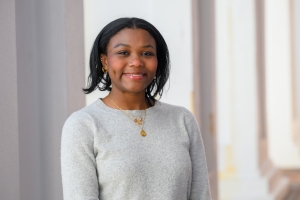
New MESA and Arabic Minors Broaden W&L Students’ Horizons Washington and Lee’s new Arabic minor grew out of its innovative, interdisciplinary Middle East and Southeast Asian Studies program.
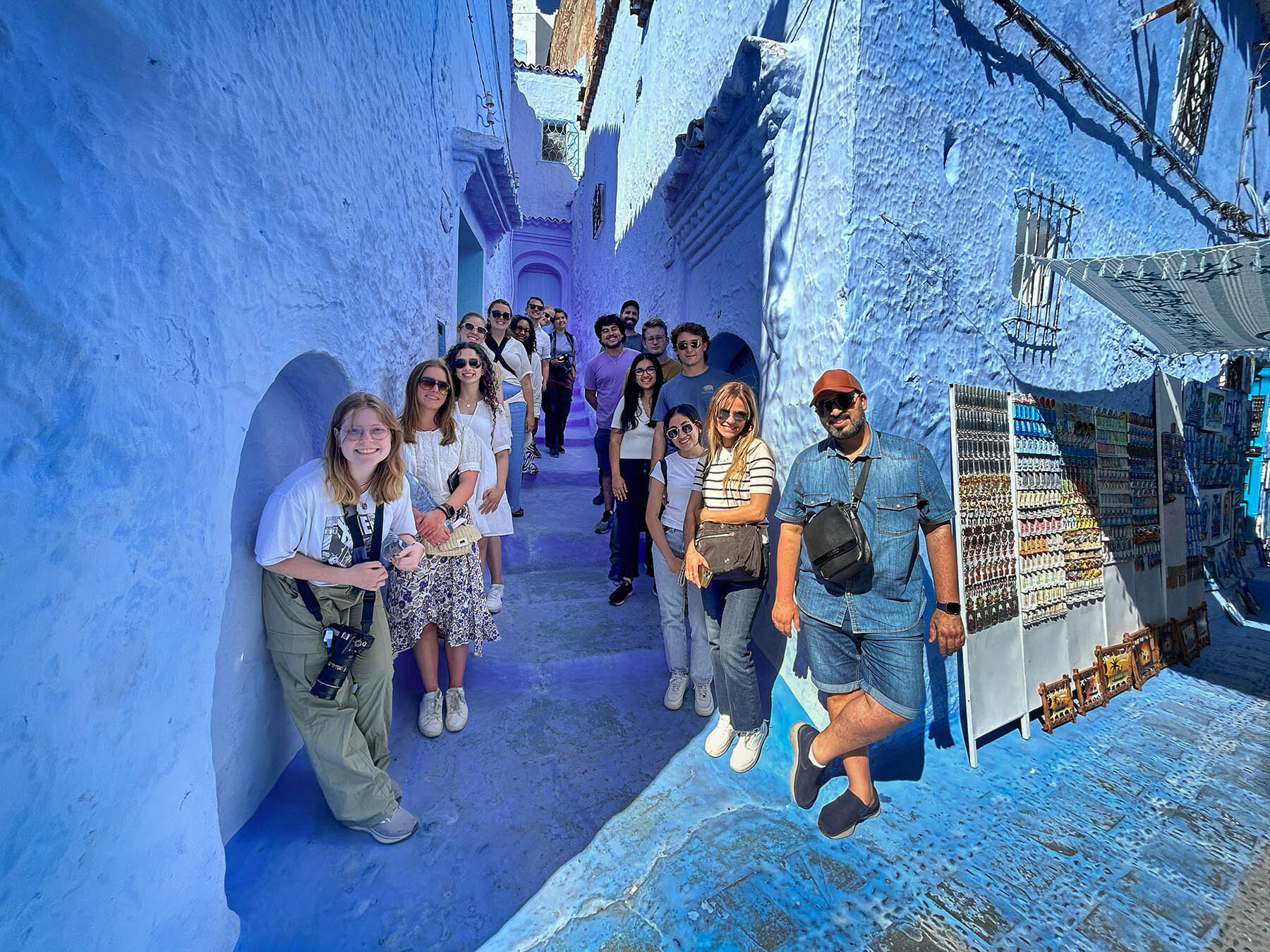 Seth Cantey’s Spring Term 2023 course in Morocco, where students could earn a MESA course credit.
“It’s a unique program, and it remains unique in this new iteration.”
~ Seth Cantey, associate professor of politics and MESA program head
This academic year marks a turning point for Washington and Lee University’s Middle East and South Asia Studies (MESA) program. What was once a single interdisciplinary minor divided into two tracks has now evolved into two distinct credentials: the MESA minor and the newly established Arabic minor. The change, years in the making, gives students more flexibility to shape their studies around either regional expertise or linguistic proficiency.
“Restructuring the MESA program was a major undertaking,” says Seth Cantey, associate professor of politics and MESA program head. “After a comprehensive self-study, an external review and a full curricular redesign, we have a program with real momentum. Arabic enrollments are strong, and the revamped MESA minor gives students more ways to explore the politics, history and cultures of the region.”
The new Arabic minor requires six courses: five in Arabic language and culture and one related to the Middle East or North Africa. The revised sequence includes Introductory Arabic I and II, followed by Arabic in Context I and II and Digital Arabic, a course exploring how the language functions in online spaces.
“We’re focusing the curriculum more on the spoken variety,” says Anthony Edwards, associate professor of Arabic. “It’s about equipping students to navigate the everyday Arabic-speaking world. By the end, they can order at a restaurant, go to the doctor or make a hotel reservation in Arabic. The Digital Arabic course will look at how people use the language on platforms like X and Instagram, reading comments written in both Arabic script and Latin transliteration.”
Edwards says he is most excited about the new Digital Arabic course.
“The digital space is where this generation lives,” he says.
The redesigned Arabic program aligns with peer institutions and industry standards while giving students a more balanced workload. For Edwards, the emphasis on community is just as important as the curriculum.
“Arabic is a Category Four language, or ‘super hard,’ according to the State Department,” he notes. “We have 25 to 30 students dedicated to learning it in all its beauty and intricacy. The bonding that happens in those classes gets them through it.”
That camaraderie is something first-year student Toni Ogunlande ’29 says she already feels.
“Everyone’s at the same level, so we will just be laughing in class when Professor Edwards starts talking in Arabic and we don’t really understand what he’s saying,” she says. “It’s the camaraderie we all have knowing we’re all starting from the same place.”
Despite juggling chemistry, calculus and religion courses, Ogunlande says she plans to stick with Arabic through all five semesters.
“I’d actually consider minoring in it,” she says. “Professor Edwards is so supportive, and beyond the language coursework, it’s only one extra class.”
The program also benefits from the contributions of World Language Teaching Assistant Dina Elsaqa, from Egypt, who works with students outside of class to enhance their language skills.
“I prepare supplementary materials that bring in cultural elements such as traditions, clothing, sports, songs, poetry and movies,” Elsaqa says. “I try to tailor these to each student’s interests. For example, one student loves poetry, so I recommend Arabic poems at his level and sometimes something a bit more challenging. Another is a jazz musician, so I suggest Arabic jazz or classic pieces. And for a geology student applying for jobs in the Middle East, we read articles about the oil industry. I try to meet each student where they are.”
While the Arabic minor focuses on linguistic and cultural fluency, the newly revised MESA minor emphasizes the interdisciplinary study of the Middle East and South Asia across politics, religion, economics, history, art and literature. The MESA minor now requires seven courses and offers more flexible pathways for students to tailor their studies.
Cantey says the former “gateway course” requirement has been removed, and the program has expanded what kinds of courses can count toward the minor. Students can now apply up to two courses even if less than half of course content is directly about the region. Courses counted in this way must be taught by members of the MESA faculty cohort, and students must complete a MESA-relevant final paper or project.
“In the past, you had to meet this 50% threshold [of course content directly about the region] for a class to count toward the minor,” Cantey says. “We’ve relaxed that requirement to give students a little more flexibility, which is consistent with how most of our peers run similar programs.” The program also offers a conditional capstone, subject to student demand and faculty availability. Whenever at least five seniors plan to minor in MESA, a capstone course will be created during Winter Term.
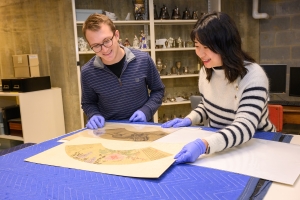
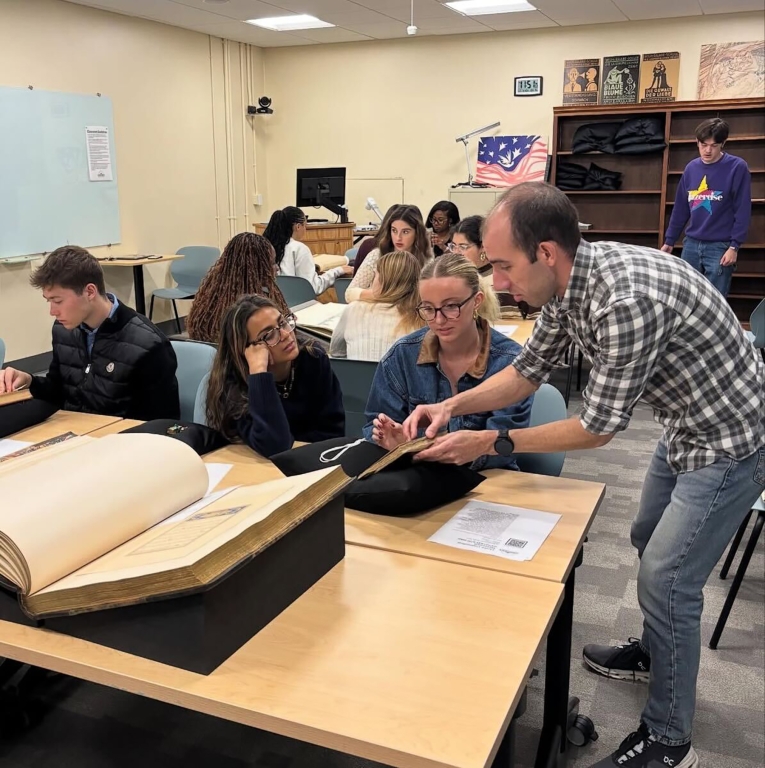 Anthony Edwards examines Arabic-language books and letters in Washington and Lee’s Special Collections with his Arabic 111 students.
According to Shikha Silwal, associate professor of economics and one of the founding MESA faculty members, that adaptability reflects how the program has evolved since its inception.
“When I joined the university back in 2012, there was a recognition that we were missing a big and very important region in the world in our curriculum,” she says. “We weren’t sure what the student interest would be, but the response was overwhelming. Classes filled immediately.”
She recalls the program’s early years as a grassroots effort between faculty across the university. By 2015, a small MESA faculty cohort had formed. Two years later, the program introduced the first iteration of the MESA minor.
“There was a really nice confluence of things happening,” Silwal says. “Once we started offering courses, the demand made it obvious that the program was needed.”
Today, she sees the MESA minor as an opportunity for students to explore the region from multiple angles.
“Within the Williams School, I advise students who are studying global finance or development economics but who also want to understand the Middle East or South Asia through that lens,” she says. “It’s a wonderful blend of disciplines.”
For students, the changes have opened new pathways to connect their global interests with their professional goals. Edison Dokken ’27, a computer science and global politics double major, said the MESA minor complements his interests in cybersecurity and world affairs.
“I started with Islamic history because I didn’t know much about Islam, and I just kept going,” he says. “It’s fascinating. There’s always something happening in the Middle East. Taking Arabic now has made it even better. Professor Edwards makes it straightforward, and it’s not as hard as I expected.”
He appreciates how the minor’s flexibility allows him to fulfill other degree requirements while pursuing his interests.
“I can get all my FDRs (Foundation and Distribution Requirements) done with courses that are actually cool,” he says. “It’s like, if you’re eating somewhere new, you should try what they’re known for. At W&L, that means taking global classes.”
Brandon Bishop ’25, who began studying Arabic as a first-year, says his experience with the language transformed his college trajectory and his life. .
“When I started, I didn’t think Arabic would become such a big part of my future,” he says. “But then I studied abroad in Jordan, and it clicked. I realized this is what I want to do.”
Bishop went on to study in Denmark, South Korea, the West Bank and Germany, and to intern at Bangladesh’s Nobel Prize-winning Grameen Bank.
“My big dream is to be a Foreign Service officer, and Arabic helps with that,” says Bishop, a computer science major with a MESA minor. “It’s a critical language that opens doors.”
Politics and economics double major and MESA minor Rachel Reibach ’19 now serves as a regional director for Sen. Tim Kaine. She says her MESA experience, paired with her majors, provided a depth to her studies that continues to shape her day-to-day work. In Kaine’s office, Reibach regularly engages with a wide range of communities, attending local events, maintaining relationships with cultural organizations and checking in with constituents after global developments that affect families across the commonwealth. She often helps surface concerns from Virginians whose lives are touched by international policy.
“The job is just to be on the ground, seeing what people are seeing and dealing with, or just kind of going into various communities and being a representative for the senator,” she says.
Reibach says now that she is working in one of the most culturally diverse regions of the state, she constantly draws on the knowledge she gained in her MESA courses.
“Knowing about Middle East and Southeast Asian communities,” Reibach says, “like how to go into a mosque respectfully, or gurdwaras or temples, what to say, and issues they might care about has been super helpful to my work.”
As the first students embark on the new curricula, Cantey says he hopes the changes make MESA more accessible and sustainable for the long term.
“We expect to see at least some students doing both minors,” he says.
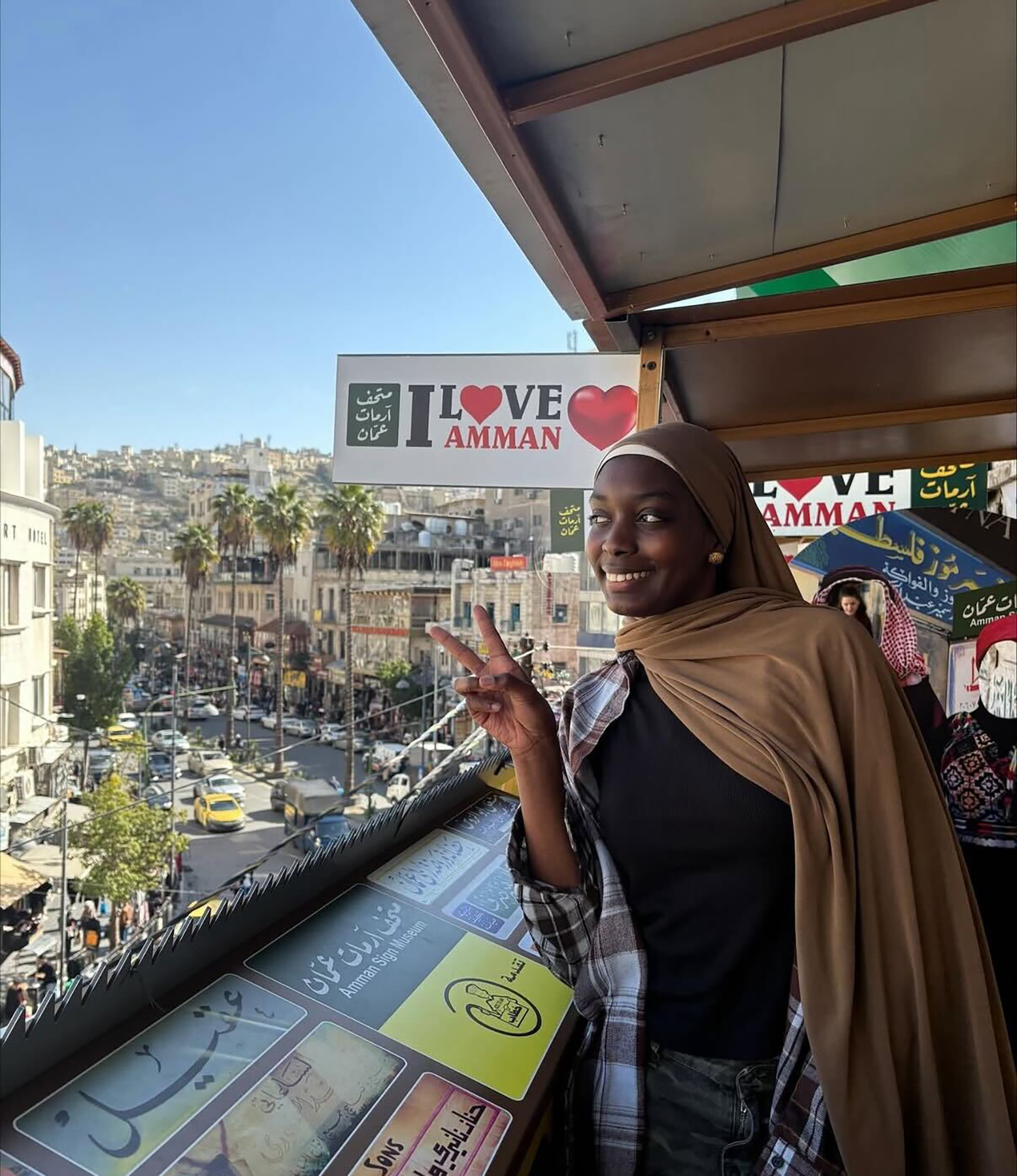 Adja Ndiaye ’26 poses for a photo in Amman during her time in the CET program.
Adja Ndiaye ’26 is one such student. An Earth and environmental geoscience major who is minoring in both MESA and Arabic, Ndiaye says her educational trajectory has prepared her for her future while keeping her connected to her roots. Ndiaye was raised in Greensboro, North Carolina, but her parents are both from Senegal.
“My family and I are Muslim, and I grew up going to a weekly Quranic school, so I had always wanted to be able to read the Quran in Arabic,” she says. “I’ve also been able to learn more about Arabic history and culture.”
Ndiaye also said her career interests may one day take her to North Africa or the Middle East, where she hopes to be able to work for a company or organization that identifies groundwater sources and provides access for developing communities.
Ultimately, both the Arabic and MESA minors reflect W&L’s commitment to preparing students for meaningful engagement with the wider world.
“It’s a unique program, and it remains unique in this new iteration,” Cantey says. “We’re proud of that.”
JUST THE FACTS
- W&L is now offering a Middle East and South Asia studies and Arabic minor, which were previously two different tracks in a single interdisciplinary minor.
- The change gives students more flexibility to shape their studies around either regional expertise or linguistic proficiency. The Arabic minor focuses on linguistic and cultural fluency, while the newly revised MESA minor emphasizes the interdisciplinary study of the Middle East and South Asia across politics, religion, economics, history, art and literature.
- Great for students interested in interdisciplinary fields such as politics, finance, economics, computer science and earth and environmental geoscience.
Related Stories
October 1, 2025
Rare Student Research Opportunity

You must be logged in to post a comment.