
Williams School Building Becomes Washington and Lee University’s First LEED Gold Certified Structure The building, housing the university’s School of Commerce, Economics and Politics, opened in August 2025.
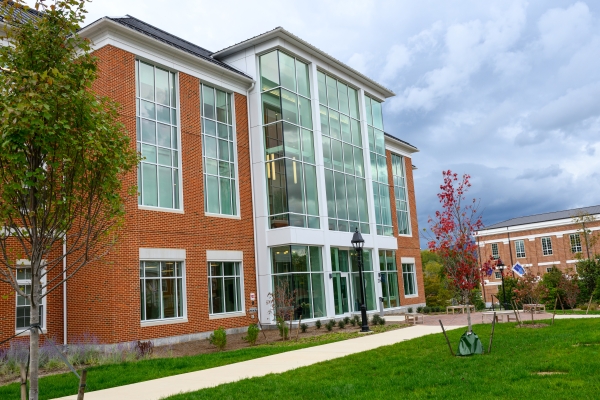 Williams School building
Washington and Lee University’s new Williams School building has received LEED Gold certification from the U.S. Green Building Council. The structure, which serves the School of Commerce, Economics and Politics and opened at the start of the 2025-26 academic year, is the first at W&L to achieve the Gold designation.
LEED (Leadership in Energy and Environmental Design) is the most widely recognized green building rating system in the world. LEED certification is a globally recognized symbol of sustainability leadership and offers a framework for healthy, efficient and cost-effective green buildings, providing environmental and social benefits. The Gold certification level represents a significant achievement in energy efficiency, environmental impact and overall building performance. To earn this certification, a building must demonstrate excellence across a range of criteria, including energy and water efficiency, sustainable materials, indoor air quality and innovation in design. W&L received 100% of the LEED points for which it applied during the certification process.
“LEED Gold certification confirms that in both material quality and operational efficiency, this building meets an incredibly high standard of long-term value,” said Steve McAllister, vice president for finance and treasurer at W&L. “The environmental benefits recognized by LEED certification directly translate into benefits for our faculty, staff and students’ health and well-being, including the focus on indoor air quality, the use of non-toxic materials and the abundance of natural light and views that research shows improve learning outcomes. Gold certification does not just indicate it is a building that is ‘better for the environment,’ but one that is better for our students, employees and visitors.”
W&L has placed a major emphasis on its sustainability efforts, establishing a long-term Climate Action Plan in 2010 and updating the plan in 2019 with strategies to achieve carbon neutrality as a campus no later than 2050. The university has made major progress in its efforts, recently creating an offsite solar array to offset carbon emissions, composting a portion of its dining waste, eliminating disposable water bottles and implementing an energy reduction program that has cut campus greenhouse gas emissions from electricity and natural gas by 50%. In June 2025, the university began updating its campus utility infrastructure to transition its heating resources from natural gas to low-temperature hot water.
Achieving LEED Gold Certification
“From the outset, the Williams School building was designed with sustainability as a core value,” said Rachel Rowland, University Facilities project manager. “The project team worked collaboratively through design and construction to integrate high-performance systems, responsible material choices and strategies that support occupant health and long-term efficiency. While the university is committed to achieving a minimum of LEED Silver certification on all new construction, this building reflects our broader goal of pushing beyond that baseline whenever possible and continuing to raise the standard for sustainable design across campus.”
The new Williams School building was designed using a lifecycle assessment approach that evaluated operational impact and material costs both now and throughout the building’s lifespan, prioritizing environmental sustainability and long-term value.
The building’s exterior sustainable features include adaptive landscaping that reduces the need for irrigation, chemicals and fertilizers; exterior lighting that reduces light pollution and its effects on the plants and animals; and a stormwater management system that releases water in a controlled manner, reducing the strain on sewer systems and impacts on nearby Woods Creek.
The interior utilizes a cutting-edge heat recovery chiller that contributes to a 37% building energy savings over standard code. Heating and cooling design in the building is also at the cornerstone of W&L’s transformational utility upgrade that will replace aging steam infrastructure at the end of its useful life with a low-temperature hot water system that will greatly increase campus heating efficiency and ultimately reduce greenhouse gas emissions from fossil fuels to near zero.
Wood products used throughout the building are certified by the Forest Stewardship Council as having been harvested and produced with methods that prevent deforestation and forest degradation and increase biodiversity protection while respecting worker and community rights.
Indoor air quality was prioritized through the use of low- or no-VOC (volatile organic compounds) interior paints, entry floor mats that capture contaminants and CO2 monitors that increase fresh air intake when spaces are fully occupied. The building design maximizes natural light to support occupant health and well-being. Additional sustainable features include low-flow water fixtures, bird-safe glass and centralized waste management systems that improve recycling rates. Additionally, the building construction achieved an outstanding 96.5% landfill diversion rate.
“I was very excited when I learned this building was in line for LEED Gold certification,” said Rob Straughan, Crawford Family Dean of the Williams School of Commerce. “Many of our faculty, including me, teach courses that explore sustainability in our given fields. In a sense, this is practicing what we preach. It is a reminder that the university is constructing spaces designed to serve generations of students and faculty long after we depart, and that those spaces minimize the negative impact on the environment.”
In the LEED
LEED certification classifications:
• Platinum (80-plus points)
• Gold (60 to 79 points)
• Silver (50 to 59 points)
• Certified (40 to 49 points).
The Williams School is the seventh building on the W&L campus to receive LEED certification recognition. An eighth is possible as the university navigates the LEED certification review process for the new Lindley Center for Student Wellness that opened in August.
W&L’s LEED Certified Buildings:
• Williams School – Gold
• Sorority House 6 – Silver
• Newcomb Hall – Silver
• Payne Hall – Silver
• Washington Hall – Silver
• Chavis Hall – Silver
• Hillel House – Certified
Related Stories

You must be logged in to post a comment.