
July 22, 2025
Creative License
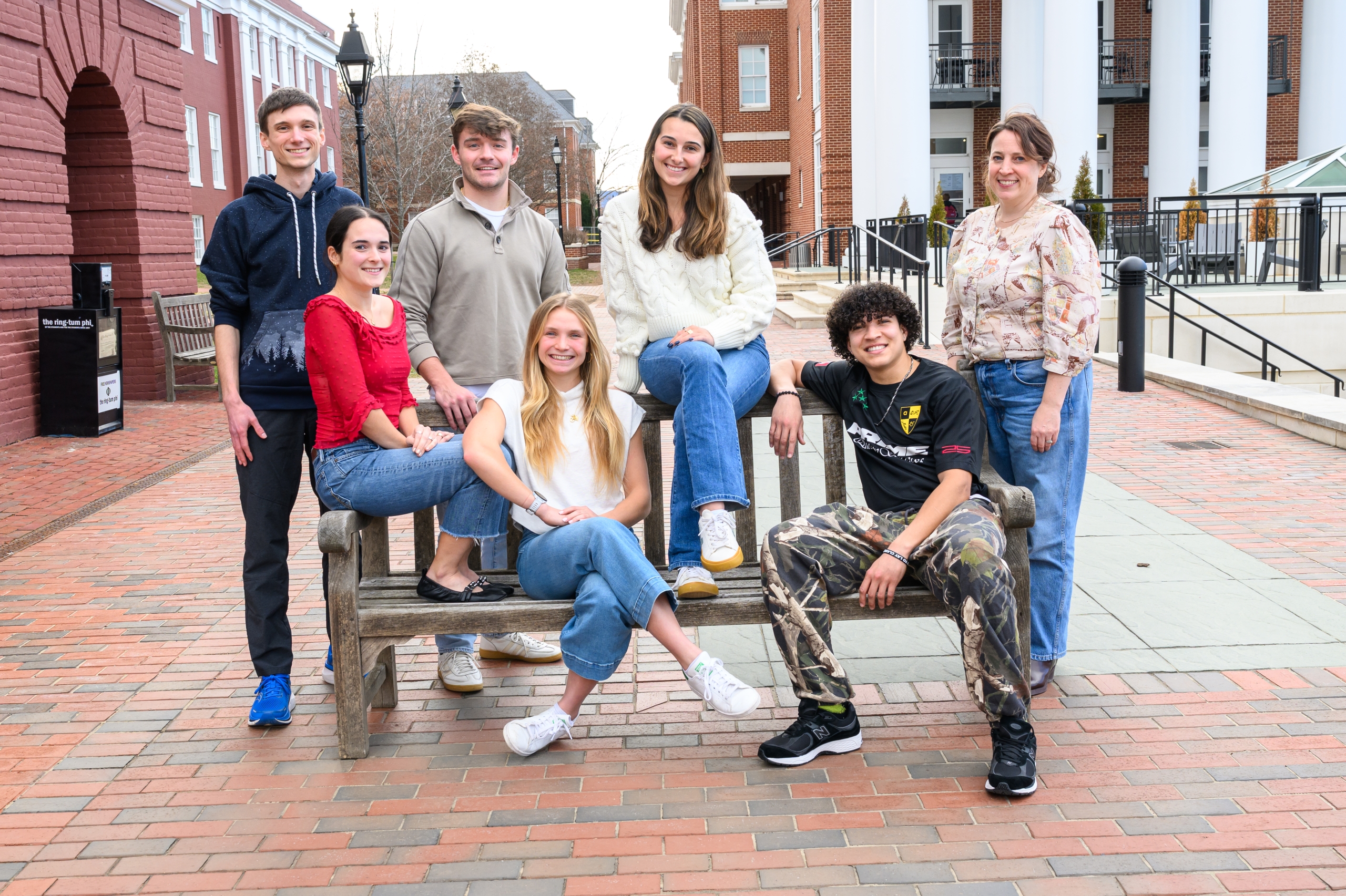 W&L’s first creative writing major capstone class, from l-r: Ryan Doty ’26, Lily Pareso ’26, Carson Duval ’26, Sophia Breschi ’26, Lucy Storey ’26, Daniel Emmanuel Jakubowski-Lewis ’26, and Beth Staples, associate professor of English and editor of Shenandoah Literary Magazine
“Creative writing is inseparable from how students learn to think.”
~ Chris Gavaler, professor of English
On a campus where students are often encouraged to pair passion with pragmatism, the newest major at Washington and Lee University does something quietly radical: It asks students to take their writing seriously as a sustained intellectual and creative practice.
This academic year, W&L’s Department of English launched its creative writing major, expanding what had long existed as a minor into a full program of study. For the first time, a small cohort of seniors will graduate this spring having completed the university’s first creative writing capstone.
Holly Pickett, professor of English and department head, says as the English department reflected on the future of its creative writing curriculum, a review of peer institutions helped clarify how the program might continue to grow in ways that best serve students. While the university’s creative writing minor already offered a strong foundation comparable in scope and rigor to similar programs elsewhere, the review highlighted how many institutions support creative writing through more clearly defined major pathways. These programs typically blend writing workshops with literature courses and provide students with a sustained, coherent experience over the course of their undergraduate years. In that context, the decision to introduce a creative writing major emerged as a natural next step, allowing W&L to build on existing strengths while offering students a more expansive and intentional pathway from introductory courses through a culminating capstone experience.
“It wasn’t about inventing something brand new,” Pickett says. “It was about recognizing that students were already doing serious creative work here and giving that work the structure and visibility it deserves.”
That structure, faculty say, reflects the way writing actually develops: through sustained practice, thoughtful reading and community.
“Creative writing is inseparable from how students learn to think,” says Chris Gavaler, professor of English. “You’re always making decisions about language, perspective and meaning.”
The arrival of Jean-Luc Bouchard, assistant professor of English, has expanded the program’s offerings in creative nonfiction, a genre many students have not encountered before W&L.
“When I talk about creative nonfiction with my students, I’m talking about nonfiction that has a significant intentional element of creative design and artistic expression in the text, so much so that you would not be able to recognize the text without these elements included,” Bouchard explains.
In his advanced workshops, students explore memoir, literary journalism and cultural critique, often discovering unexpected connections between research, observation and voice.
“A lot of the early work is about identifying what you’re genuinely interested in, what you notice and care about,” Bouchard says, adding that that approach helps shape how students see their own writing. Looking ahead, Bouchard hopes to develop courses that extend writing beyond genres associated with traditional literary publishing, including comedy writing and video game narrative design.
“Students’ eyes light up when we talk about games as storytelling,” he says. “It’s already part of how they understand narrative.”
Sophia Breschi ’26, a creative writing and cognitive and behavioral science double major from York, Pennsylvania, took Bouchard’s advanced creative nonfiction workshop before enrolling in the capstone.
“He gave some of the best feedback I’ve ever received on my writing,” Breschi says. “He really pushed me to not be afraid to completely change the structure.”
She credits that experience with helping her take creative risks.
“Sometimes too much creative liberty gets me stuck,” she says. “Talking through possibilities made a huge difference.”
Breschi, who initially planned to pursue the minor, says she is thrilled to be able to add the major to her list of W&L experiences. Although she plans to pursue a career in physical therapy, she hopes that her time at W&L will also support a life of writing that can be interwoven with her other endeavors.
“I’ve always loved writing, and it was something I’d really hoped I would be able to expand on in college. It’s a passion for me and I hope I will be able to continue writing throughout my life,” Breschi says.
That hope, faculty say, is the point.
“The world will tell you your creative life doesn’t matter,” says Beth Staples, associate professor of English, who is teaching the senior capstone class. “But it’s probably the thing that matters most.”
The program itself is still evolving, but its purpose is already clear: not just to teach students how to write, but to help them carry that practice forward. Staples says the capstone course is designed to help students ultimately construct a writing practice that they can take into their daily lives no matter where they go after graduation. In addition to starting class with a daily writing exercise, students also read books throughout the term about creativity and the creative process and present on how those ideas intersect with their own practices.
“I want them thinking about what a creative life looks like after graduation,” Staples says. “How do you protect this once the structure disappears?”
Lucy Storey ’26, a business administration and creative writing double major from Richmond, Virginia, will be starting her career as an analyst at Leerink Partners, an investment banking group in New York City, this summer shortly after graduation, and says that during her internship there last summer, she realized the depth that her creative writing major will bring to her future success.
“I found that my minor – now my major – played a really big role,” Storey recalls. “I had to do a lot of storytelling, creating a story around a company when we prepared presentations for other companies. My major was much more helpful than I had anticipated it being in that setting.”
Carson Duval ’26, a double major in creative writing and cognitive and behavioral science, is now applying to master’s programs in clinical psychology while pursuing his passion for fiction writing. Duval highlights the flexibility and variety in W&L’s creative writing program, which allows students to explore different genres and literature courses, enhancing their creative and academic growth. He says he has been looking forward to the capstone course.
“Having all of these people under the umbrella of creative writing in the same room with passions in different areas, I’m just excited to see the freedom and flexibility in choosing what we want to pursue,” Duval says.
Ryan Doty ’26, a chemistry and creative writing double major from Tipton, Michigan, will be attending graduate school to pursue a Ph.D. in chemistry or materials science but also plans on recording and releasing music and hopes to publish a book during that time as well. Doty views the capstone as an opportunity for self-discovery.
“To me, one of the most important aspects of writing is understanding your target audience, but in order to understand your audience, you first need to understand yourself,” Doty says. “During this capstone, I hope to acquire a greater sense of who and what I want to portray as a writer, and what I actually wish to accomplish through my writing. Something that’s always intrigued me is how we develop characters, so I’d love to try and exist within my characters’ headspaces more and create well-defined personalities that remain across a longer project.”
Daniel Emmanuel Jakubowski-Lewis ’26, a business and creative writing double major and Japanese minor from Roselle, New Jersey, says that his creative writing coursework at W&L has also helped him learn more about himself through exposure to a wide variety of ideas and genres.
“My classes have taken me from postcolonial literature all the way to superheroes to an internship with Shenandoah literary magazine, and I’m now writing a memoir,” he says. “I’ve not only found these pieces of the world, but also myself in the process of just fulfilling my requirements.”
After graduation, Jakubowski-Lewis will be working as a sales representative with Aptive Environmental and pursuing pastoral/ministerial education. He is proud to have been the first W&L student to officially declare a creative writing major and says that his relationships with faculty in the department have provided him with personal and professional growth.
“They have had a profound impact on not only my experience here, but my development as a person,” Jakubowski-Lewis.
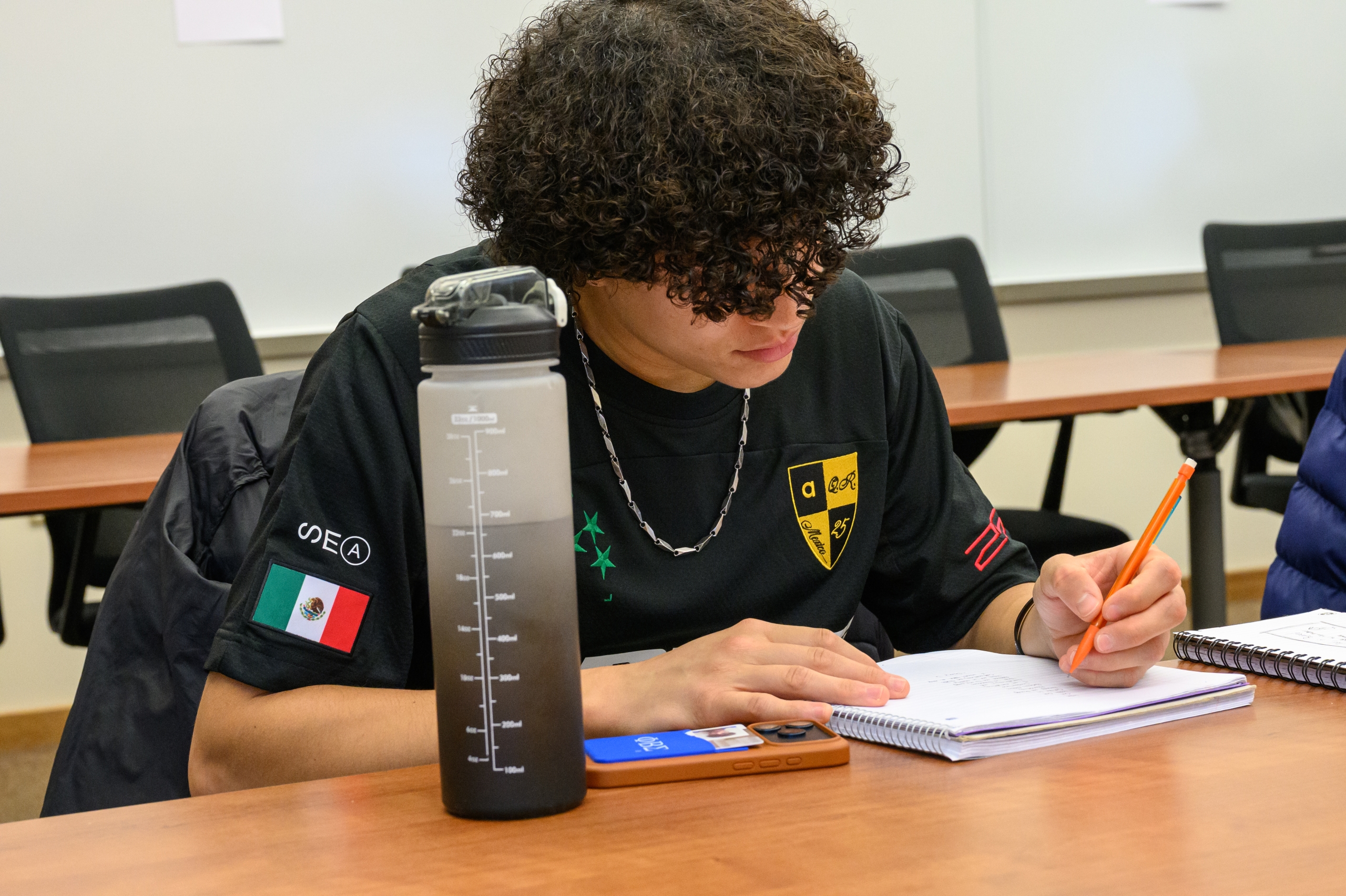 Daniel Emmanuel Jakubowski-Lewis ’26 concentrates on a writing exercise at the beginning of his creative writing capstone course.
If you know any W&L students who would be great profile subjects, tell us about them! Nominate them for a web profile.
The creative writing major builds on the strengths of the minor but adds depth, structure and a culminating experience, allowing students to leave Washington and Lee with a polished body of work and a clearer sense of what it means to sustain a creative writing practice beyond graduation.
The creative writing minor curriculum:
The creative writing major curriculum:
For more information, visit the Department of English homepage.

You must be logged in to post a comment.