June 9, 2025
Law School Announces 2025 Faculty Fellowships
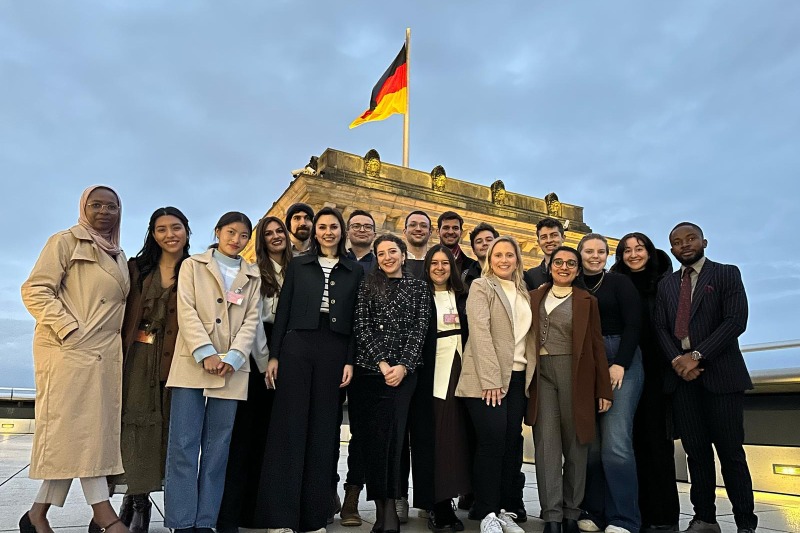 The Rule of Law Academy in Germany is one of the many opportunities students have to engage with international law.
Washington and Lee University School of Law has again been recognized as a top school for the study of international law. The law school received an A+ grade in a National Jurist study that evaluated curricular and extracurricular offerings that expose students to law in the global context.
Students at W&L Law encounter international law very early in their law school journey with a required first-year course titled Transnational Law. This rigorous keystone course is taught by Professors Russell Miller, Shannon Fyfe, and Mark Drumbl. A part of the curriculum since 2009, the course introduces students to core principles of public and private international law, comparative law, foreign law, cross-border legal process and deal-making, transboundary dispute resolution, and elements of U.S. law that have international effect.
Professor Fyfe, whose research focuses on philosophy and international conflict, notes that the goal of the course is to equip students for the reality that U.S. practitioners increasingly require conversance with international, foreign, and extraterritorial law in their legal work.
“Our students enter the U.S. legal profession ahead of their peers, not just when it comes to understanding doctrinal public international law, but also how to think critically about achieving their clients’ interests on the global stage,” said Fyfe.
This first-year course, a unique requirement among the nation’s law schools, sets the stage for an array of opportunities for W&L Law students to engage in study, research, and practice-based experiences involving international law. Upper-level doctrinal courses include the study of human rights in various contexts, mass atrocity and its aftermath, global environmental governance, and international business transactions.
Professor Kish Parella teaches and researches at the nexus of corporate and international law. Her current research focuses on geopolitics, national security, and corporate law and examines international contracting and global supply chain resilience in emerging technologies, such as Bitcoin mining.
“The international legal order is under stress with economic tensions, armed conflict, human rights abuses, and a variety of other geopolitical challenges,” said Parella. “Business lawyers must understand how these international challenges affect their client’s ability to do business, at home and abroad. International law and corporate law are increasingly intertwined, demanding that today’s lawyers have adequate fluency in both.”
The school also offers practice-based courses that include work simulations or actual client interaction, for example in cross-border transactions. In the Immigrant Rights Clinic, directed by Professor Lauren Hughes, student attorneys serve as the primary legal representatives for non-citizen clients in immigration matters, providing legal services to persons in removal proceedings, both detained and non-detained.
 Professors Shannon Fyfe, Mark Drumbl, Kish Parella, Russell Miller, and Lauren Hughes play key roles in educating students about international law.
Additional practical opportunities are delivered through the W&L Transnational Law Institute (TLI), directed by Professor Mark Drumbl, an expert in international criminal law, post-conflict justice, and transnational legal process. The Institute supports and coordinates a small but targeted number of internships to help prepare students for the increasing globalization of legal practice. Recent summer internships include placements with United Nations entities, non-governmental organizations, branches of the U.S. government, and private law firms. Internships have been forged across the globe, from Italy to Fiji. The Transnational Law Institute has also helped support student moot court activities.
“In addition, the Transnational Law Institute also has an academic bent, hosting visiting scholars and speakers from around the globe, and it is currently the host for the International Criminal Law Review, which offers opportunities for students to assume editorial responsibilities,” said Drumbl. “Students have moreover been able to undertake published writing with faculty and participate in a series of international scholarly conferences held at W&L or elsewhere.”
Carlyn Kirk ‘27L worked through the TLI to secure an internship with an international human rights lawyer who represents clients before the European Court of Human Rights in Paris and Milan.
“My work included legal research, drafting memoranda and briefs (including a referral to the Grand Chamber), and observing proceedings before the Tribunale di Milano,” said Kirk. “The experience offered invaluable exposure to international human rights litigation and deepened my interest in cross-border legal practice, while strengthening my research and writing skills in a comparative legal context. Also, it was fun!”
Upper-level students can also engage in editing and writing opportunities related to international law through the German Law Journal (GLJ), one of the world’s leading forums for legal scholarship from a transnational and comparative perspective. Co-founded more than 25 years ago by Professor Miller as one of the first online and open-access law journals, the GLJ consistently ranks among the top five journals focused on European and international law according to Google Scholar.
“The students do impressive and highly professional work managing the publication and editing the content for language, style, and substance,” said Miller. “That’s an especially noteworthy role because the GLJ publishes scholarship on issues not deeply covered by the typical American law school curriculum. In that way, the students are pushed substantively, but their work with scholars from around the world also challenges them to develop the skills needed to work effectively across linguistic or cultural differences, skills that will be of great benefit in their legal practice, regardless of the focus.”
Professor Miller complements this experience for student editors with a trip to Berlin, Germany for the annual Rule of Law Academy, where W&L Law students partner with law students from other countries to engage in deep study of a common constitutional law issue or topic that is central to the rule of law, encompassing issues of state organization or basic rights.
Sabrina Callender-Clewett ‘25L reflected on her experience participating in the Rule of Law Academy in 2024, where students from the U.S., Kenya, Germany, Lebanon, Singapore, Senegal, Ecuador, and Romania considered the guiding question, “Can the law save democracy?” She said the students concluded that the rule of law does not exist in a vacuum.
“Participating in the Rule of Law Academy revealed just how significantly a country’s history factors into the way it structures and esteems the rule of law and democracy,” said Callender-Clewett. “That means that these national backgrounds are also central to understanding how a country might go about protecting its democracy. What works in one country to bring about and maintain democracy might not be relevant in another country.”

You must be logged in to post a comment.