June 10, 2025
W&L Outcomes: Alaina Pastore ’25
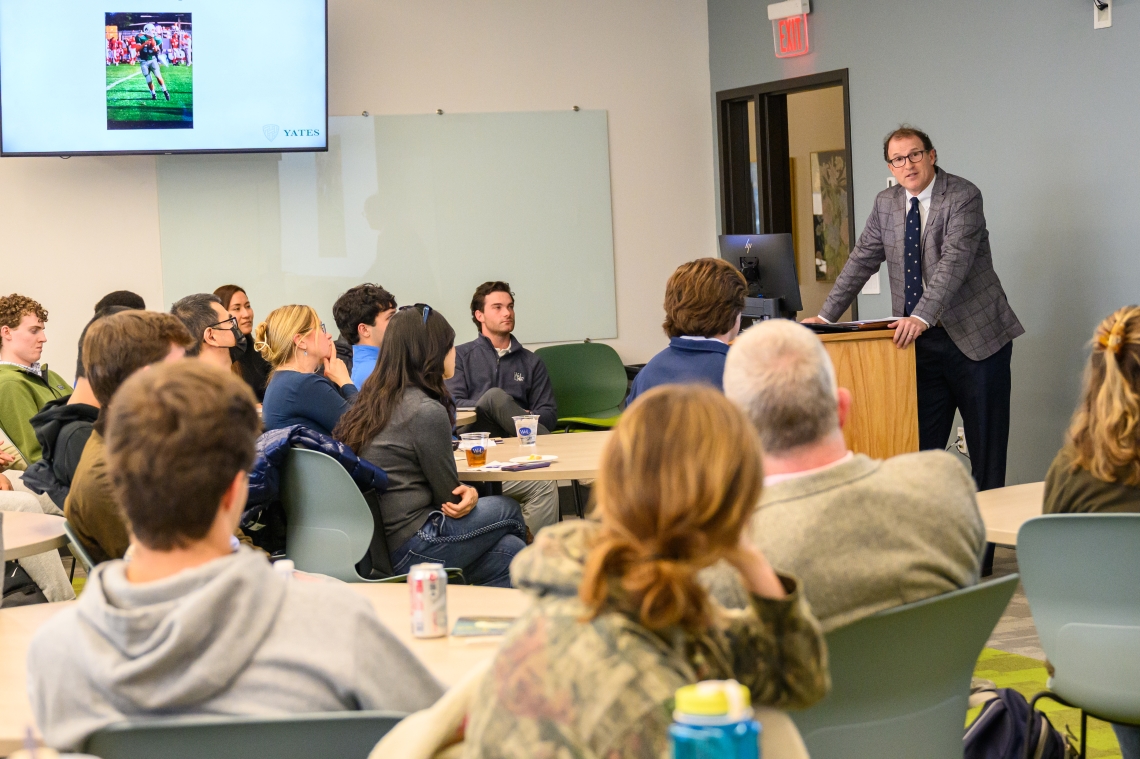
Before Brooks Fischer’s graduation from Washington and Lee University in 1997, George Bent, Sidney Gause Childress Professor in the Arts, gave a lecture in which he provided some affirming assurances: that whatever paths the graduating seniors embarked on after Lexington, Virginia, they didn’t have to be permanent. Their W&L liberal arts education provided them with the tools to pivot and explore as the years unfolded.
In the decades since, Fischer realized how much he took those words to heart. Since graduating with a Bachelor of Arts in English, Fischer worked as a financial sales specialist at First Union National Bank, was a project manager at Internet Security Systems, obtained his MBA from Emory University, then served as managing director at Bullock Mannelly Partners; he is now managing partner at Yates Insurance in Atlanta, where he lives with his wife, Maggie Fischer ’00, and their children, Charlie and Henry. Reflecting on his career, he felt that because of his humanities background, he could tackle what lay ahead, professionally and personally.
On Wednesday, March 18, Fischer returned to campus to give a lecture of his own, “Pitching Your Humanities Major for Jobs in Business,” and to offer solace to students – that they, too, have the tools to evolve.
The English major has been walking alongside me from the very beginning of my career. Every stop has involved dealing with people, and literature does an extraordinary job of preparing you for that.
What drew you to English and why did you decide to ultimately major in it? Was there a particular class or professor that ignited the love?
I owe a great deal to my mom, who spent countless hours working with me on my writing in high school. She is a remarkably patient teacher. I was also fortunate to have an outstanding 10th-grade English teacher, Tom Bartelt, whose lecture on “The Catcher in the Rye” was legendary. Because of them, I arrived at W&L with an appreciation for literature and some training in writing, though I had not made any decisions on where to focus my academic studies.
When I was a freshman on the football team, many of the upperclassmen I looked up to were English majors, and a surprising number of them concentrated in early British literature. Professor of English John Evans served as the adviser to both Kappa Alpha fraternity and Phi Delta Theta fraternity, where I pledged, and he used to invite football players over for dinner on Friday nights before home games. One night, Jason Chartrand ’95 invited McGuire Boyd ’97, ’06L and McGuire brought me along.
There was just this sense that being an English major was cool. I remember pulling all-nighters finishing papers at Phi Delt with Cole Van Nice ’96, P’27 and later passing the torch to younger friends like Nick Hodge ’98, Lyle Ross ’99 and Reece Wilson ’99. We half-jokingly called ourselves “the house that reads.” Socially, it wasn’t just acceptable – it was something to aspire to.
Academically, I had a great experience my freshman year in English 105 with Edward Adams. But the clincher, in terms of choosing the English major, was my first upper-level survey with Ed Craun. He taught us “Beowulf,” introduced “The Canterbury Tales,” and “Sir Gawain and the Green Knight.” Craun talked about the chivalric code – about aspiring to live your life a certain way, coming to terms with your flaws and moving on anyway. That idea hooked me, and it’s stayed with me ever since.
Was a career in business always where you wanted to end up or did that path gradually evolve?
I never walked around knowing exactly what I wanted to do with my life. The expectation wasn’t about choosing a specific destination so much as being successful wherever you tried to make it. In that respect, students today are often much more advanced than we were in knowing what they want. I didn’t have any grand plans about business.
My dad worked in international banking, so I assumed I would do something in business – wear a coat and tie – but I wasn’t focused on an end game; I was focused on the fact that I was at a world class liberal arts institution: what the best teachers taught, what the people I admired were studying and what I both enjoyed and was good at. All of that converged in English, and specifically in early British literature.
Along the way, I fell under the very positive influence of John Evans. He would casually rattle off the names of former students from the 1960s, 1970s and 1980s, who had taken their English degrees and gone on to build meaningful careers in business or law. Listening to him, it became clear that I could do the same.
John had a remarkable ability to connect with students and to persuade them that they had what it took, that starting with the right formation mattered and that this kind of foundation would sustain them no matter where they eventually went.
The crux of my talk harkens back to a lecture professor George Bent gave before graduation, when he advised us that the liberal arts gave us the ability to pivot in our careers if we found ourselves on the wrong path. That advice ended up predicting the arc of my story, and it’s the core message I want to share with students today: Let your career evolve.
In your LinkedIn post about coming back to campus to talk, you mentioned a former professor’s view on the value of the humanities – can you share what that was and how it influenced you?
I need to be careful here because I have lots of friends who spent time in the C-School. Professor Evans had a colorful way of making his point. He absolutely wanted us to go on to make a living, but he believed strongly you should start with the humanities before venturing into business or law.
To drive the point home, he used to joke that Las Vegas was created for C-School majors who made a lot of money but lacked the foundation to know what to do with it. We laughed, but he was warning us about something serious: that you can win professionally and still lose where it matters.
A group of us took him to dinner in February, and he didn’t even remember making that comment. When we reminded him, he said that was fine because he still believes it.
In what ways have you seen your English background help you throughout your career – from First Union National Bank to IBM to Bullock Mannelly Partners to Yates?
The English major has been walking alongside me from the very beginning of my career. Every stop has involved dealing with people, and literature does an extraordinary job of preparing you for that. The best example I can think of is “The Canterbury Tales,” because it forces you to reckon with backstories and motives, not only with other people but most crucially in yourself. That kind of honest self-assessment becomes invaluable if you can withstand that look in the mirror. What do you really want out of life, and what do you stand for?
At the more practical end, of course, the close reading, the storytelling, the writing, the ability to answer the question asked and cite actual evidence – all of those skills travel well, no matter the field.
And finally – though you didn’t ask about this – I graduated four years before 9/11. A few years later came the Great Financial Crisis. Then COVID. Add to that the rest of what life can throw at you; I am deeply grateful for the foundation the humanities gave me. I genuinely wonder how people get through it all without something like Chaucer, Milton and Shakespeare to hold on to. And I feel like I’ve lived a charmed life.
Not to be flippant, but what Excel macro do you refer to when sickness hits a loved one? Who are we training to give eulogies? Who’s going to have the words? The world is moving fast, and while AI can do many impressive things, it still lacks a real heart. I say it that way because I feel so strongly about it.
You’ve recruited W&L students for Yates internships – what do you feel like W&L students bring to the table?
The W&L students I meet are as impressive as ever. They have the total package. What stands out is how quickly you can imagine putting them in front of a client. And when you consider how much time you end up spending with coworkers over the course of a career, the ability to relate to people matters enormously.
As a friend said to me recently, the work is not that complicated, whatever it is. It’s just math. But can you relate to people? Are you teachable? Can you handle feedback? Can you handle adversity – and success? W&L students tend to strike that rare balance between confidence and humility.
The school just does an exceptional job training students in all of this because of what happens on the Hill and out at Windfall.
If you could boil it down, what are the top three qualities that humanities majors bring to the table, especially in the world of business?
Put together, those three qualities are exactly what the modern business world is starving for, even as technology keeps accelerating.