March 17, 2026
W&L Dance Program Celebrates 20 Years
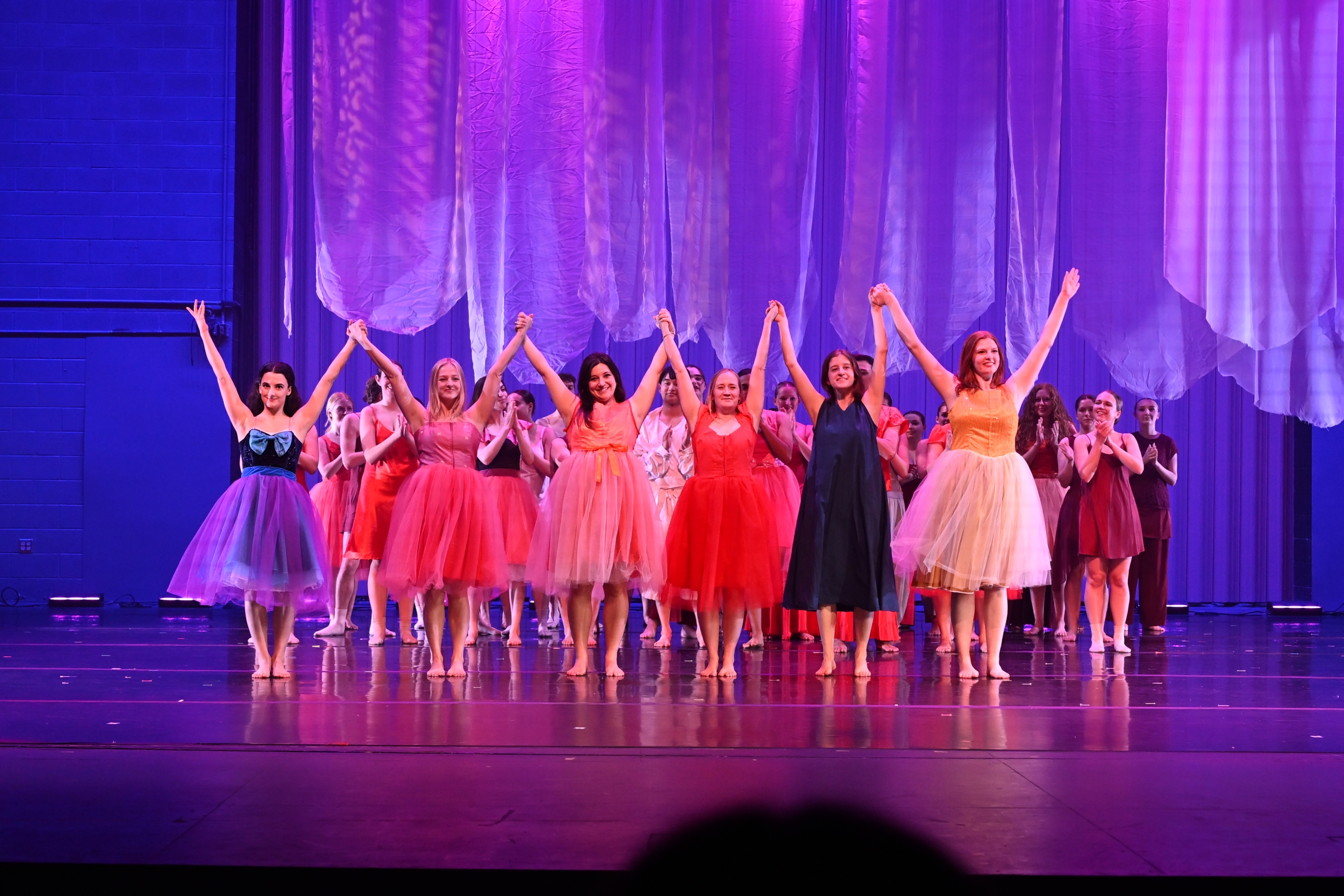 Amalia Nafal Bosch ’21, Katie Daly ’21, Runa King ’20, Kaitlin Coughlin DeLuca ’15, Sara Dotterer ’18 and Mary Pace Lewis ’20 take a bow along with current students in Keller Theatre.
“I truly believe that if you can move, you can dance.”
~ Jenefer Davies, professor of dance and theater
The evening before the W&L Repertory Dance Company’s Thursday, March 26 performance, the backstage hallways of Keller Theatre teem with nervous energy as dancers ready themselves for the dress rehearsal. Washington and Lee University alumni who haven’t stood in a theater’s wings in years warmly greet one another with hugs as they arrive in costume to the green room. Current students drop bookbags and water bottles in the hall outside the theater as they prepare to go onstage. When the lights go down over the audience, the first group of performers moves into position on the horizon of the stage lights, smiling at one another as the first song, Big Thief’s “Simulation Swarm,” begins to play.
The performances, held March 26-28, were the culmination of months of work undertaken by current students and alumni invited to help the Department of Theater, Dance and Film Studies honor of the 20th anniversary of W&L’s Dance Program and its founder, professor of dance and theater Jenefer Davies, who also serves as department chair and director of the W&L Repertory Dance Company. The program Davies has built since arriving at W&L in 2006 is grounded in a philosophy that is, on its surface, straightforwardly simple: Anyone can dance.
“I truly believe that if you can move, you can dance,” she says. “And dance doesn’t have to be pliés. Dance can be walking and hopping and skipping and rolling and falling.”
The anniversary events were not the only opportunity students have had to engage with dance program alumni this year. In January, Davies and several students traveled to New York City for the program’s biennial student/alumni dance performance, a tradition initiated in 2010 to give dance alumni a way to reconnect with the W&L dance community.
“I created the joint opportunity for alumni and current students because I recognized the educational value in travelling with the student dancers to NYC, the hub of professional dance in this country, to give them an experiential performing opportunity in a professional space with new audiences,” Davies says. “I knew alums wanted to stay connected with W&L dance, and I recognized that there could be an amazing synergy if they worked and performed together.”
The March anniversary weekend took that experience to the next level; instead of alumni and students performing separately, as they typically do in New York, they rehearsed and performed pieces together, with alumni from 2010 to 2022 learning current student choreography and students learning alumni’s pieces. Participation was as diverse as the group of alumni themselves. One alumnus spent 10 days on campus in early January and choreographed a dance specifically for the students; one performed a voiceover narration for a dance; two taught master classes during the week of the anniversary performance over Zoom; two alumni created an interactive art installation piece in Kamen Gallery; seven alums participated in a dance projected onto a screen; 10 alumni took part in a roundtable discussing the arts after W&L; and 14 alumni performed in the concert. The logistical challenge of preparing to perform together was considerable. Most alumni learned their choreography remotely — either over Zoom in monthly rehearsals with Davies, through shared video albums or, in what Amalia Nafal Bosch ’17 describes as a “first” in her 18 years of dancing — via text message.
“I think this is the first time I’ve ever texted to change a dance,” she says. Bosch, who majored in philosophy and art history and minored in dance, is the deputy marketing director for Coral Gables Trust in Miami and says that the supportive atmosphere of the dance program is what has kept her returning regularly to perform with the company in New York as well as in the 20th anniversary show.
“My experience at W&L would have been so different without the dance company,” she says. “There’s a saying that ‘art saves lives’; that’s how I feel about the dance company.”
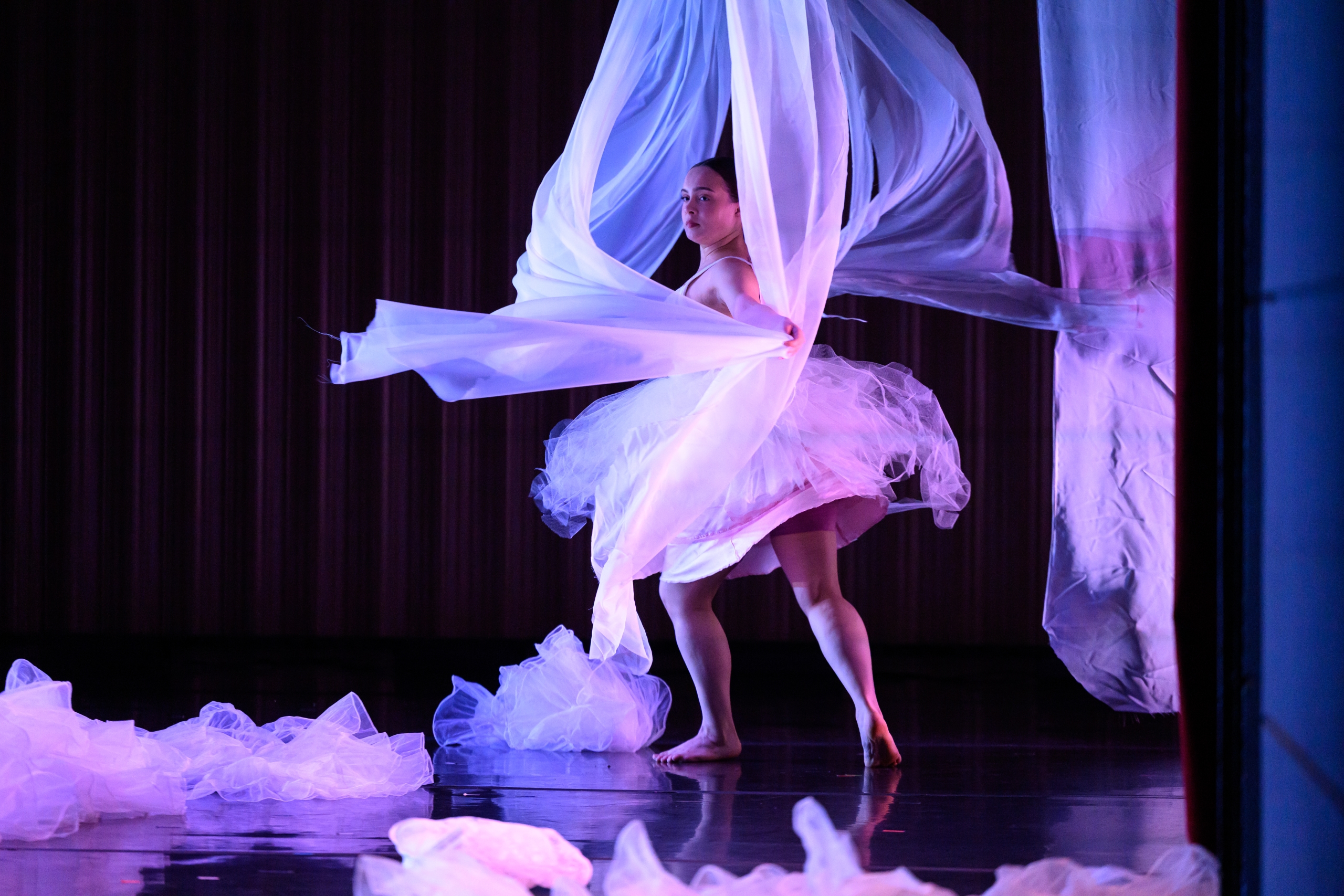 Mikaela Schon ’27 during a March 27 dance performance
Moving Through the Years
As the curtains open on March 26 on a collaborative piece between Sara Dotterer ’18 and Runa King ’20, images of a bustling cityscape play across the screen behind them as the two dancers gradually circle one another, each dressed in royal blue. Sweeping their arms upward, their choreography gradually syncs as they move in parallel.
Dotterer, a studio art and anthropology double major who obtained an MFA in interdisciplinary art at Southern Methodist University and works in financial services marketing at Ricciardi Group in New York City, was inspired to perform the piece alongside King, a geology (now known as Earth and enivronmental geoscience) and politics double major and dance minor who works at Gibney, a dance and performing arts organization in New York City, by their shared post-W&L career and life experiences.
“The piece was developed with Runa as we thought about commuting, working and going through the grind of the 9-to-5, especially in a chaotic city like New York,” Dotterer says.
Davies says that while formally creating the W&L Repertory Dance Company was foundational to creating the vibrant dance community that W&L now knows today, there was already a palpable passion for dance when she arrived at the university. Initially hired on a three-year contract and asked to build a dance program from scratch, Davies says she discovered that the university had a large and enthusiastic student dance club that had been staging informal performances for several years.
“I didn’t have to go out and market the dance program,” Davies says. “I just created some classes, and the students showed up.”
[Learn more about Davies in her episode of the W&L After Class podcast]
Her first studio was a small square room called the Maslansky Rehearsal Hall, located below Keller Theatre in the Lenfest Center for the Performing Arts; Davies says she immediately went looking for a larger one, which she found in the attic of what was then called DuPont Hall (now the Ruscio Center for Global Learning). A dance floor was installed in what had been unused storage space, and the program moved in. By 2012, it had outgrown that space as well, and the university found a building off campus to rent: a wide-open warehouse in downtown Lexington that had once housed the printing presses of the local newspaper. The reason the presses had been there — the absence of interior columns, the raw industrial floor plan — made it exactly the kind of rehearsal space that a growing dance program required.
The dance program offers technique classes for academic credit such as Modern Dance, Ballet, Musical Theater Dance and Aerial Dance, as well as traditional courses like Dance History, Dance Analysis and Dance Composition. Participating in the dance company is also an academic class for which students receive credit. The dance minor is a combination of technique, history, composition and performance courses.
Davies holds auditions and offers students feedback, but no one is ever turned away from being a part of the dance company or participating in dance classes.
“I hold ‘auditions’ simply so that I can learn where each student is in their dance journey and place them into roles that will challenge them, but I never cut anyone who wants to participate,” Davies says. “Typically, dance companies ‘cut’ folks who haven’t had a lot of experience or training, but I truly believe in the liberal arts and the benefits of its broad interdisciplinary principles. Any student, regardless of major or area of study, will benefit from having danced. Those critical thinking and nimble problem-solving skills and collaboration and communication competencies are transferable to any career.”
A student who has never danced before can find themselves performing in the same concert, sometimes in the same piece, as a student who has trained since age 3. The challenge for Davies, as a choreographer and teacher, is to make sure both are genuinely being pushed. The result of this philosophy and approach is a dance company unlike most others.
Benjamin Blevins ’27, a creative writing major and dance minor from Roanoke, Virginia, says W&L’s dance program has offered him opportunities that few other schools could.
“At a small school like this, it’s really rare to find a dance company that is so art-forward and focused on making room for student choreography and collaboration,” Blevins says.
Dancing Side by Side
Maslansky Rehearsal Hall echoes with laughter on the evening of March 25, as the performers, both W&L alumni and students, prepare for the dress rehearsal. Davies arrives to find three of her former students seated together on the floor, applying makeup in front of the floor-to-ceiling mirror that spans the length of the room. Students flutter in and out to search for costumes from one of the racks stationed in the rehearsal space as Davies catches up with her former students in between pretzel-like warm-up stretches.
Many alumni arrived in town on Monday, March 23, or Tuesday, March 24, and had only days before the Thursday opening to put it all together on an actual stage. What Davies says she had not fully anticipated was what happened when alumni and students started working side-by-side.
“There’s something special about dancing with others,” she says. “Even though you are 18 and that person is 35 or you are a first-year and they have two children, you’re peers because you’re both learning a dance, helping each other work out problems, questioning and growing together. A special bond develops.”
The week’s events also included a roundtable panel of 10 alumni representing careers in medicine, finance, marketing, technology and the arts; panel participants were asked to discuss what studying dance had given them.
“I really wanted to talk about transferable skills,” Davies says. “What does studying the arts give you? I think it doesn’t really occur to students that what they’re learning in a dance class is relevant to the job they want on Wall Street one day or their law school interview. And it’s very relevant.”
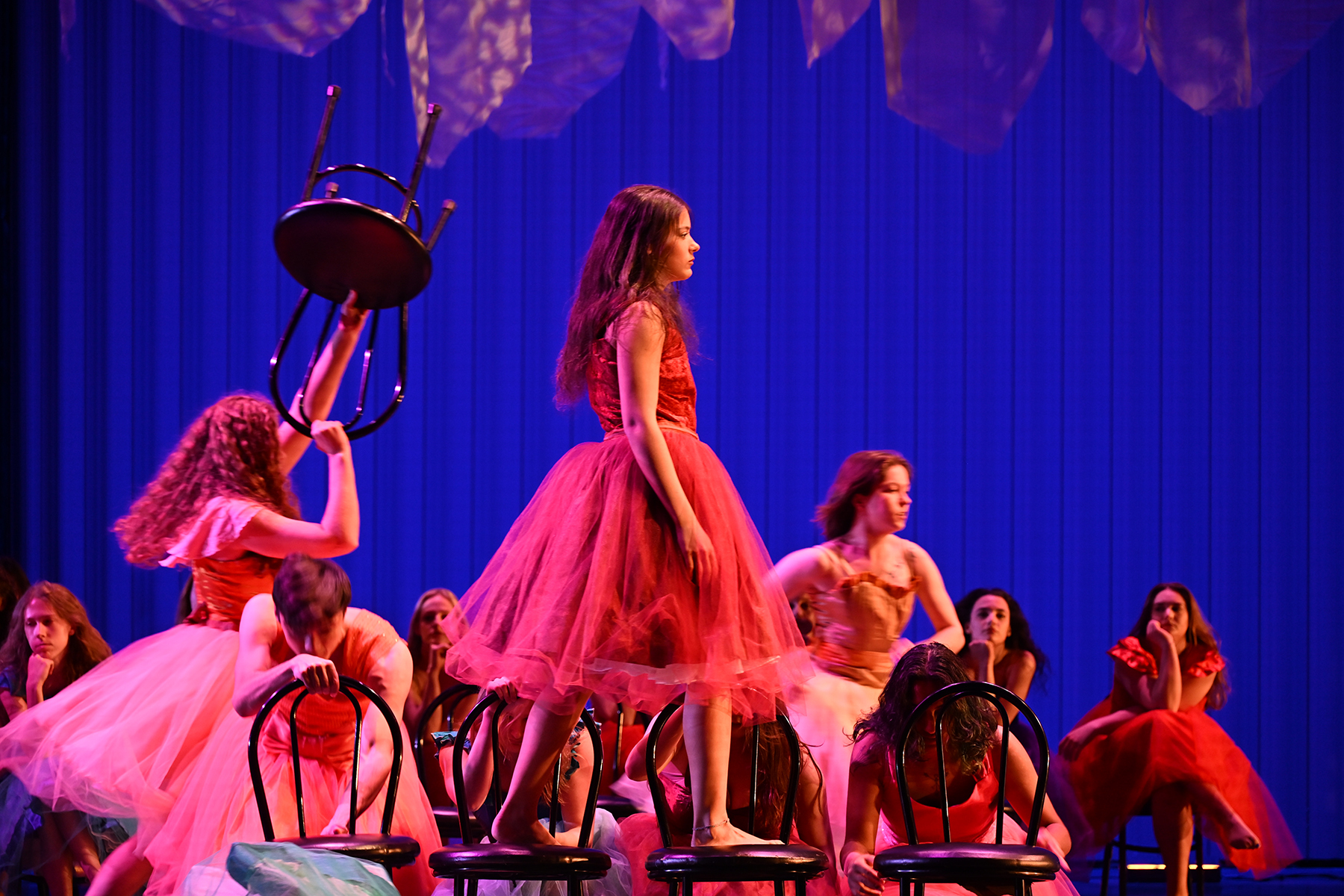 Students and alumni perform a complex dance number together.
Two alumni joined the conversation via Zoom: Nacho Portela ’15, a theater and business double major and dance minor who teaches movement and choreography in Argentina, and Rasaq Lawal ’10, an economics major who teaches dance and serves as community engagement director for the nonprofit arts program Musicopia in Philadelphia. Both also taught master classes over Zoom for students and visiting alumni during the week. Portela, who has worked in event services, social media and construction in addition to his dance experience since graduation, says he can trace a line from Davies’ composition classes to everything he does now.
“I definitely think of myself more like a philosopher of movement or a researcher,” he says, “which makes sense as someone who went to a university that very much taught us how to think, how to analyze and how to investigate.”
Elliot Reza Emadian ’17, who danced professionally for nearly a decade after graduating and is now a master’s student in statistics at Cleveland State University, describes the dance program at W&L as “like a greenhouse, in some ways, for teaching people that the components of us that make us human are important to stay in touch with.”
“Jenny helped create these imaginative spaces where you can try on the person you want to become,” says Emadian, a mathematics major who holds an MFA in dance from the University of Illinois Urbana-Champaign. “That’s not just good teaching. That’s life-changing. To me, that’s what college is supposed to be about: imagining the version of yourself that you want to become and actually getting to practice being that person while you’re still in school.”
Throughout the week’s performances, Emadian collaborated with Dotterer on an interactive performance art installation in Kamen Gallery that greeted audience members upon their arrival. Attendees were invited to collaborate with the duo by offering up a movement that Emadian incorporated into choreography on the spot, which Dotterer recorded. That footage was then looped and projected onto the wall before the next evening’s performance.
The anniversary took on a special significance for King and classmate Mary Pace Lewis ’20, a history major who minored in dance and classics and now works as a business analyst for the Federal Bureau of Investigation in Washington, D.C. Lewis and King were seniors in the spring of 2020, the year the pandemic shut the campus down in March just weeks before what should have been their final dance concert.
“We feel like we finally got the closure of our last dance concert,” King says. Many alumni invited their parents to the concert to see them dance again at W&L.
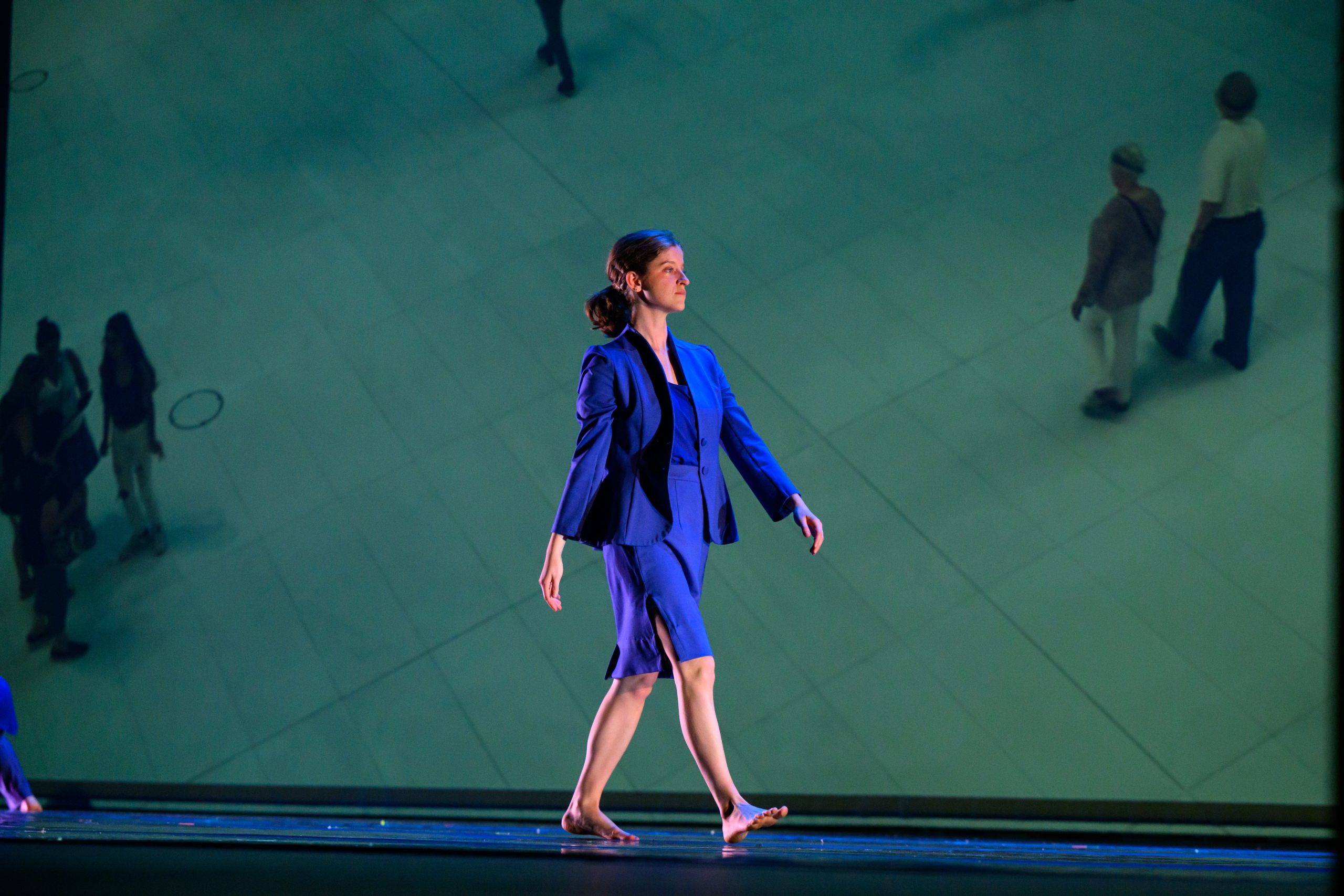 Sara Dotterer ’18 dances in front of recorded footage projected onto a screen on the Keller Theatre stage.
Choreography and Collaboration
One of the biggest changes for W&L dance students, Davies says, was the addition of minors in W&L’s curriculum in 2010.
“When minors came about at W&L, that sort of revolutionized things for us,” Davies says. The program began cross-listing many of its courses; Dance History also satisfies a women’s and gender studies course requirement, Dance Composition is a business elective, and World Dance is cross-referenced with Latin American and Caribbean Studies.
The dance company now offers a fall performance composed entirely of student choreography, in which students perform a finished piece of new work created over the course of the 12-week term, as well as a winter concert featuring faculty and guest choreography, which offers new challenges for experienced dancers. Her composition class — which she has been teaching for 25 years — remains, she says, one of her favorites to teach.
“Part of what I love about teaching dance composition is an ongoing collaboration with the W&L IQ Center, where we put dancers in motion capture suits and record their movement,” Davies says. “We then organize and edit the movement using computer software to create new dance phrases and short compositions. It’s quite a cutting-edge compositional process that isn’t generally practiced yet.” Davies says she is always looking for new opportunities for her students, whether through collaborations on campus or through bringing in guest instructors and choreographers to give students exposure to a wide variety of teaching styles.
Finnegan Driscoll ’29, a first-year from Charlottesville, Virginia, who chose W&L in part because of the dance program, says the opportunities that the dance program provides by bringing in experts in the field has been a highlight of his time in the program so far.
“I think that was something that I wasn’t expecting,” he says, “to have professional artists and choreographers come in and do set pieces and to be able to work one-on-one with people in the field who’ve been doing it for many years.”
During the anniversary weekend, Blevins says it was affirming to hear from several alumni that their entry into the dance program had reinvigorated their love for dance, something Blevins says he treasures about his experience. Audrey Knabe ’18 echoed this sentiment in her submission to a commemorative booklet, compiled by Dotterer and presented to Davies as part of the weekend’s events, that asked alumni to share their reflections on the program’s anniversary. Studio art and cognitive and behavioral science double major Knabe is now the program services coordinator for the Executive Education and Lifelong Learning program at the University of Virginia’s Darden School of Business and credits Davies and the dance program with continuing to inspire her to pursue her creativity.
“I made lifelong friendships through that space and treasure memories of backstage prep for shows, all the rehearsals and the pure joy of dancing with others,” Knabe says. “I took a break from dance after graduating but have returned to it in the past couple years and am apprenticing with a new modern dance company, ORH Dance, in Charlottesville. Dance also informs the visual art I create, and I see Jenny’s legacy as one that radiates beyond W&L into many corners of the world, inspiring generations of dancers to continue shaping the spaces around them and making compelling art.”
Waiting backstage as the lights dimmed in the theater just before the final dress rehearsal, W&L senior Joe Lee reflected on the weekend’s gathering and its assurance that no matter where life after W&L takes him, he will take the love of dance with him.
“It’s just so inspiring to see alumni who continue to dance despite having all different career paths,” he says. “It’s reassuring to see that not everyone who graduates is solely focused on dance. They aspire to their passions but also keep dance on their side.”
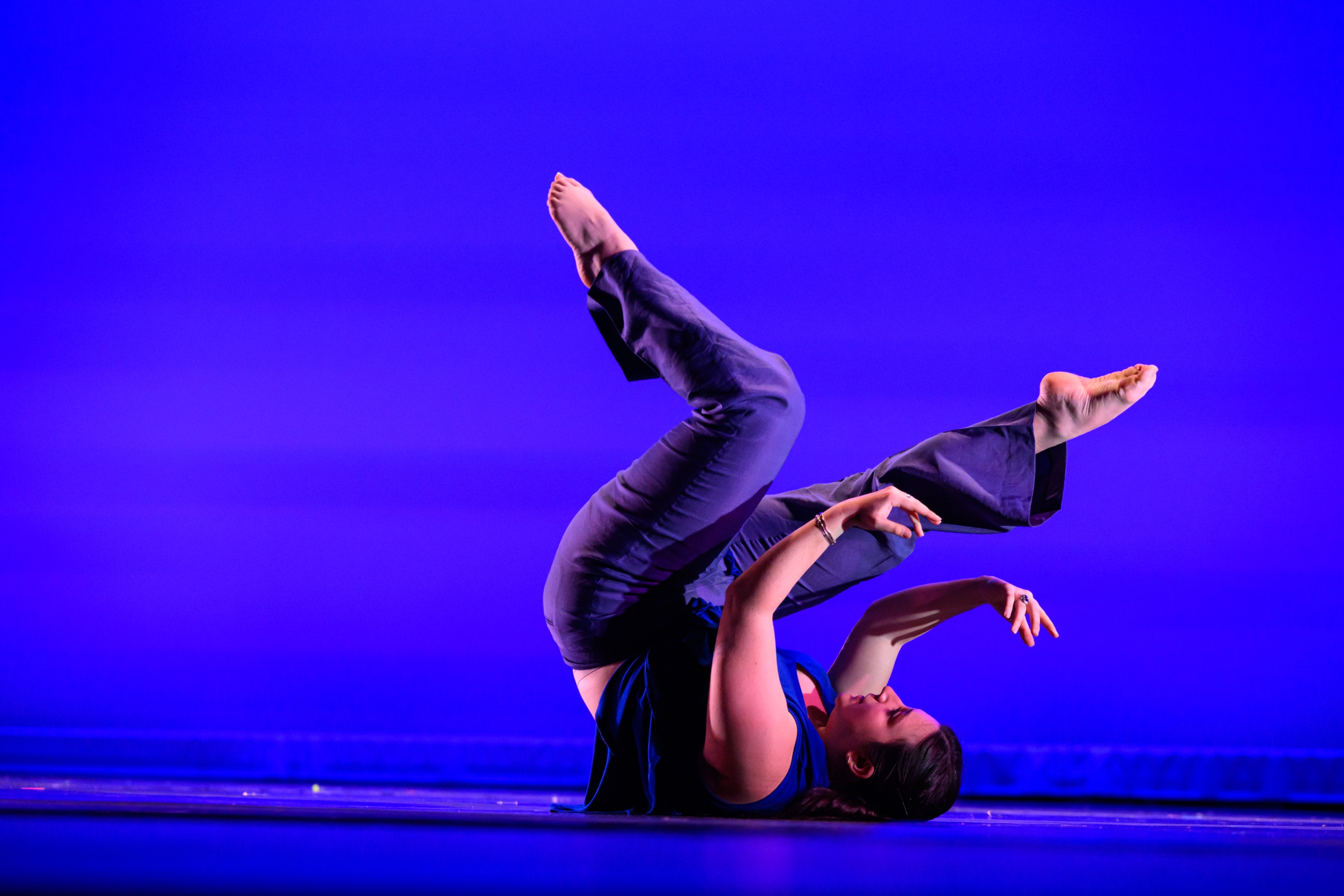 Runa King ’20
W&L’s aerial dance program, believed to be among the first at any university in the country, is another unique feature of dance at W&L that has evolved into a signature offering within the Department of Theater, Dance and Film Studies. Years before she came to W&L, professor of dance and theater Jenefer Davies had been experimenting with aerial dance, which entails rope-and-harness work while suspended from rigging above a stage. She staged rooftop performances with the nonprofit dance company she directed for more than a decade and arrived in Lexington knowing she wanted to bring it with her.
In addition to semester-long classes, the department also offers an intensive Spring Term class that is capped with a vertical dance performance where the students are rigged to the roof of Wilson Hall and perform 40 feet in the air along the walls. Aerial students have also performed at the Ailey Citigroup Theater in New York City, at the Corcoran Gallery of Art in Washington, D.C., at the Southeastern Theatre Conference and from rooftops on W&L’s campus. In addition, Davies published the first academic textbook on the form, “Aerial Dance: A Guide to Dance with Rope and Harness,” in 2017. Davies says the aerial program attracts students who might never otherwise find the dance department, noting that the class seems to interest non-dancers, student-athletes and male students in higher proportions than the other dance offerings draw.
“Because it’s so beautiful, obviously athletic, and a unique and fun experience, aerial dance is less intimidating than other dance forms,” Davies says. “It is a wonderful entry into the program for those students without dance experience. They really get to experience the joy of movement without self-judgment or fear of being ‘wrong.’ However, many times, once they experience aerial, they realize that dance isn’t about criticism. It’s about community, and celebrating our bodies and the way we move.”
Watch the Spring Term 2025 aerial dance performance.

You must be logged in to post a comment.