January 16, 2026
Linh Ngo ’26 Earns David G. Elmes Pathfinder Prize in Psychology
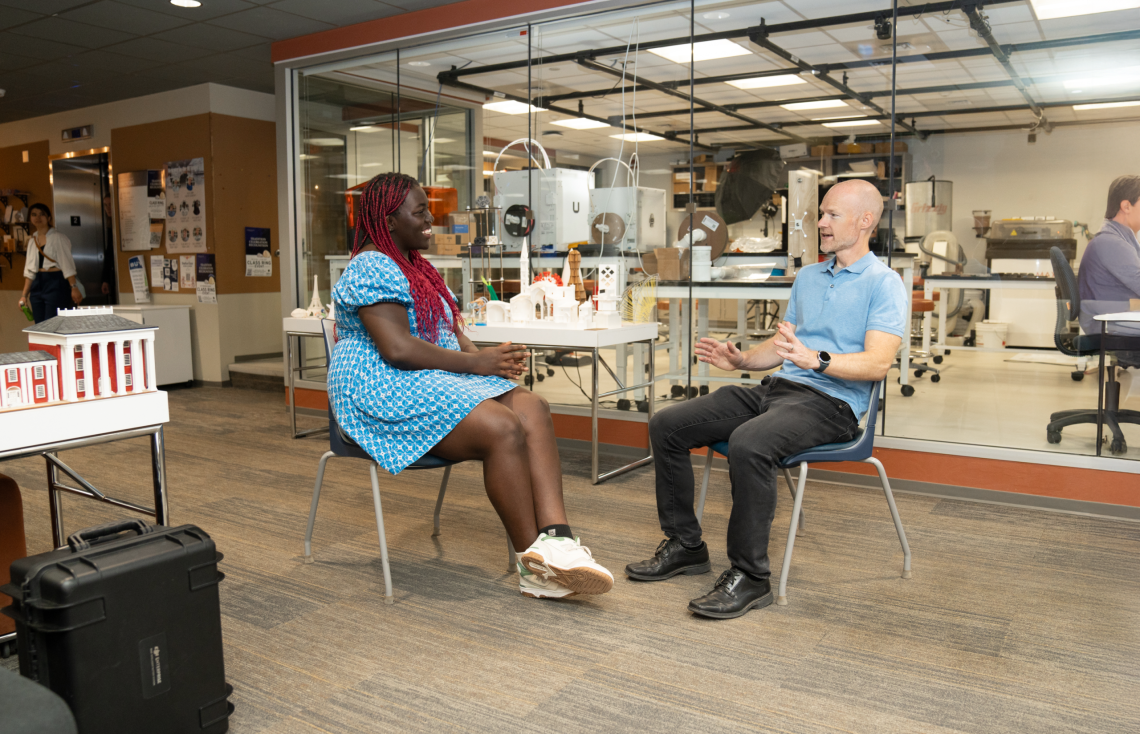
As a sophomore, Mariam Drammeh ’25, a cognitive and behavioral science and German double major with an art history minor, reached out to Dan Johnson, professor of cognitive and behavioral science and head of W&L’s Data Science Program, on her own initiative to ask him for resources on sentiment analysis and topic modeling, data science areas she had little formal training in at the time but was interested in learning more about. Johnson was struck by her initiative, and it was an early signal of what would become a defining feature of their working relationship: Drammeh’s willingness to seek out opportunity and Johnson’s willingness to help her along the way.
That dynamic is, in many ways, a product of W&L’s culture. Drammeh notes that one of the advantages of a liberal arts education like W&L’s is that “professors will still support you even if you aren’t part of their department.”
“They know that you’re exploring all these different things, and they’re ready to be on that journey with you,” Drammeh says. For Drammeh, Johnson was exactly that kind of mentor: supportive of her curiosity even before she was formally part of his lab and responsive to her persistence once she made clear she wanted in.
Drammeh joined Johnson’s Computational Cognition and Creativity Lab and evolved, Johnson says, into a driver of the research lab’s success. The work itself reflected the reciprocal nature of their mentorship. The lab focuses on natural language processing and, in particular, on a growing problem at the intersection of AI and human creativity: the tendency for AI tools like ChatGPT to make individual ideas slightly more creative while simultaneously narrowing the collective space of ideas, a race toward homogeneity that few researchers have yet studied in depth. Drammeh worked across every layer of that project, from writing code and prompt engineering to learning to interact with AI through its API, which Johnson describes as going through the “back door” to work more efficiently and at greater scale. For her part, Drammeh says that what Johnson models in the lab — a consistent return to questions of human impact and ethics and a reminder that data and AI touch real people’s lives — is reflective of the values infused into her overall W&L experience.
Johnson describes Drammeh’s independence and drive as contagious.
“She would take on so much independence and have her own trailblazing journey, and that then would often inspire the rest of the team,” he says. “When Mariam walks into the room, both the positivity and the productivity go up dramatically.”
Drammeh, who completed a U.S. Teaching Assistantship to teach English in Austria after graduation and will be begin her Master of Public Policy at Duke University in fall 2026, credits the mentorship she received at W&L as something she hopes to carry forward into her own career.
“Dr. Johnson is a mentor like no other — he’s an expert in compassionately pushing you to the best of your abilities,” says Drammeh. “I’ve been lucky to have very compassionate and caring mentors, and being able to do that for other people in my personal life and future career is something that I would like to hold very dear from my W&L experience.”

You must be logged in to post a comment.