
November 13, 2025
Faculty Profile: Maureen Edobor
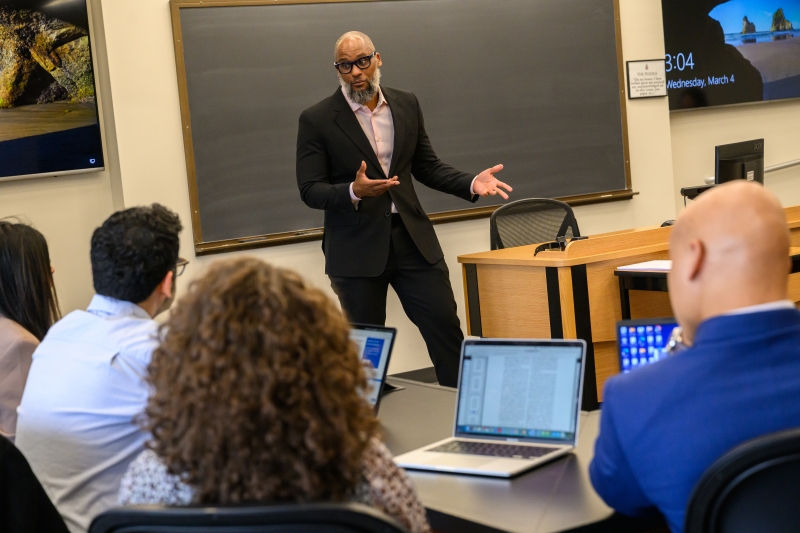 Professor Dennis Sweet with his clinic students.
For Dennis Sweet, the decision to pursue a career in law was shaped by two powerful family influences. His father was an attorney who practiced civil rights law, while his mother was a college professor. Both sets of grandparents were educators, making law and teaching central features of his upbringing.
“I was always influenced with law and education,” said Sweet, who joined Washington and Lee University School of Law in 2025 as director of the Civil Rights and Racial Justice Clinic. “I thought law school would be kind of the best way to attack both.”
Born in Washington, D.C., Sweet spent his formative years in the western suburbs of Chicago. He attended Tougaloo College in Mississippi, where both of his parents had studied and met, before earning his J.D. from Texas Southern University in Houston.
While in law school, Sweet had an experience that would significantly influence the direction of his legal career. Hurricane Katrina devastated communities along the Gulf Coast, including areas of Mississippi where his family lived. Houston became a major destination for displaced residents, and Sweet, who lived near one of the city’s evacuation centers, volunteered to assist people struggling to rebuild their lives.
His work involved helping evacuees secure housing, obtain financial assistance, and navigate the practical challenges of displacement. The experience reinforced his longstanding interest in social justice and demonstrated how legal knowledge and advocacy could make a tangible difference in people’s lives.
“I think that experience had a big impact on my decision to continue pursuing social justice,” Sweet said.
After law school, Sweet returned to Mississippi and began practicing law, initially working alongside his father. He subsequently moved to Washington, D.C., where he earned an LL.M. in litigation and dispute resolution from George Washington University Law School. The program’s emphasis on practical training, including mock trials, moot courts, and litigation simulations, appealed to both his interest in courtroom advocacy and his desire to teach.
Sweet eventually returned to Jackson, Mississippi, where he developed a broad litigation practice handling civil and criminal matters, federal litigation, and civil rights cases. He established his own law office while continuing to collaborate closely with his father, particularly on civil rights and public interest matters.
Among his notable cases was Lewis v. City of Jackson, in which he represented an innocent bystander injured during a high-speed police pursuit arising from a minor offense. The litigation resulted in a Mississippi Supreme Court ruling addressing the factors law enforcement officers must consider when deciding whether to initiate or continue a pursuit.
In another significant case, Sweet represented the family of Helen Ruth Harrion, a woman who was murdered after police responded to her emergency call but failed to enter her home. Sweet helped secure a $1.5 million jury verdict against the city, although the Mississippi Supreme Court subsequently dismissed the federal civil rights claim while upholding the state-law finding of reckless disregard.
For Sweet, the importance of that litigation extended beyond the financial outcome.
“The jury found the city liable, and what the family really wanted was that acknowledgment that the city had acted improperly,” he said.
Throughout his years in practice, Sweet remained committed to education. For more than a decade, he taught moot court and mock trial, conducted continuing legal education programs, and trained other attorneys. Eventually, his interest in teaching began to take precedence over his desire to maintain a full-time litigation practice.
Sweet also notes that civil rights advocacy has historically been driven by younger generations, whose energy and willingness to challenge established thinking are essential to advancing change. “Usually younger people just have that energy, they have that fight,” he said. After nearly two decades of practicing law, Sweet felt he could make a different contribution by preparing the next generation of civil rights attorneys.
That combination of experience and purpose led Sweet to W&L Law, where he saw an opportunity to bring his civil rights litigation background and passion for teaching together in a clinical setting. As director of the Civil Rights and Racial Justice Clinic, Sweet has focused initially on housing-related matters, an approach designed to establish a clear identity for the clinic while creating opportunities for future growth.
His approach emphasizes grassroots relationships with organizations already engaged in civil rights and social justice work. The clinic has developed connections with legal aid organizations, community advocacy groups, and other public interest partners throughout Virginia. Those relationships generate potential cases and provide opportunities for students to participate in community education, know-your-rights programs, and professional training.
For students, Sweet emphasizes the development of practical litigation skills that will serve them regardless of their eventual career paths. Clinic students participate in actual cases, from investigation and drafting pleadings to discovery and courtroom proceedings. Because litigation often extends beyond a student’s time in the clinic, Sweet supplements their work with simulations designed to expose them to other stages of the litigation process.
“The litigation skills transcend civil rights. They transcend social justice,” Sweet said. “That’s just being a good lawyer.”
Equally important is the opportunity for students to understand how civil rights advocacy operates beyond the courtroom, through community organizing, relationships with public interest organizations, and engagement with policymakers. Whether students pursue careers in public interest law, private practice, or other areas of the profession, Sweet hopes they leave with both stronger legal skills and a deeper understanding of the role lawyers can play in advancing justice.
“The students are so smart, and they are very engaged,” he said. “It’s just a thrill to be around that type of intelligence and hard work,” he said.
If you know any W&L faculty who would be great profile subjects, tell us about them! Nominate them for a web profile.

You must be logged in to post a comment.