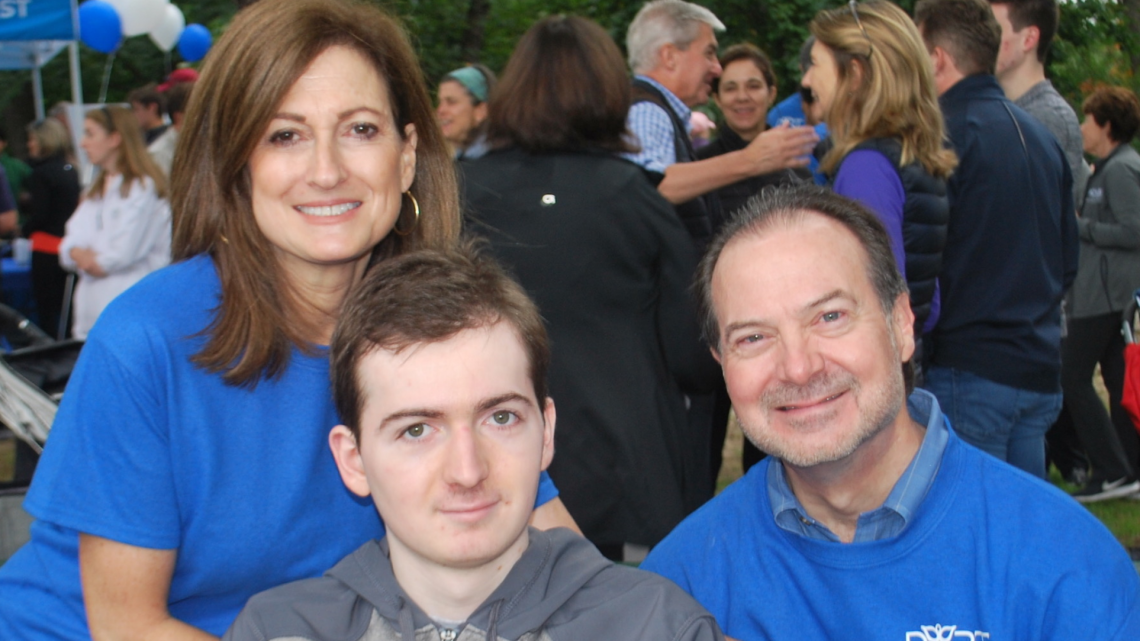
Finding the Why Phil Marella '81 is the founder of Dana's Angels Research Trust, an organization dedicated to funding research on Niemann-Pick disease type C.
“We need to bring brilliant young minds into this research. That’s what W&L students represent to us.”
~ Phil Marella ’81
Phil Marella ’81 keeps a framed print of a Mark Twain quote in his home office. It reads: “The two most important days of your life are the day you were born, and the day you find out why you were born.” The answer to its implicit question has unfolded in his life in ways Marella couldn’t have anticipated.
Marella says that his journey to finding his “why” began in late 2001, when his daughter Dana was 8 years old. After more than three years of unexplained symptoms and inconclusive tests, the chief of pediatric neurology at Columbia University identified Dana’s condition: Niemann-Pick disease type C, a rare genetic disorder in which a faulty protein disrupts the body’s ability to transport cholesterol within cells. The result is a progressive neurological deterioration. The prognosis was devastating, as there were no approved treatments.
“When someone tells you your child has a fatal disease, there are no treatments and they’re not likely to live past their early teens, you don’t even know how to think,” says Marella, a father of four children (one of whom – his son Philip – graduated from W&L in 2018). “You almost forget how to walk. It just devastates you.”
A dinner that year with Ara Parseghian’s family — three of the legendary Notre Dame football coach’s grandchildren also had NPC — clarified something. Marella and his wife, Andrea, were inspired by Parseghian’s organization, the Ara Parseghian Medical Research Foundation, and its work on NPC research, and decided they would build their own. In 2002, with early fundraising energy from Dana’s school community in Greenwich, Connecticut, they founded Dana’s Angels Research Trust (DART). The Marellas have run DART as an all-volunteer operation ever since, with no paid staff and minimal overhead, out of a home office.
In 24 years, DART has raised more than $6.5 million for NPC research. In 2025 alone, the foundation funded nearly $300,000 in grants.
“I tell donors: ‘Don’t think of this as a charity,’” he says. “Yes, you get a charitable deduction, but you’re making an investment in science. We want to deliver returns — not back to you, but to the patients.”
Rather than broadly fund institutions, Marella says, DART targets specific gaps. A frequent strategy is funding postdoctoral fellowships in key labs, providing dedicated hands to accelerate work that might otherwise languish in a queue. Over time, those investments have created genuine relationships. Marella speaks about leading NPC researchers the way he talks about old colleagues or friends.
“These researchers are like family to us, and us to them,” he says. “They understand the urgency. We’re not just hoping to find a cure someday. We’re here to save the kids who are here today.”
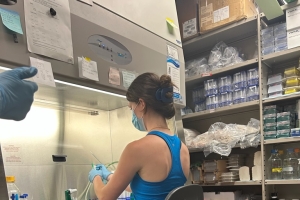
That philosophy of urgency extended to Washington and Lee, when Marella established DART’s summer internship program, which places W&L students in leading NPC research labs. The connection was personal: Dr. Joseph Goldstein ’62, whose Nobel Prize-winning lab with Dr. Michael Brown at the University of Texas Southwestern helped establish the science of cholesterol metabolism that underlies NPC, is himself a W&L alumnus. When Marella reached out to Goldstein and other researchers to ask if undergraduate students would be genuinely useful, the answer was an enthusiastic yes. Two DART interns were subsequently hired by the Brown and Goldstein Lab after graduation.
“We’ve already lost some of the great researchers in this field to retirement,” Marella says. “In academic science, when a lab closes, it doesn’t get handed off to a successor. It often just ends. We need to bring brilliant young minds into this research. That’s what W&L students represent to us.”
At Washington and Lee, Marella majored in accounting and business administration, earning a B.S. with special attainments in commerce. He split his time between the Williams School of Commerce, Economics and Politics and the journalism school, spending long nights at the radio station, producing television segments and learning how to manage competing demands. Bob de Maria, W&L professor of journalism and mass communications emeritus, became a formative presence. Recognizing Marella’s interest in the media business rather than reporting, de Maria helped him navigate around prerequisites and into the advanced television and radio courses that aligned with his goals. It was the kind of accommodation, Marella points out, possible at a small institution that trusts students to make a case for themselves and meet the expectations that follow.
“I wasn’t going to be a journalist,” Marella explains. “I wanted to be on the business side of media. And they let me build a path that made sense.”
After graduating from W&L and working at ABC for two years, Marella returned to school and started on his law degree from Fordham University while working full-time. After almost six years in accounting and finance at ABC, he started his legal career with Spelling Entertainment’s distribution arm, Worldvision Enterprises, where he eventually ran the legal and business affairs department. Marella also worked for entrepreneurial companies such as Microcast, Inc., a video streaming company, and Pinnacle Broadcasting. He continues to work in negotiating media transactions while devoting his energy to DART. Marella credits the liberal arts with giving him the ability to adapt throughout a diverse career that has culminated in becoming a “self-educated scientific philanthropist” navigating FDA drug applications and biomarker research.
“I only took three credits of science in four years at W&L,” he says. “But Washington and Lee taught me how to learn. And I’ve been learning ever since.”
He describes himself as the person in scientific meetings who asks the simple questions that occasionally stop researchers in their tracks — the person “who can see the forest when scientists are caught between the blades of grass.”
Dana Marella passed away just before her 20th birthday, by then unable to walk or speak and dependent on a feeding tube. Her brother Andrew, now 26, has the same diagnosis. The difference between their trajectories is a measure of what DART’s research investments have helped achieve. Andrew currently receives four different drugs and five treatments per month, including a spinal infusion of cyclodextrin, the compound DART helped develop from preclinical research beginning in 2009. He walks with assistance and feeds himself, and, twice a week, he ushers at a movie theater in Connecticut, delivering part of the pre-show presentation over a microphone.
“I’m just not sure I expected to see that in his lifetime,” Marella says, “but that’s what we’ve been able to help do.”
The cyclodextrin manufacturer filed a New Drug Application (NDA) with the FDA in December 2025. Approval is anticipated by fall 2026, a milestone that has been roughly 15 years in the making. The implications extend well beyond NPC. The Niemann-Pick protein governs cholesterol metabolism in every human cell, which means NPC research generates insights relevant to Alzheimer’s disease, Parkinson’s disease, heart disease and strokes. The statin drugs now taken by tens of millions of Americans were discovered not while researchers were looking for them, but from the study of a rare blood disorder, work that eventually led to the Brown and Goldstein Nobel Prize.
“Rare diseases let you find things you can’t find in a giant petri dish,” Marella explains. “It’s easier to find them in a smaller one.”
Marella doesn’t romanticize the work. He knows what it costs, and he knows his son’s health can change at any time.
“You just stay focused on the positive and moving things forward,” he says, “because that’s what you’re here to do.”
Learn more about how W&L students are engaging with cutting-edge research through the DART fellowship program.
If you know any W&L alumni who would be great profile subjects, tell us about them! Nominate them for a web profile.