February 23, 2026
Sarp Sahin ’26 Publishes Research Paper
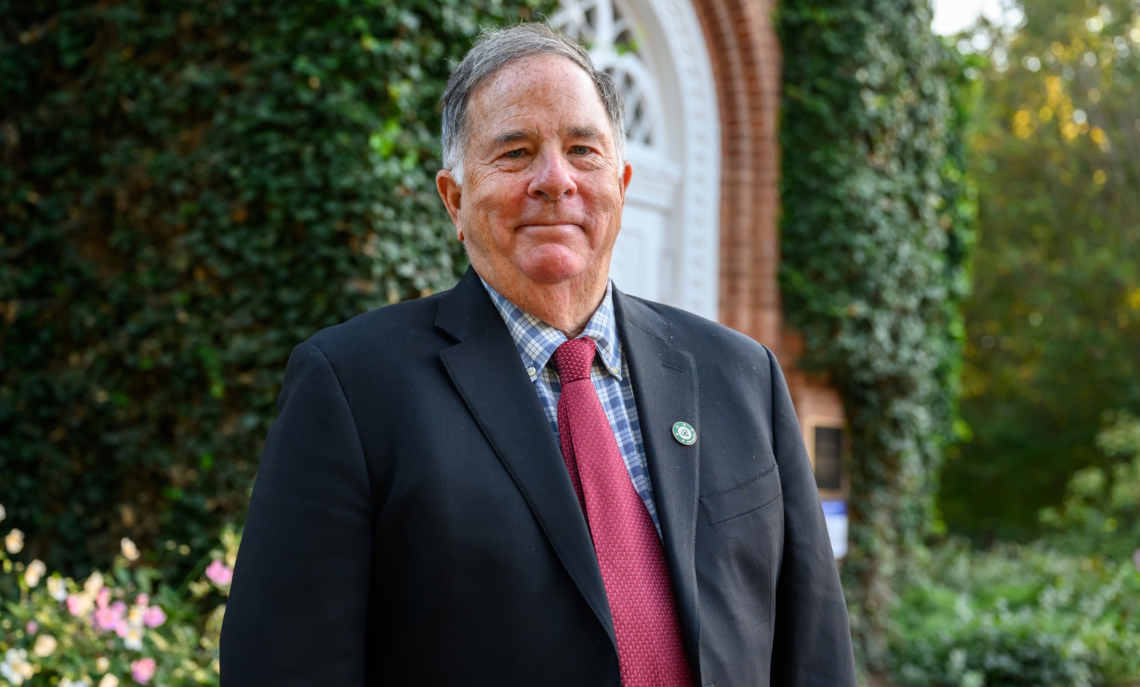
As I began to work with [Professor of Chemistry Keith] Shillington, I got a bug for research and discovery. That’s what got me going.”
~ Chip Schooley ’70, P’96
As a sophomore at Washington and Lee University, Chip Schooley ’70, P’96 was floundering in the classroom.
“I was earning a classic ‘Gentleman C’ without opening a book,” Schooley said. “‘Gentleman C’s’ get you out of school but not into the next one.”
Along came the late chemistry professor Keith Shillington to recruit Schooley into the university research program. Schooley spent three hours every Monday in the organic lab on the fourth floor of Howe Hall.
“As I began to work with Shillington, I got a bug for research and discovery,” said Schooley. “That’s what got me going.”
He hasn’t stopped since. Described as a visionary, a maverick and a pioneer, Schooley’s trailblazing HIV/AIDS research helped transform the disease from a death sentence into a manageable chronic condition. More recently, he became the first physician in the U. S. to use bacteriophages to save a patient dying from a multidrug-resistant superbug, and he spearheaded the University of California San Diego’s award-winning response to COVID-19.
Schooley got his M.D. at Johns Hopkins, then conducted early antiviral drug studies in fellowships at Massachusetts General Hospital and the National Institutes of Health.
In 1981, Schooley joined the Harvard Medical School faculty the same week the Centers for Disease Control first described AIDS. As cases were emerging in Boston, he shifted his research from herpes viruses to focus on developing antiretroviral chemotherapies for HIV/AIDS.
When the University of Colorado pulled a major coup by recruiting Schooley to head its Division of Infectious Diseases in 1990, the hiring was compared to the Denver Broncos signing John Elway. At Colorado, Schooley led the national AIDS Clinical Trials Group (ACTG) from 1995 to 2002 and its expansion of global research sites.
“Once it became clear that we had a good idea about how to treat HIV, the problem was that people who most needed to be treated were not getting the drugs,” Schooley said, referring to Africa, South Asia, India, South America and Haiti.
In 2005, Schooley became head of the Division of Infectious Disease at the University of California San Diego’s Medical School, where he is now employing viruses called bacteriophages (or “phages”) to treat bacterial infections in patients for whom antibiotics don’t work.
“It’s something I never thought I would be doing,” said Schooley. “Phages have been evolving with bacteria for 300 million years. These are viruses that don’t infect us. They infect bacteria, killing them quickly and going on to kill the next bacterium in the colony.”
Schooley’s initial experience with phages began in 2015. His friends and colleagues, Tom Patterson and his wife, Steffanie Strathdee, were in Egypt when Patterson was infected by a superbug, Acinetobacter baumannii. Once back in San Diego, Patterson’s outlook was grim. He was in a coma and on a respirator when Strathdee, herself an infectious disease epidemiologist, found a scholarly paper describing phage therapy to treat Acinetobacter. She sent Schooley the paper and asked, “Could we try this to treat Tom?”
“I told her we hadn’t done this in the West for 70 years. In the ’20s and early ’30s before antibiotics, some companies marketed bacteriophages to treat bacterial infections. It didn’t work because we didn’t understand the biology of bacteriophages and didn’t know how to choose the right ones for each infection,” Schooley said. “But technology has moved along, and we can now identify specific phages to kill specific bacteria.”
Schooley and his team searched for phages to attack Acinetobacter, found some in labs at Texas A&M University and the Navy’s Medical Research Command in Bethesda, Maryland, and concocted a “phage cocktail” to administer intravenously.
“Tom turned the disease around, survived and is thriving,” said Schooley who, with Strathdee, received a $1.5 million grant to create and direct the Innovative Center for Phage Applications and Therapeutics (IPATH), the country’s first phage therapy center doing both research and patient care.
“It pulls together my whole career, from starting out interested in antibiotics, then saying, ‘That’s solved. I’ll work on viruses,’ next realizing the antibiotics weren’t working so well and now using viruses to treat the bacteria,” said Schooley. “It’s a good thing there’s nowhere else to go.”
This article first appeared in the Summer 2026 issue of W&L: The Washington and Lee Magazine. Contact us at magazine@wlu.edu.
Schooley recalls “Low Sunday” and “High Sunday” dinners at Professor of Chemistry Keith Shillington’s house — Low Sundays with student colleagues and High Sundays when Shillington “prepared wild and crazy dinners” for anybody from the lacrosse coach to the university president.
Schooley’s brother, Bill, graduated from W&L in 1978, and his daughter, Kim Schooley Hickman, is a 1996 graduate. This fall, his granddaughter, Olivia Hickman, will be a first-year.