November 18, 2025
Mark Drumbl Publishes New Book “The Character of International Law”
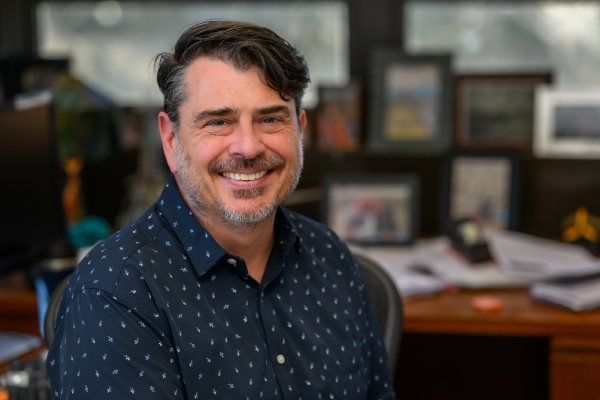 Professor Mark Drumbl
Opinio Juris, a leading international law blog, recently hosted a symposium examining “Reframing Transitional Justice: Innovations, Boundaries, and Refractions,” a new book co-edited by Washington and Lee University School of Law Professor Mark Drumbl and Kirsten Fisher of the University of Saskatchewan.
Published by Routledge in April, “Reframing Transitional Justice” brings together scholars from eight countries and four continents to reconsider the field of transitional justice—the ways societies respond to legacies of mass violence, human rights abuses, and political upheaval. The volume examines the field through three themes: innovations, boundaries, and refractions, exploring subjects ranging from artificial intelligence and digital evidence to environmental destruction, racism, gender, and democratic backsliding.
“We assembled this collection because we think the time is right, amid the tumble of the current tumult, to rethink where transitional justice and post-conflict reconstruction are going,” Drumbl and Fisher wrote in their introduction to the symposium.
The Opinio Juris symposium features five scholars engaging with the book’s larger challenge to conventional understandings of transitional justice. The contributors explore how victims can become producers, rather than simply subjects, of knowledge; question the field’s traditional focus on individual nations and periods of political transition; and examine whether state institutions can adequately address racial and gender harms that are themselves embedded in ordinary systems of governance. Other contributions consider community-based and non-state approaches to justice and ask a fundamental question raised throughout the volume: as transitional justice expands to encompass more forms of historical injustice, victims and harms, at what point does that expansion risk obscuring what the field is meant to accomplish?
Drumbl and Fisher opened the symposium with an introduction to the book and concluded it with a response to the five commentaries. In their conclusion, they describe the symposium as extending the intellectual community created by the volume.
“These five commentaries are so much more than interlocutions or interventions,” they write. “Indeed, they feel like expansions of the community of the book itself, as if we now have twenty-one contributors rather than sixteen.”
Drumbl is the Class of 1975 Alumni Professor and Director of the Transnational Law Institute at W&L. His research and teaching interests include public international law, global environmental governance, international criminal law, post-conflict justice, and transnational legal process. His work has been relied upon by national and international courts; he has served as a defense lawyer in Rwandan genocide trials; co-authored an amicus brief to the International Criminal Court in the Ongwen case; and has been an expert in litigation including on international terrorism, with the UN in matters involving child soldiers, and with the UN Human Rights Council in the drafting of a global convention to criminalize racist hate speech.
If you know a W&L faculty member who has done great, accolade-worthy things, tell us about them! Nominate them for an accolade.

You must be logged in to post a comment.