
February 17, 2026
Mikki Brock to Headline Fourth Beyond the Page Event
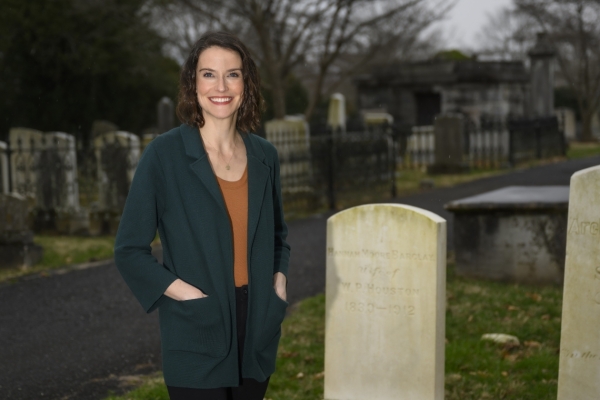
“Spooky season” got an early start this fall for students taking The Age of the Witch Hunts, taught by Mikki Brock, professor of history. The course examines how early modern people understood witches — using case studies on witch trials in the Basque country, Germany and Massachusetts — and explores not only the causes and consequences of the witch hunts, but the dangers of demonization and the peculiar powers of fear.
Brock teaches courses on early modern British and Scottish history, the history of the devil, the age of the witch hunts and other topics related to religion, gender and the supernatural in the early modern world. Below, she discusses what drew her to studying the relationship between religion and the supernatural, the origins of witch hunts and why people lean into the supernatural around Halloween.
What initially drew you to your research on early modern Scotland, and particularly the religious and supernatural landscape of the period?
As a child, I was fascinated by stories of the supernatural. I loved movies like “Hocus Pocus” and books on ghosts and witches, and I always wanted to know where these stories came from. I also grew up in the Dallas area in a broadly religious environment, and I remember having a lot of questions about things like God and the nature of salvation. As for Scotland, I studied abroad there when I was an undergraduate; I fell in love with the place and learning about its past, which included religious turmoil and intense witch hunts. The rest is history!
Why was the supernatural so prevalent in premodern daily life, and how did religion and supernaturalism influence each other?
The premodern world was understood to be filled with non-human entities — God, angels, demons, witches, fairies, goblins, ghosts and more. When misfortune happened, people did look for natural causes, but supernatural explanations also made perfect sense in the context of their perceived realities. Some of these things seem quite fantastical to us now, but they were accepted based on the sources of authority people relied upon, such as folkloric traditions, personal experiences and, above all, theology and scripture. Religion and the supernatural were not separate; they were deeply intertwined, occasionally in tension but usually mutually reinforcing.
Why is this relationship between religion and supernaturalism important to study today?
One of the most important things to know about the witch hunts is that the accused were seen by authorities as servants of Satan, a profound threat to society and enemies to be eradicated at all costs. Demonization and dehumanization are two sides of the same coin, and framing people as “evil” led to the horrific treatment of human beings by those who believed they were doing a “godly” thing. The witch hunts also show what happens when leaders demonize others and peddle in conspiracy theories. These are, I think, timely and urgent lessons.
Historically, why do people lean into the supernatural around Halloween?
The history of Halloween is murky, but the gist is: The origins of the modern holiday trace back to the Catholic vigil for the dead observed on the event of All Saints Day, Nov. 1, during the Middle Ages. Halloween may also have roots in Samhain, an ancient Celtic festival that also took place on Nov. 1 and centered on the idea that on this night, otherworldly spirits roamed the Earth. Origins aside, I think people lean into the supernatural on Halloween because it is fun; it’s a way to dabble in spooky things, but in a very contained way.
Where did the idea of witches come from, and what beliefs/fears were being projected during witch trials?
This is such a big question, but the simplest way to answer is this: People across time and space have believed in witches and magic, but in the late Middle Ages, elites began to connect magic to the devil and to heresy, creating the composite idea of the demonic witch that was at the heart of the witch trials. These ideas — known as demonology — were spread widely in the early modern period thanks to the printing press, and legal developments allowed witchcraft to be prosecuted as a capital crime. The ensuing witch hunts were fueled above all by fear; ordinary people worried that witches would use magic to harm their families and farms, while elites believed that witches were part of a demonic conspiracy seeking to overthrow Christendom.
When people thought about who was likeliest to be a witch, most imagined women, due to theological ideas about women’s deviant natures (think Eve here), fears surrounding fertility and the gendered division of work, among other things. Patriarchy and misogyny were crucial factors, too, but they alone don’t explain the gender dynamics, because of course these existed long before (and long after!) the witch hunts.
What is your favorite scary movie?
Robert Eggers’ “The Witch,” by far. The film is a fantastic portrayal of how early modern people thought about witches. I really recommend it to anyone wanting to understand the beliefs and anxieties that underpinned the witch hunts in Puritan New England and early modern Europe as a whole. I also love Mike Flanagan’s TV shows, especially “Midnight Mass,” “The Haunting of Hill House” and, most recently, a remake of Stephen King’s “Carrie.”
If you know any W&L faculty who would be great profile subjects, tell us about them! Nominate them for a web profile.
On Halloween, Mikki Brock will deliver a talk at the American Shakespeare Center in Staunton, Virginia, titled “On Witchcraft in the Early Modern Period,” focused on dismantling some of the myths surrounding the witch hunts.
“I hope the audience will leave with an appreciation for the complexity of history and the importance of understanding the early modern past on its own terms,” Brock said. “If you ever hear someone say that ‘witch hunting was really about this one singular thing,’ you should know they are wrong; history is rarely monocausal, and the witch hunts resulted from a perfect storm of so many factors. That’s what makes them so challenging, fascinating and important to study.”
Brock’s lecture is part of the American Shakespeare Center’s Lights ON Blackfriars series, held on select Saturdays throughout the year. Her talk will be held at 11 a.m. on Oct. 31, ahead of the day’s performances of “Witch” and “Mary Shelley’s Frankenstein.”


You must be logged in to post a comment.