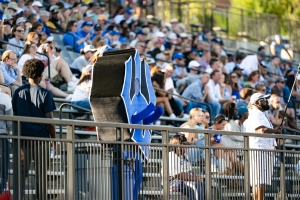
Saving the Season: How Special Collections and University Alumni Preserved a Piece of W&L’s Athletics History Reel-to-reel videos from the 1974 lacrosse season were preserved, digitized and turned into a documentary about one of the most notable teams in the school’s rich athletics history.
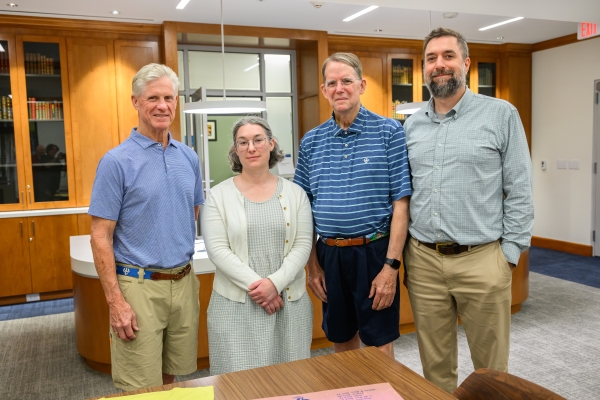 Jim Farrar ’74, Paula Kiser, associate professor and digital scholarship librarian, Phifer Helms ’74 and Seth Goodhart, public services manager for Special Collections & Archives, worked to preserve an important piece of W&L’s athletics history.
Somewhere in the lower stacks of Leyburn Library, the story of Washington and Lee University’s 1974 men’s lacrosse season was sitting inside metal canisters just waiting for someone to come calling. The 16 mm reel-to-reel films survived for more than 50 years, but the journey from their original home in the former gymnasium building to becoming part of the W&L digital archives almost never occurred.
The 1974 men’s lacrosse team has long been considered one of the best teams in W&L’s athletics history, completing an undefeated regular season and rising as high as No. 2 in the national polls against a schedule that included the University of Virginia, Princeton University and Duke University. The Generals eventually finished 15-1 overall with the lone blemish being a controversial 11-10 road loss to Johns Hopkins University in the NCAA tournament semifinals.
Decades after the evidence of W&L’s dominance of the sport’s most storied programs was first recorded, it was almost lost forever.
As the university began preparing to make improvements to the Doremus Gymnasium and Warner Center complex, the Department of Athletics undertook a major house-cleaning effort. In the process, Chuck O’Connell, a former assistant men’s lacrosse coach and athletics administrator, came across a box of film canisters that had been earmarked for the trash. O’Connell identified them as missing game films from the 1974 season and rescued them.
“Thanks to Chuck’s curiosity and quick thinking, we were able to recover these irreplaceable game films that were literally on the way out of the gym,” said Jim Farrar ’74, longtime W&L administrator and an All-America defenseman on the 1974 team.
The recovered films eventually made their way to W&L Special Collections and Archives, which occupies a dedicated wing of Leyburn Library and preserves, maintains and makes accessible the documentary heritage of the university. Within this wide-ranging collection is Record Group 18 — the W&L athletics archive.
“We have various W&L team photos that date as far back as the late 1800s,” said Seth Goodhart, special collections and archives public services manager. “It’s a rich archive, even if things aren’t yet as organized as we would like.”
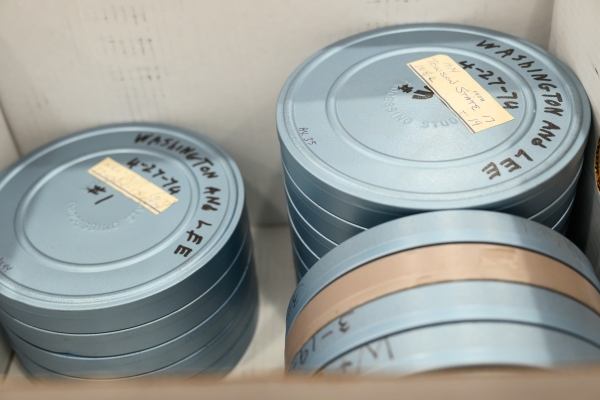 The 1974 films were nearly discarded, but found their way to the university’s Special Collections & Archives.
Among the athletics collection are 60 bankers boxes filled with video reels covering football, basketball, baseball, soccer and lacrosse games across multiple decades. Not everything has been cataloged in full detail, and, for years, the athletic film collection was a prime example of how much remained to be discovered. The lacrosse films sat quietly in that collection, waiting.
Goodhart had been keeping a quiet eye on those boxes since he joined the department 15 years ago. A former lacrosse player himself, he was drawn to the markings on several boxes identifying the sport and an approximate era.
“I snooped around in them and was intrigued when I saw a notation for lacrosse films,” said Goodhart. “I identified that there were definitely some films from the mid-1970s, which was exciting.”
Goodhart knew what was there in a general sense — all he needed was a reason to dig in.
That reason arrived in the spring of 2024, in the form of a question posed during the Class of 1974’s 50th reunion luncheon on Cannan Green. Several members of W&L’s fabled 1974 men’s lacrosse team were seated together at that event, including Farrar and fellow All-Americans Skip Lichtfuss ’74, Ted Bauer ’74 and Skeet Chadwick ’74, among others. Naturally, the talk gravitated toward the on-field exploits of one of the greatest teams in the history of the university. However, it was a question posed by a classmate seated with them that changed the course of history for the slowly degrading evidence of the team’s exploits.
Phifer Helms ’74, P’05, P’07, P’11 and a former member of the W&L track & field team, wondered aloud if any videos still existed. No one present at the luncheon could answer with any confidence. A self-described “film geek,” Helms sought to find out. His search led him to Goodhart, who only needed a reason to begin auditing the boxes that had sparked his curiosity years earlier.
Goodhart sorted through all 60 boxes, looking specifically for 1974 material and working to rebuild as complete a set of game films as possible. It was detective work as much as archival work. Over the years, reels had been pulled for viewing but weren’t always returned to the corresponding box. He even found canisters from the same game scattered in multiple locations, some labeled and some not.
“I did go through all of these boxes trying to piece things back together once I realized there might have been reels for each quarter,” said Goodhart. “I wanted to build back, as best we could, the entirety of what had been preserved.”
The audit carried an added dimension of familiarity. When Helms mentioned that Farrar was also involved, Goodhart recognized the name immediately. Farrar was among a group of community members who had coached Goodhart’s middle school lacrosse team many years ago.
“Beyond his impactful work and presence at W&L for decades, Jimmy has been a staple in the local lacrosse community,” said Goodhart. “He’s a great man, and he was a stellar athlete here in both football and lacrosse.”
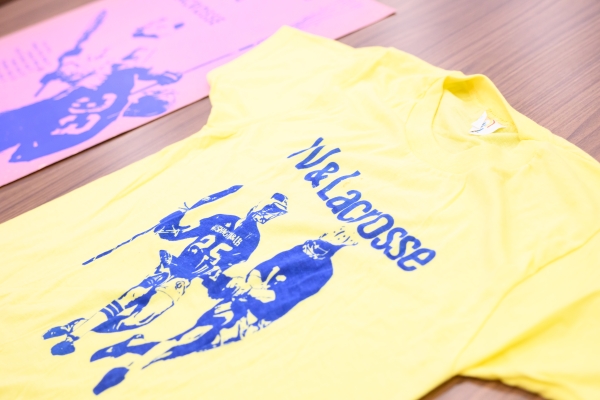 The archives contain a number of artifacts, including shirts and posters from the 1974 season.
Farrar quickly contacted Chadwick, who realized the potential of the project and jumped on board. With assistance from Helms, Farrar and Chadwick, Goodhart was able to assemble the surviving game films from the 1974 season. The footage was in 16mm format, black and white, with no audio, and each game had been captured — one reel per quarter. They recovered footage of four full games, contests against the University of Virginia, U.S. Naval Academy, Cortland State University and Towson University. They also recovered one half of a game against Morgan State University and limited footage of the NCAA semifinal game against Johns Hopkins.
With several game films realized, the next challenge fell to Paula Kiser, associate professor and digital scholarship librarian, who oversees the W&L Digital Archive and manages all audiovisual reformatting for the Special Collections and Archive. Since the university does not own 16mm reel-to-reel projectors, there was no way to see the actual footage. It was apparent that the films would need to be digitized to view and preserve that season’s highlights and that this was not a project the university could handle on its own. Digitizing 16mm film properly requires specialized equipment, specific software and a level of hands-on expertise that falls outside the department’s standard workflow.
“It would have been a much heavier lift for us to buy the equipment necessary, figure out how to use it and then get the right software,” said Kiser. “It just made a lot more sense to outsource it to somebody who already knew what they were doing.”
That somebody, as it turns out, was another member of the W&L alumni network: Bill Parks ’82.
Parks and his wife founded Dominion Post in the early 1990s, building the Northern Virginia company on a foundation of real estate video and broadcast television production. Over the years, it evolved into a high-end post-production operation whose credits include documentaries for PBS and the Discovery Channel. As a W&L student, Parks was a broadcast journalism major who ran the university’s cable news station and directed Mock Convention broadcasts. He had already worked with Special Collections on digitizing Mock Convention footage for an earlier project, which led to a phone call from Kiser.
Parks’ process of digitizing film bypasses projection entirely. A telecine uses a camera and a series of precision lenses that zoom directly onto the film itself, recording the image in high quality without projecting light through the reel. When the lacrosse films arrived, Parks found that the telecine his company had on hand was calibrated for television broadcast work and was not the right fit for this job. So, he acquired a new one.
With the right equipment in place, Parks cleaned each reel with a chemical solution to remove accumulated dust. The films then presented their biggest challenge: Some reels had splices where sections with no game action had been edited out decades ago, and a number of those old splices had come apart.
“You don’t know how that will work until you run the reels through and have them fail,” he said. Film cement and a clean second pass solved the problem.
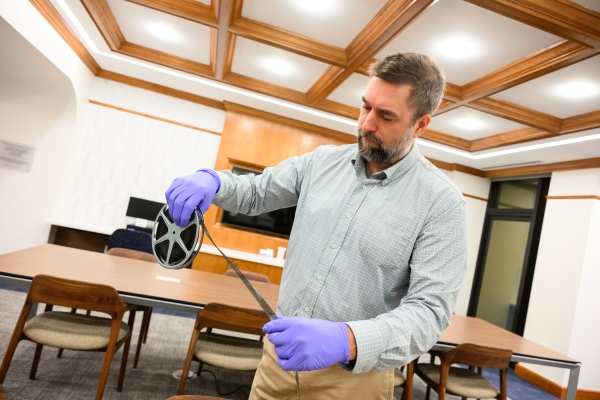 Goodhart carefully handles one of the 1974 lacrosse reels.
Playback speed proved to be another hurdle. The game films had been shot at 18 frames per second, common for 16mm film, but standard equipment runs at 24 frames per second. Parks noticed immediately that the footage was moving too fast and, drawing on experience, identified the proper correction.
“The original version looked like Keystone Cops running around,” recalled Kiser.
Once the speed was right, Parks produced two versions of each file, a high-resolution preservation copy in Apple Codec format and a compressed MP4. A final step converted the footage from its aged sepia tone back to true black and white. A small number of reels offered an unexpected bonus: Some footage had been shot in color, a considerable expense for 1970s game film. Parks color-corrected those reels to restore the reds and blues that had faded over the decades.
“I am thrilled to be able to help as an alum, and this helps me stay connected to the university,” said Parks. “I was glad to do it because I have the equipment and the technical know-how to pull it off and I obviously wanted to do a really good job as cost effectively as possible.”
Rather than risk mailing the delicate reels in summer heat, Kiser drove them to Parks herself. She dropped the reels off in early October 2024, and the first completed files came back within three weeks, with the full set being returned by mid-December.
Given that the library had limited resources for a project such as this, a small group of 1974 alumni financed the film restoration project themselves to preserve a piece of history.
The videos, however, did not tell the entire story. Helms took things one step further.
“I knew this was an amazing story that had to be told,” said Helms. He set out to tell the story of the 1974 team in a full documentary about the season.
“In ‘The Washington and Lee Swing,’ there is a line that says, ‘Washington and Lee men fall in line, we’re going to win again another time,’” said Helms. “Those great lacrosse teams of the 1970s, including the 1974 team, represented that ideal, and so I thought it was only natural to use ‘Fall in Line’ in the title. Everyone fell in line behind the team — students, professors, administrators, alumni and the Lexington community.”
Helms titled the documentary “Fall in Line: The Story of the 1974 W&L Lacrosse Team.” He used additional archival works from Special Collections and resources from members of the team, including personal scrapbooks from Farrar and artifacts provided by then-team manager Ben Sherman ’75.
Helms also recorded interviews with several of the team’s great players, many who are enshrined in the W&L Athletic Hall of Fame as well as the U.S. Lacrosse National Hall of Fame. Additionally, he recorded commentary from former members of the Generals’ coaching staff, including head coach Jack Emmer, O’Connell and fellow assistant John McDaniel ’64. All told, the documentary runs just over an hour in length and provides a comprehensive analysis of the 1974 season. Helms was direct in speaking about his motivation for this labor of love.
“The 1974 lacrosse team gave so much to me and to the entire W&L community as fans,” said Helms. “I just wanted to say thank you from all of us and to make those stories easily accessible and permanent for people to enjoy.”
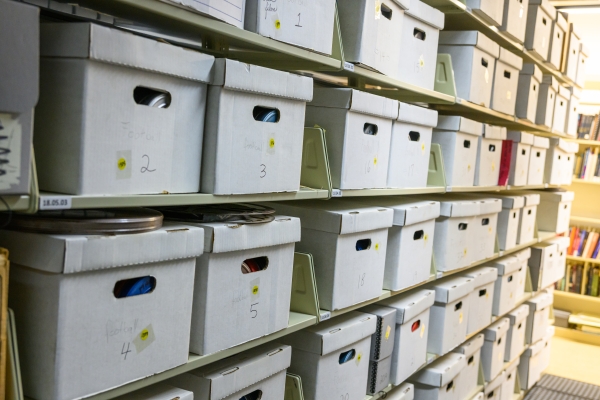 Rows of bankers boxes hold treasured pieces of university history in the Special Collections & Archives’ climate-controlled stacks.
The ever-changing landscape of collegiate sports makes it hard to imagine that W&L once competed on the biggest stage with today’s powerhouse schools. Preserving that history helps educate the masses of W&L’s athletic prowess in the early to mid-20th century. However, while it’s nice to reminisce, Helms said it’s also important to understand that today, W&L athletics is right where it belongs.
“All of the alumni involved in this film project fully support W&L’s rightful place as a premier athletic department competing at the Division III level,” said Helms.
To assist in sharing these special pieces of history, Kiser included “Fall in Line” in the university’s digital archive alongside the individual game videos. She said the project opened a window into what becomes possible when alumni engagement, institutional resources and the right expertise align.
“My dream is to get the rest of the reels we have of sporting events digitized,” she said, “because we have such an amazing treasure trove of historic athletic footage that no one has seen for decades.”
Goodhart’s takeaway was aimed squarely at anyone who might have something in an attic or a closet worth preserving.
“Give us a call and let us guide you,” he said. “Don’t throw things away. Sometimes the best content gets tossed before we have a chance to take a peek at it, and you never know what could end up being a valued piece of history.”
If you have photos, artifacts or information you wish to share with W&L’s Special Collections and Archives, contact them at 540-458-8109 or specialcollections@wlu.edu.
Special Collections & Archives
Learn more about the resources available in Washington and Lee University’s Special Collections & Archives.
Special Collections & Archives Services
Visit Special Collections & Archives
Contact Information
Email: SpecialCollections@wlu.edu
Phone: 540-458-8109
Mailing Address:
Special Collections and Archives
James G. Leyburn Library
Washington and Lee University
204 W. Washington St.
Lexington, Virginia 24450
Hours
Academic Year: M-F, 10 a.m.-4 p.m.
Summer: M-TH, 10 a.m.-4 p.m. (Closed Friday)



You must be logged in to post a comment.