To the Moon and Back with Andy Scott ’99 Scott, systems analysis integration lead for the Orion program at Lockheed Martin, shares about his role in the Artemis II mission.
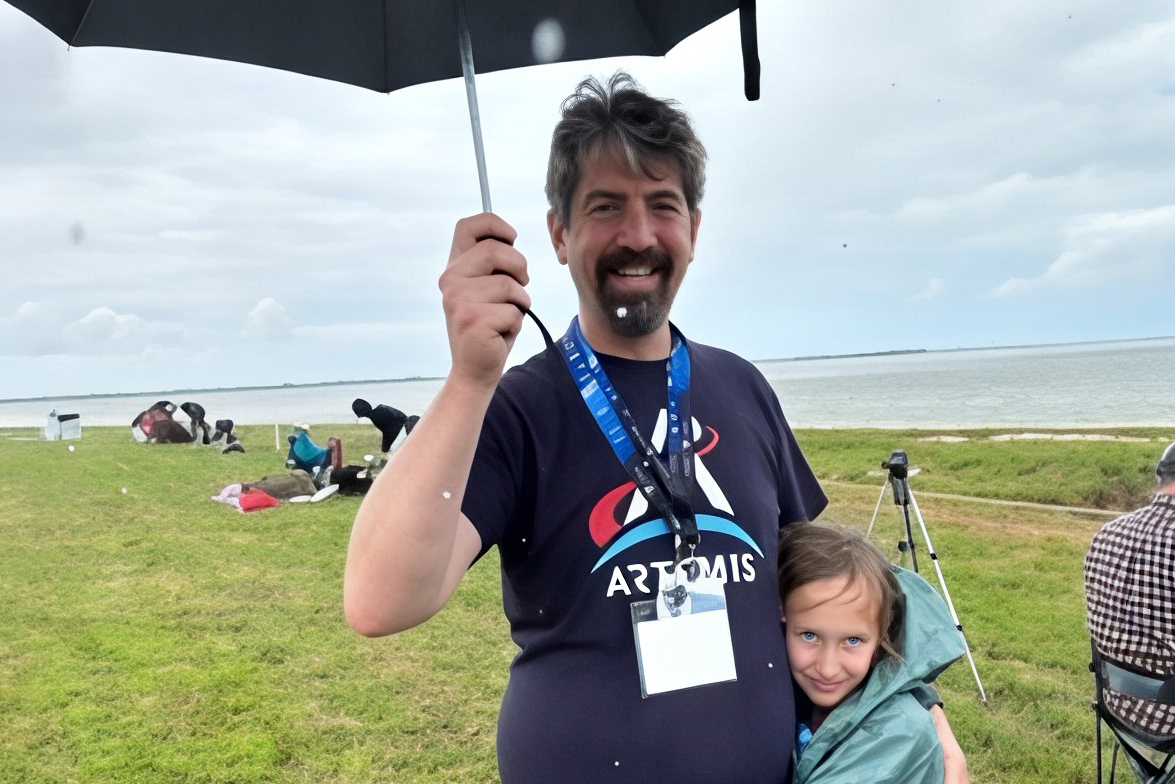 Andy Scott ’99 and his daughter, Evvy, at the Artemis II launch.
When Artemis II lifted off on April 1, 2026, from NASA’s Kennedy Space Center in Florida, Andy Scott ’99 was there with his daughter, Evvy, to witness the launch of the mission that would carry humans the furthest distance from Earth. Scott was witnessing not only history, but the culmination of his own life’s work. As systems analysis integration lead for the Orion program at Lockheed Martin, Scott has spent more than two decades helping engineer the Orion spacecraft, the crew capsule at the heart of NASA’s Artemis missions. Scott graduated from Washington and Lee University with a B.S. in physics-engineering and obtained a master’s in aerospace engineering from Georgia Tech. We caught up with him on splashdown day to talk about the mission, his path from W&L to aerospace engineering and why he thinks the hardest part of going to the moon has less to do with rocket science than most might think.
What exactly is your role in the Artemis mission?
I’m one of many on the team, and I work on the spacecraft that goes on top of the rocket. I’m the lead for all the pre-flight analysis groups who make sure the performance of the vehicle during the mission is acceptable (e.g. it doesn’t get too hot or too cold and has enough power). We check out all the mission permutations as part of the process of signing off that we’re ready to fly. The nice thing about my job is I get done with it about two months before launch, and then I get to sit back and watch the show. This is a program I’ve been working on for almost all of my 20-plus-year career. This is our second Artemis mission, and the first with crew.
For those of us who aren’t aerospace engineers, can you break down what Orion is and how it fits into the bigger Artemis picture?
There is the rocket, which is called the Space Launch System (SLS) — if you’ve seen it, it kind of looks similar to the space shuttle, just stretched out a little bit. The Orion spacecraft is what goes on top of that. Technically, Orion is comprised of four big pieces: There’s the Launch-Abort System (LAS) on top, the European Service Module (ESM) behind it that has the engines and solar arrays and then the Crew Module (CM), which is the element Lockheed Martin has developed and designed. All of those come together to make what’s called the Orion spacecraft, which Lockheed Martin is also responsible for integrating as a whole. We sent the spacecraft out to the moon without crew and tested things out on the Artemis I mission. Artemis II is the first mission with crew. The goal is that future missions — Artemis III, IV and V — will introduce lunar landers and even set up a base. The overall goal is to go back to the moon and stay there, which is very different from the Apollo mission. Whereas Apollo was about going there and proving we could do it, this is about going back and staying, eventually using the moon as proving grounds for a Mars mission.
How long have you been looking forward to this moment?
We won the contract in August 2006. When I first started, we were trying to figure out the replacement for the space shuttle. There were lots of different concepts, and I was on a team working on what was called the Crew Exploration Vehicle (CEV). That concept didn’t ultimately take off, but eventually NASA started putting out bids for lunar mission capsule designs, and our team morphed into the proposal team for Orion. The fact that Lockheed won it was kind of a big deal. We were trying to get the first crewed mission around 2020, and it wound up being 2022. Things definitely took longer than expected, but it’s all the more satisfying now that we’re here.
What was it like getting to watch the launch with your daughter?
We actually got lucky: They have a lottery for tickets to ride the bus out and see the launch, and I did not end up winning tickets, but then my old boss, who is a retiree, mentioned that the retiree bus had extra room in it. So, we wound up with free tickets on what they call the “Legends Bus,” which included a lot of my old bosses among the retirees. That was a pretty special crowd to be watching it with. Many of the other folks with whom we watched the launch either worked on the mission or were family members of those that did.
When you were an undergraduate at W&L, did you have any idea this is where you’d end up?
I didn’t, honestly. I knew I was into engineering and math. What’s kind of funny is, at least at the time, W&L didn’t have minors, so I was trying to do a double major because that was the only option. I probably would have wanted to major in physics engineering and minor in politics. In hindsight, it’s funny: Engineering and politics is right in line with what NASA is all about. But I wasn’t thinking that way at the time.
What made you choose W&L?
Ironically, when I was applying to colleges, I was kind of looking at journalism. I was one of the editors putting together the yearbook in high school. I had also gotten into Columbia University, but my mom was not going to let me go to New York. After visiting W&L, though, it was great. I was thinking I’d be doing more journalism or politics, but as I got there, I figured out I was pretty good at math and engineering, and I should probably pursue that.
How do you feel that attending a small liberal arts college for your undergraduate studies shaped your career?
I definitely feel that, compared to some of my colleagues who went more traditional engineering routes, I bring some different soft skills to the table. Starting at W&L and then going to Georgia Tech was a great two-step move. One of the things I remember most fondly from W&L was a special relativity class I took. It was literally just me, one other student and the professor [the late W. Barlow Newbolt, professor of physics emeritus]. We basically had lunch and talked about Einstein and space-time. I never would have gotten that at a big engineering school.
More broadly, I think the liberal arts perspective helps me see the bigger picture. I often tell people that when we look back at the Apollo program, everyone talks about how technically difficult it was to build those rockets and land on the moon, but I actually think that pales in comparison to the achievement of the national organization and political movement required in getting all those different congressional districts, NASA, the military, the media and everybody working together. That’s the hard part. Those are the skills I think about when I’m trying to get people to buy into a plan. The soft skills of how you work with people and get them engaged have benefited me a lot.
What aspect of your work tends to surprise people most?
Now that I’ve got two kids in elementary school, I’ve been doing Career Day, and I get kids who love it but also a few parents who are completely geeking out. With the mission being in the press these past few weeks, I’ve been getting texts from all kinds of people out of the blue who knew me and kind of knew what I did but didn’t quite realize how big and cool it was.
What’s the plan for subsequent Artemis missions, and how soon could they happen?
The stated goal right now is to get to a cadence of a mission every 10 months. That’s going to be a challenge, and it’s all-hands-on-deck. With the new administration, there’s real urgency to accelerate the schedule and get back to the moon, so we’re all scrambling to figure out what we can do to get things moving more quickly. And, of course, Orion is always part of any of those missions, because we’re the crew capsule they’ll ride in at launch and on return.
What advice would you give to current W&L students who are interested in going into this field?
Your academics are important, obviously, but I think the big springboard for me was getting good internships. I had a couple of internships with different companies before Lockheed Martin, and once I was there, I realized it was a great fit. What I tell people is: When you apply through online portals, you’re one of thousands. It’s hard to stand out. But if you go through as an intern, people already know you, and by the time you formally apply, it’s kind of a formality. They know they want you. Find good advisers at school who have those industry connections and seek out internships that are genuinely exciting to you. Find out what gets you energized and pursue that.
Looking ahead, where are you hopeful your career takes you next?
I’ve settled into this role at the nexus of the technical and the organizational, and I really enjoy it. When I started my career, they were talking about getting to Mars by 2030. That’s clearly not happening, but Mars is still the dream. The moon is something we have to do first, and I think everybody recognizes it’s the proving ground for eventually tackling Mars. At a minimum, I want to be on the team that wins that contract and gets things started. And if I happen to retire before we get there, I’m at least hoping to ride the retiree bus to the first Mars launch.
If you know any W&L alumni who would be great profile subjects, tell us about them! Nominate them for a web profile.

You must be logged in to post a comment.