Tom McClain to Present Nobel Prize Symposium Talk The assistant professor of physics will discuss this year’s Nobel Prize winners for physics Thursday, Oct. 30.
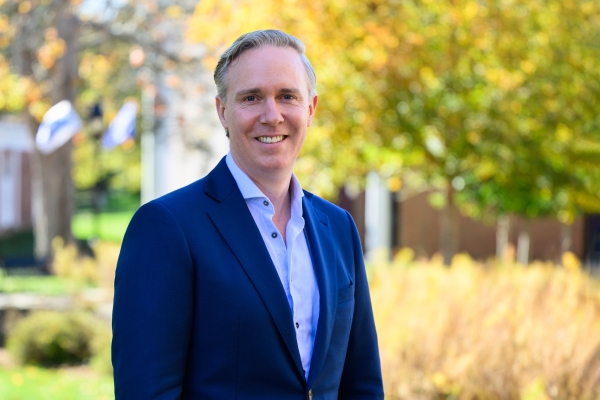 Tom McClain, assistant professor of physics
Tom McClain, assistant professor of physics at Washington and Lee University, will present on the 2025 Nobel Prize in physics awarded to John Clarke, Michel H. Devoret and John M. Martinis for their precise work on macroscopic quantum mechanical tunnelling and energy quantization in an electric circuit.
McClain’s talk will be held from 11:45 a.m. to 12:45 p.m. Thursday, Oct. 30, in room 128 of the Harte Center for Teaching and Learning, located in Leyburn Library. The event is free and open to the public. Snacks and refreshments will be provided.
The three physicists collaborated on their research in the mid-1980s at the University of California, Berkeley, where Clarke was a member of the faculty. Devoret served as a postdoctoral researcher and Martinis was a graduate student working on his Ph.D. Together, they performed groundbreaking experiments demonstrating that quantum mechanical effects can occur on a macroscopic scale. Their experiments involved superconducting electronic circuits separated by thin non-conductive layers that created a system of charged particles that behaved as a single macroscopic particle.
The group demonstrated two key quantum phenomena: the system’s ability to escape from a zero-voltage state through quantum tunnelling and its quantized energy behavior where it only absorbed or emitted specific amounts of energy. This work proved that quantum mechanical properties, which are normally only observed at microscopic scales, could be made concrete and observable in larger systems. Their research opened doors for developing next-generation quantum technologies including quantum cryptography, quantum computers and quantum sensors.
“While much was already known about the kinds of macroscopic quantum effects investigated by the prize winners, their extraordinary experimental acumen allowed all the electrical characteristics of their circuit to be measured classically prior to their probing the circuit’s quantum behavior,” said McClain. “This, in turn, meant that their findings directly confirmed our theoretical models of macroscopic quantum properties, without any wiggle room from undetermined experimental parameters.”
Clarke was born in 1942 in Cambridge, United Kingdom, and attended Cambridge University, where he earned a bachelor’s degree in physics in 1964 and a Ph.D. in physics in 1968. He completed a postdoctoral fellowship at UC Berkeley and joined the faculty there in 1969. He retired in 2010 and serves as a professor of physics emeritus at the school.
Devoret was born in Paris in 1953, graduating from École Nationale Supérieure des Telecommunications in 1975. He earned a Ph.D. in condensed matter physics from the University of Paris in 1982 and then spent two years as a researcher with Clarke at UC Berkeley. Devoret is the Frederick W. Beinecke Emeritus Professor of Applied Physics at Yale University, and he currently serves as professor of physics at the University of California, Santa Barbara.
Martinis was born in 1958 and raised in San Pedro, California. He earned a bachelor’s degree and Ph.D. in physics from UC Berkeley, studying under Clarke. He forged a career in electromagnetic technology and quantum computing, working with Google Quantum AI and later co-founding the quantum computing company Qolab, where he serves as Chief Technology Officer. He is also currently a professor of physics at UC Santa Barbara.
Learn more about all of the 2025 Nobel Prize winners.

You must be logged in to post a comment.