Where Creativity Meets Commerce: W&L’s New Arts Management Minor Collaboration between the business administration and theatre, dance and film studies departments has created pathways for students to blend creative interests with professional skills.
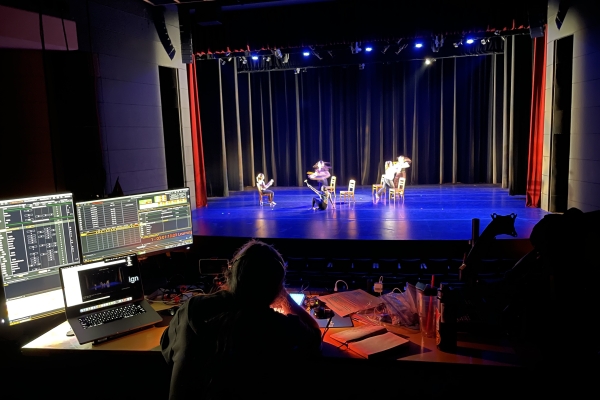
For years, Washington and Lee students passionate about the arts have faced a familiar dilemma: how to pursue their creative interests while building a stable career foundation. Some cobbled together their own solutions, double majoring in theater and business administration or minoring in dance while majoring in economics. Others reluctantly set aside artistic pursuits to focus on what seemed like more practical paths.
This year, W&L is addressing this dilemma head-on with the launch of its arts management minor, which offers students a structured way to blend artistic passions with business acumen.
“I think there’s a real push and pull between their love of the arts and their concern about having a stable career,” said Jenny Davies, professor of dance and theater and chair of the Theater, Dance and Film Studies Department. “This minor allows for the best of both worlds.”
The new minor, which officially launched this academic year, represents an ambitious collaboration between Davies and Amanda Bower, the Charles C. Holbrook ’72 Professor of Business Administration and chair of the Business Administration Department. Together, they have created one of W&L’s most truly interdisciplinary programs, drawing courses from business, the arts, sociology, anthropology and philosophy to prepare students for careers at the intersection of creativity and commerce.
The partnership between Davies and Bower began more than a decade ago. Davies, who came to the university with experience as executive artistic director for a dance company and school, recognized early on that many students needed skills that bridged both worlds.
“A couple of years after I came to W&L, I met with Amanda and said, ‘What do you think about an arts management degree?’” recalled Davies. “But the timing wasn’t right then because both departments were growing and changing.”
The idea resurfaced about a year-and-a-half ago when Davies mentioned it during conversations with then-Dean of the College Chawne Kimber. Kimber was immediately supportive, as was Associate Dean of Strategic Initiatives and Thomas H. Broadus Professor of English Genelle Gertz, who spent years working to strengthen the arts and humanities at W&L.
“The arts management minor was shaped out of the conversations that Jenny and I had about the need to provide students with knowledge about their own transferable skills, as well as the need to give them better tools for building a career out of the arts,” said Gertz.
Gertz noted that focus groups comprised of W&L students and findings from national organizations have identified this as a focal point because the names of majors in the arts and humanities don’t always fit a specific job title. Communicating to the students about the value of what they study will lead to meaningful work.
“Jenny was one of the faculty members who understood this immediately, and she took the initiative to build this new minor,” said Gertz. “I am so proud of how quickly, but also deliberately, Jenny and Amanda planned and built this program of study. They devised it from internal review of what courses we could realistically offer in business and the arts, along with alumni recommendations and careful evaluation of peer and vanguard programs in arts management. The result is a path of study that provides a set of essential skills in production, management, financial analysis, aesthetic understanding and design that sets a student up for success in several professional areas, including, and especially in, the arts.”
With the support of the university administration, Davies and Bower dove headfirst into the process of creating the minor.
“Balancing administrative systems and creative processes is fundamentally interdisciplinary in nature. We’re talking about seemingly disparate ideas like economic stability and artistic integrity,” said Davies. “However, when the walls of isolated departments are broken down, the disciplines interact and inform one another.”
The collaboration between departments exemplifies W&L’s commitment to educating the whole student and breaking down barriers to a broad-based educational approach.
“We have a strong belief in a sort of Venn diagram approach to education, not a silo approach to education,” Bower said. “We tend to think about where we can contribute, where are the things that we can support or augment somebody else’s education? By the same token, we need to think about how a business major’s education can be strengthened by courses from outside the department.”
This approach led to the creation of a minor that requires seven classes, totaling at least 21 credits. Students select courses from seven distinct categories, each designed to build specific competencies. Introduction to Accounting provides the financial literacy essential for any arts organization. A signature course, Arts Management, serves as an introduction to the field and will be taught collaboratively by faculty from both departments. Courses like Management and Organizational Behavior prepare students to lead teams and organizations, while strategy courses offer options in entrepreneurship, marketing management, integrated marketing communications, social entrepreneurship or niche marketing.

The legal and ethical issues requirement offers particularly diverse options, ranging from business ethics and intellectual property to courses exploring collective memory and producing culture from the margins. In the arts practice category, students engage directly with the arts through courses in dance, theater, film, visual arts or music. The final requirement, an arts practicum, offers hands-on experience through internships, independent studies or courses like stage directing or museum studies.
“The arts practicum can be a class, an independent study or an internship,” said Davies. “Amanda and I both are really interested in looking at the internship part of this — how it could be expanded to create relationships with alumni who might be interested in hosting students within their companies.”
Students completing the arts management minor are not permitted to major in business administration due to significant course overlap, but the restriction opens possibilities for exploring other majors while gaining essential business skills.
“The creation of this minor gives students the opportunity to branch out in other directions for their major, which is great, because our students have so many varied interests,” said Davies.
The arts management program is ideal for students who love the arts but have chosen other majors such as English, history, sociology or the sciences and want to build skills for arts-related careers. It’s also perfect for students who are passionate about the arts but hesitant about performing.
“Some of our students shy away from the arts if they feel like they have to perform,” said Davies. “I think they automatically assume they will have to get up on the stage and dance or sing, and that can be scary.”
The minor offers plenty of non-performance options including dance history, art history, music theory, writing for stage and screen, narrative filmmaking and studio art courses such as light studies and optical culture.
Furthermore, the minor’s career possibilities span an impressive range. Graduates could become executive directors of ballet companies or opera houses, museum directors or gallery managers, event planners or talent agents. They could work in education program direction, marketing or development or become community arts advocates or cultural policy analysts. The entertainment industry offers still more opportunities in movie and television production, and there’s also the opportunity to jump into the streaming industry, the gaming sector or theme parks. All of these professions need individuals who understand both creative processes and business operations.
“This minor also equips you to create a nonprofit or for-profit company, if you desire,” Davies said. “That kind of entrepreneurial spirit, that passion, there is a stability in that. In terms of a career, you have all the tools that you need. The security of your future is within your own hands.”
Bower also emphasized the flexibility the minor provides.
“They take the education and figure out what they want to go do,” she said, noting that students might work in theaters, pursue intellectual property law, enter advertising or take positions at entertainment companies such as Disney.
The demand for the arts management programming is already evident among W&L students. Daniel Reiter ’26 worked with Davies, the Dean’s Office and Andi Coulter, assistant professor of business administration, to design his own arts management major last year, which was approved by the Committee on Courses and Degrees.
“I created my own major because I wanted to study the arts, not just as performance, but as a craft supported by business, law and policy,” Reiter said. “During my first year at W&L, a Yale Law admissions representative pointed out that I was fortunate to be at a school where I could design my own major. Instead of choosing between all my different interests, I was able to bring them together.”
Fred LaRiviere, associate dean of the college, sees the arts management minor as part of a larger trend at W&L toward interdisciplinary studies that prepare students for complex, multifaceted careers.
“I see the arts management minor as another way to show students in the arts and the humanities that the skills that they’re learning in those areas can be marketed in ways that can lead to really interesting job prospects,” he said.
Reiter has used his arts management experience to secure internship experiences with Americans for the Arts in Washington, D.C. and Warner Bros. Discovery in New York City.
“I have seen firsthand how business strategy, advocacy and creativity intersect in arts and entertainment,” said Reiter. “I am thrilled that W&L students can now minor in arts management, where they can bring together their artistic passions with the skills that help the arts thrive as they prepare for careers in the arts, entertainment and beyond.”
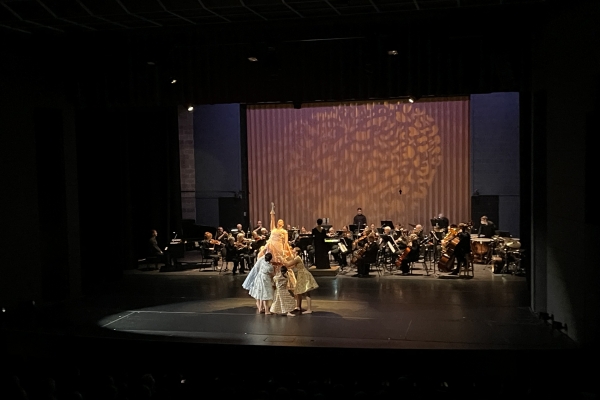
The gateway to the new minor is a namesake arts management course which will be offered for the first time in Winter Term 2026. The course will have two sections, one taught through the Business Administration Department and a second taught through the Theater, Dance and Film Department. Students majoring in the arts can take either section. Business Administration students may take the class, but must take the section taught through Theater, Dance and Film.
Bower and Davies hope the minor will benefit both the Williams School and the College. Business classes, which have seen high enrollment, may see students distributed more evenly across course offerings. Meanwhile, arts courses could see increased enrollment from students who now see a clear career path that incorporates their creative interests.
An emphasis on the interdisciplinary approach has also led to the hiring of new faculty members who can instruct and facilitate this type of collaborative educational approach. For instance, Soo Yon Ryu, a first-year assistant professor of business administration, holds a Master of Arts degree in art management in addition to a Ph.D. in marketing. She will teach the business administration version of the arts management gateway course along with Coulter, whose scholarship includes a focus on the music industry and social sustainability in art.
“We have seen the explosive growth in the data science minor and this interdisciplinary approach to education,” said Bower. “This minor underscores our hope to support the varied studies and meet the needs of our student population.”
One thing is clear, for students seeking to marry their passion for the arts with the business acumen to continue cultivating it, a path now exists to guide them on their journey.
“Our students are committed to the liberal arts, but they are also savvy,” Davies said. “Their careers are at the front of their minds. I think that the arts management minor provides some amount of confidence knowing that they’re armed with certain things that will enable them to have a career and make their mark. I also love the idea of empowering students so that they go out into the world to develop, protect and defend the arts in our society and our world — that they’re contributing in that way.”
If you know any W&L students who would be great profile subjects, tell us about them! Nominate them for a web profile.
Arts Management Minor
• Collaboration between the Theater, Dance and Film Studies and Business Administration departments
• Officially launched for the 2025-26 academic year
• Requires seven classes and 21 total credits
• Signature arts management course will be offered through both Theater, Dance and Film Studies (THTR 254) and Business Administration (BUS 354) departments. Business administration students taking the class (but not minoring in arts management) must take THTR 254.
• Students may not use more than nine credits that are also used to meet the requirements of another major or minor.
• Business administration majors may not minor in arts management

You must be logged in to post a comment.