February 11, 2026
Winter 2026 Update on Campus Construction Projects
With the initial phase (Phase 1a) of its campus utility infrastructure project now complete, Washington and Lee University is preparing to move forward with the next stage of its low-temperature hot water (LTHW) transition. The next phase of the project was approved by the Board of Trustees at its May meeting and is anticipated to begin in mid-June 2026 and to be completed in summer 2027.
These necessary updates to the campus utility infrastructure support the university’s Campus Master Plan and will help achieve the sustainability goals of its Climate Action Plan. The comprehensive plans set the framework for transforming W&L’s campus into a carbon-neutral environment by 2050. One of the most significant steps toward achieving this goal involves the replacement of the campus’s current natural gas heating infrastructure. Despite consistent upgrades over the years as W&L transitioned from coal to heating fuel to natural gas, several key pieces of the current infrastructure pre-date World War II and must be replaced. A majority of the ongoing infrastructure project involves a conversion to low-temperature hot water as the primary heating resource for the university.
What Phase 1b involves
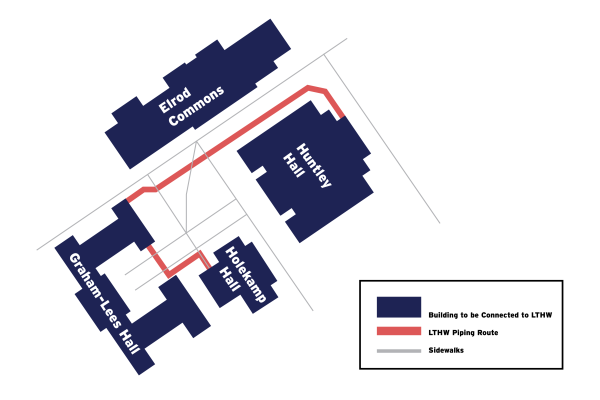
Phase 1b will extend the LTHW piping network through central areas of front campus in three connected segments: from the northeast corner of Graham-Lees Residence Hall along the sidewalk between Elrod Commons and Huntley Hall to the northeast corner of Huntley Hall; along the walkway connecting the main entrance of Elrod Commons to the front entrance of Huntley Hall; and from the east side of Graham-Lees across the adjacent sidewalk and portions of the courtyard to the side entrance of Holekamp Hall, where it will connect to the existing infrastructure.
Upon completion, the piping systems installed during Phase 1b will be tied into the heat recovery chiller currently in operation at the new Williams School building.
What to expect on campus
When the work is occurring, temporary fencing will be erected at each work zone as construction moves through three separate segments. Areas to be fenced will include the northeast corner of Graham-Lees, the courtyard behind Graham-Lees, and the north and west sections of Huntley Hall, as well as the area directly in front of Huntley Hall.
Fencing will only be placed in areas where construction is actively underway and will not be erected in zones where work has not yet begun or has been completed.
Signage will direct pedestrians to appropriate routes throughout each phase. While the construction will not restrict access to Graham-Lees Residence Hall, Elrod Commons, Holekamp Hall or Huntley Hall, alternate paths through those areas will be necessary when work is actively taking place nearby.
Construction equipment and vehicles will periodically use the sidewalks in front of Graham-Lees and along the west side of the building, between the residence hall and Cannan Green and Elrod Commons. These blockages will be brief, lasting no longer than 30 minutes, and construction personnel will be on hand to maintain a safe environment during those times. The work is not expected to affect vehicular traffic along Washington Street or Lee Avenue.
The construction will also have noise impacts in the areas surrounding Graham-Lees Residence Hall, Elrod Commons, Holekamp Hall and Huntley Hall. Campus community members should expect typical construction noise between the hours of 8:30 a.m. and 4:30 p.m. The work and resulting noise is not expected to occur outside of normal business hours or weekends.
Brief hot water interruptions planned
Community members in several buildings should also expect occasional, brief shutdowns of domestic hot water service. These shutdowns will affect Gaines Residence Hall, the Duchossois Center for Athletics and Recreation, Elrod Commons and Graham-Lees Residence Hall. These shutdowns are necessary to connect LTHW systems in those buildings that will serve to preheat domestic water and reduce the university’s reliance on natural gas.
Advance notice will be provided to the university community before each planned shutdown.
Looking ahead to Phase 2
Planning for Phase 2 of the LTHW infrastructure project is already well underway and has advanced through design development and early budget planning. A proposal will be presented to the Board of Trustees in February 2027, and, if approved, work could begin on Phase 2 shortly after Phase 1b is completed in summer 2027.
Phase 2 will extend the LTHW network to the area below the Cohen Family Amphitheater, through the outdoor classroom area and across Woods Creek, and will include work along Generals Lane and the vehicle bridge over Woods Creek. A new heat recovery chiller will be installed at the university’s central plant, located in the vicinity of the School of Law, connecting all of the work completed in Phase 1a and Phase 1b into a unified LTHW infrastructure. Phase 2 will also incorporate the planned Founders Hall project into the system.
When Phase 2 is complete, the university anticipates a 36% reduction in its total carbon footprint. At that point, any remaining campus infrastructure deemed in poor condition will be evaluated for replacement and integration into the new LTHW system.
For more information about this and other ongoing capital projects, please visit University Facilities’ capital project updates page.

You must be logged in to post a comment.