June 9, 2026
Chris Seaman Quoted by Chalkbeat
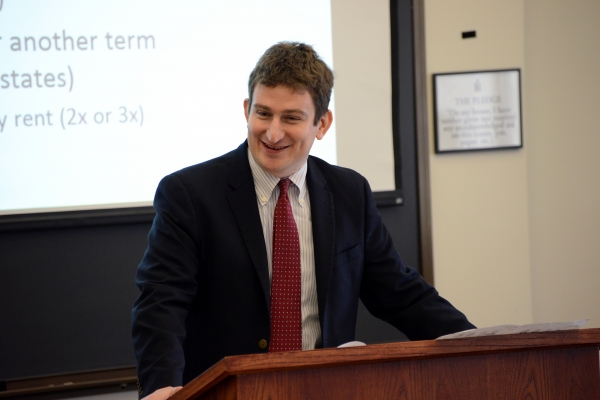 Professor Chris Seaman
Chris Seaman, the Robert E.R. Huntley Professor of Law at Washington and Lee University School of Law, has published a new empirical study examining more than four decades of litigation under Section 2 of the Voting Rights Act. The article, “Voting Rights and Private Rights of Action: An Empirical Study of Litigation Under Section 2 of the Voting Rights Act, 1982–2024,” appears in the Florida State University Law Review.
Section 2 of the Voting Rights Act prohibits voting practices and procedures that discriminate on the basis of race, color, or membership in certain language minority groups. The provision plays a central role in legal challenges to electoral maps and voting systems that plaintiffs argue dilute the voting strength of minority communities.
In the article, Seaman examines over 1500 challenges of Section 2 brought in federal court between 1982 and 2024. He found that over 90% of these challenges were brought by private plaintiffs rather than the Department of Justice. Moreover, private plaintiffs were highly successful in these challenges, winning nearly two-thirds of the time.
The findings have important implications for a developing legal dispute over whether private individuals and organizations can bring lawsuits to enforce Section 2. The U.S. Court of Appeals for the Eighth Circuit has held that private plaintiffs lack an implied right of action under the provision, raising questions about the future enforcement of the law. Seaman argues that eliminating private enforcement would significantly undermine the Voting Rights Act because the federal government lacks the resources and political independence necessary to replace the substantial role private litigants have historically played.
A prepublication version of Seaman’s research was cited in briefs filed by the petitioners and two amici curiae in Turtle Mountain Band of Chippewa Indians v. Howe, a voting rights case involving Native American voters in North Dakota. The U.S. Supreme Court subsequently granted the petition for certiorari, vacated the lower court’s judgment, and remanded the case for further consideration in light of its decision in Louisiana v. Callais. The case has returned to the federal district court.
The full article is available online through W&L Scholarly Commons.
If you know a W&L faculty member who has done great, accolade-worthy things, tell us about them! Nominate them for an accolade.

You must be logged in to post a comment.