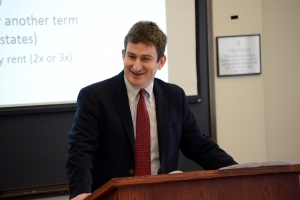
Paper by Chris Seaman Selected for 2026 Conference on Empirical Legal Studies The empirical study examines how separating issues in patent trials can affect juror decision-making.
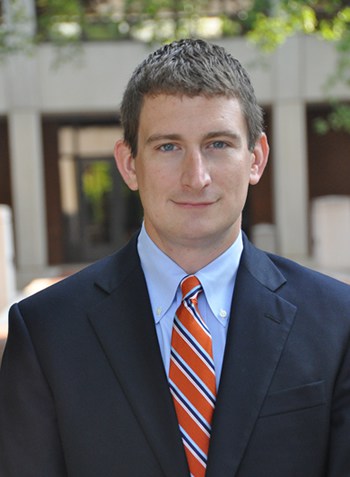 Professor Chris Seaman
Washington and Lee University School of Law professor Chris Seaman and co-authors Jason Reinecke of the University of Wisconsin Law School and David L. Schwartz of Northwestern Pritzker School of Law have had their paper, “Bifurcation: An Experiment from Patent Law,” selected for presentation at the 2026 Conference on Empirical Legal Studies (CELS).
The conference will be held Oct. 2–3 at Northwestern Pritzker School of Law. Selection for this year’s conference was extremely competitive as organizers received roughly 400 submissions.
The paper uses an experimental study of more than 2,000 participants to examine bifurcation, the practice of separating different legal issues into distinct phases of a trial. The authors focus on patent litigation, where courts sometimes separate the question of whether infringement was willful from other issues because evidence suggesting intentional misconduct could influence how jurors evaluate otherwise unrelated questions.
In the experiment, participants considered a hypothetical patent dispute involving two principal questions: whether a patent was invalid because the invention was obvious and whether infringement was willful. Participants were randomly assigned to different trial structures, including one in which the issues were considered together and another in which they were considered separately.
The researchers found that trial structure significantly affected verdicts. Participants in the bifurcated trial found the patent obvious at a higher rate than those who considered the issues together. Bifurcation also produced a higher rate of willful-infringement findings. Analysis of the participants’ written explanations found evidence that information relevant to one issue influenced their reasoning about the other.
The authors conclude that the findings complicate the conventional understanding of bifurcation as simply a way to shield jurors from prejudicial information. Instead, separating issues may change the broader narrative jurors construct about a case and influence their decisions in multiple directions. Although the study focuses on patent litigation, the authors argue that its implications may extend to other civil cases involving financial harm and to broader questions about how trial structure affects jury decision-making.
If you know a W&L faculty member who has done great, accolade-worthy things, tell us about them! Nominate them for an accolade.


You must be logged in to post a comment.