
Drumbl and Fyfe Explore Land, Memory, and Justice in Namibia In an essay published in the Leiden Journal of International Law, the W&L Law professors draw on a visit to a historic cemetery to examine the legacy of colonial genocide and the possibilities for reconciliation.
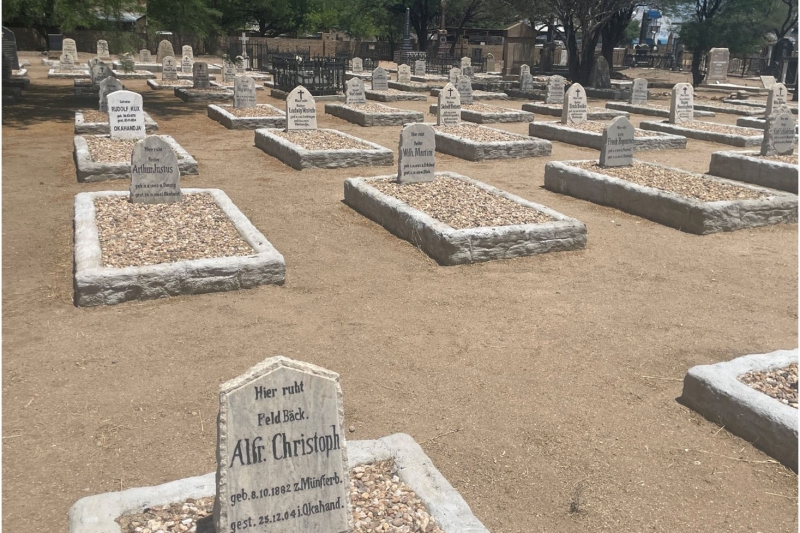 German Soldier Graves, German Military Cemetery, Okahandja, October 2025
A historic cemetery in Namibia, where German soldiers who fought against the Herero and Nama peoples are buried alongside more recent generations of local residents, provides the setting for a new essay by Washington and Lee University School of Law professors Mark Drumbl and Shannon Fyfe. Drawing on their October 2025 visit, the professors explore historical injustice, reconciliation, and the continuing struggle over land ownership in Namibia.
Their essay, “Land, Genocide, and Kintsugi in Namibia,” appears in the Leiden Journal of International Law as part of its “Visual Legal Sightseeing” series, which explores legal issues through images and observations of particular places.
 Professor Mark Drumbl
The essay examines the legacy of German colonial rule in Namibia, which began in 1884. Following an uprising by the Herero people in 1904, German military forces carried out a campaign of extermination against the Herero and Nama populations. The genocide claimed tens of thousands of lives and left lasting consequences for the country’s Indigenous communities.
In the town of Okahandja, Drumbl and Fyfe encountered a striking contrast: German soldiers and later generations of Namibians share a burial ground, while the graves of prominent Herero chiefs nearby remain separated behind locked gates. The authors acknowledge that such proximity may evoke different responses, including resentment over the cemetery’s continued identification with the German military.
The essay then moves beyond historical memory to consider contemporary questions of land ownership and reparations. Drumbl and Fyfe contrast the shared ground of the cemetery with the concentration of agricultural land ownership among descendants of German settlers, arguing that meaningful reconciliation must address the material consequences of colonial dispossession.
“Questions of land ownership and justice in Namibia remain raw and unresolved despite the years that have passed since the genocide,” they write.
 Professor Shannon Fyfe
The published essay is part of a broader, ongoing project examining the legacy of colonialism in Namibia. A longer account of the authors’ research and travels, published on the Legal Sightseeing blog, also explores colonial-era street names, public memorials, and debates over reparations. In September 2026, Drumbl and Fyfe presented their work at a research colloquium organized in part by the University of Basel’s Center for African Studies in Switzerland. The professors plan to continue expanding the project in 2027.
The essay, which includes photographs taken by the authors during their visit, is available online through the W&L Law Scholarly Commons.
If you know a W&L faculty member who has done great, accolade-worthy things, tell us about them! Nominate them for an accolade.

You must be logged in to post a comment.