March 27, 2026
Experience Spotlight: Lucie Cao ’26L
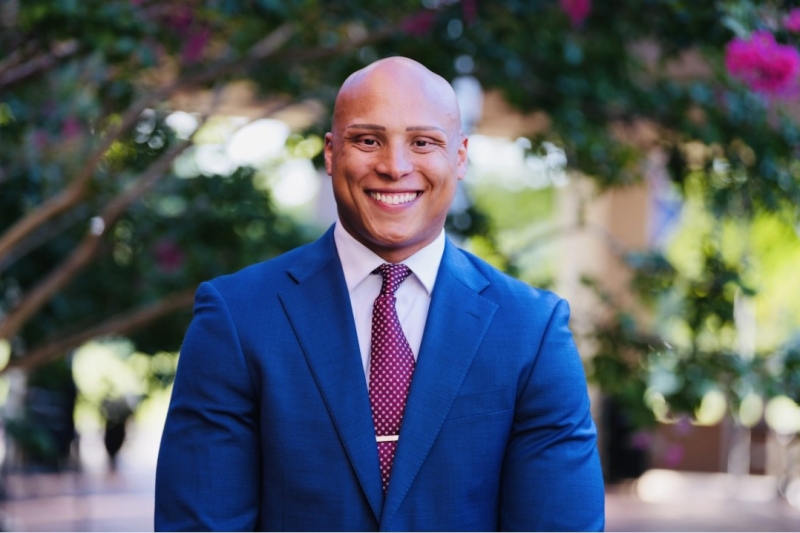 Jeremy Thompson ’26L
Jeremy Thompson is a member of the Class of 2026 at Washington and Lee University School of Law. A native of West Virginia, he graduated from High Point University in 2020 with a degree in criminal justice and business administration. Prior to beginning law school, Jeremy worked for three years with a federal agency in Washington, D.C., where he gained valuable experience in public service and federal operations.
During his second year at W&L Law, Jeremy was named the 2025 Mock Trial Competition Champion. He also is deeply engaged in the law school community, serving as a Law Ambassador, Chair of the Academic Committee for the Black Law Students Association, Research Assistant, and Co-Chair of the 2026 Mock Trial Competition. He also works as a student clinician in the Civil Rights and Racial Justice Clinic, where he contributes to community-focused legal work.
Outside of his academic and professional commitments, Jeremy enjoys watching sports, playing chess, and maintaining an active lifestyle.
Why did you choose to participate in this Civil Rights and Racial Justice Clinic for your 3L year?
I chose this clinic for two main reasons. First, I wanted to learn from one of the most successful professors in their field of expertise. Professor Sweet has a lengthy and accomplished resume. He has the understanding and patience to find a student’s skillset and develop them. He has a bottomless drive for the legal profession, but it is cloaked in respect and kindness for others. I value learning from a professor and legal professional that is regarded so highly for both his personal kindness and professional success.
Secondly, I chose this clinic because the goal of the clinic, in its simplest form, is to ensure a community where everyone is respected and treated fairly. I support equality. The role of a civil rights lawyer, and even a civil rights clinician, has many ups and downs. It is never a smooth ride, but it certainly is a rewarding one. This clinic enables you to speak for those without a voice. This clinic cultivates opportunities to give back to the community that has surrounded me in my three years here in Lexington, Virginia. I wanted to be a part of something bigger than myself. Frankly, I wanted to be a catalyst for change in someone’s life, and this clinic primes you to achieve that desire.
What classes have prepared you to work in the Clinic?
I would argue, in true lawyer’s fashion, that every class I have taken has played some role in my success with the clinic. There is pedagogical value in each class here at W&L Law. However, the most vital classes could be distilled down to three: Legal Writing, Virginia Civil Procedure, and Torts. First, Legal Writing in your first year of law school does two things. It exposes your poor writing, even though you thought it was great, and it equips you with another tool in civil litigation. Legal Writing is crucial for the entire legal field, but particularly for civil rights cases. The way one articulates and represents through writing could be the difference in winning and losing a case for someone. Next, Virginia Civil Procedure was an instrumental class in preparing me for clinic work. In the clinic, we dealt with clients within the Commonwealth of Virginia, so having this foundation of Virginia Civil Procedure allowed me to be confident in the procedural technicalities and focus more on the legal substance of my work. Lastly, Torts in my first year helped prepare me for the clinical work. Civil Rights cases can take many forms, as did our cases this semester. However, even if a case is brought under a civil rights statute, the underlying conduct could still be evaluated under tort principles. So, having a good grasp of torts, its limits, and the legal requirements, shaped me into being a better clinician for my colleagues and our clients.
Describe your schedule with the Clinic.
The schedule with the clinic tends to mimic a law firm setting. The clinic had hard deadlines for tasks that were to be consistent throughout the semester. Many of those tasks were logistical and housekeeping matters to ensure transparency and collaboration with everyone in the clinic. Moreover, the rest of the assignments and clinical work were dependent on a variety of factors, such as client availability, receiving a new case, and court schedules. I found this mix of predicted and unpredicted scheduling to be helpful because there was structure and organization with your schedule, but you still had to be flexible if something unexpected arose, much like a firm in the real world.
What are some skills you have developed this year?
The clinic provided an opportunity to write legal memorandums, engage in mock trial strategies and presentations, conduct actual client interviews, and perform legal research. The clinic truly provides a holistic learning experience, through actual court experience, trial simulations, and firm management techniques. I have developed skills in all those areas due to the work with the Civil Rights and Racial Justice clinic. I have even developed skills in office management, as that is a crucial part to the functionality of the clinic.
What surprised you about the work you have done for the Clinic?
One thing that surprised me was the sheer complexity and difficulty of proving civil rights cases. There are laws, statutes, and procedures in place to help preserve and protect individuals from civil rights violations. However, satisfying the legal standard to adequately prove these cases seems to be more challenging than other suits that could be brought within the court system.
What was your favorite aspect of your work with the Clinic?
My favorite aspect of clinical work was learning about new areas of law that I had yet been exposed to. For example, the clinic handles anything in the realm of civil rights and racial justice, but the clinic has an intentional focus on housing discrimination. Prior to the clinic, I had not been exposed to much litigation or law surrounding housing laws and its intersectionality with civil rights. It was fascinating to learn these new areas and see how they overlap, or even diverge, from one another and the areas of law that I am familiar with.
What was your biggest challenge working in the Clinic?
By far, my biggest challenge was assessing cases that potential clients brought to the clinic. An individual calls the clinic or comes in person and they have this troubling, and often sad experience, that happened to them. It is the clinician’s job to assess the case and determine if there is a plausible legal claim that can be pursued. Many times, as unfortunate as the situation may be, there was no legal claim or remedy. So, you enter this clinic wanting to help those in need, but sometimes you must have a tough conversation on how you cannot help. As much as we want to help everyone, we still have professional responsibilities to uphold within the profession, and we must ensure we are bringing claims that are justified by law and in fact. These conversations are tough to have, but they build character and molded better judgment in determining cases that should be accepted as opposed to claims that should not.
Has this experience helped you figure out your post graduate plans, and if so how?
I would not say that this experience alone has aided in me figuring out my post-graduate plans. Before joining the clinic, I was blessed to receive an offer to join a great firm with even better people, which I happily accepted. However, what this experience has done was help me develop tools, tactics, and strategies that I can take with me to the firm after law school. Many of the skills that you learn and enhance during the clinic are transferrable and can be applied in settings far beyond the reaches of civil rights and racial justice. So, I plan to lean into my training, experiences, and successes that this clinic has furnished to help me become the best first-year associate I can be after graduation.
Favorite Spot in Lexington
My favorite spot in Lexington is TAPS. TAPS has a great ambience, a beautiful fireplace, and wonderful food. It is a spot where you can have a formal dinner or it can also serve as a location to simply catch up with friends.
Best Law School Class So Far
My favorite law school class was Evidence. I loved the class and learned about the intricacies of admissible evidence, scopes of witnesses, and the dreaded exceptions to hearsay. Not only is it extremely practicable when going into litigation, but it was intriguing because many of the rulings involving evidence is the subjective interpretation of the judge.
Wellness Habit
The wellness habit that I try to maintain is a consistent gym routine. It resets my mind, energy, and allows an escape for me for a small portion of each day.


You must be logged in to post a comment.