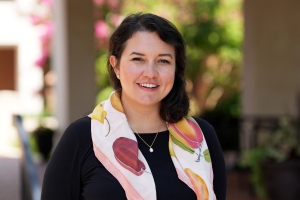
Faculty Profile: Lauren Hughes Lauren Hughes is director of the Immigrant Rights Clinic and researches in the areas of immigration law, asylum and refugee law, and international human rights law.
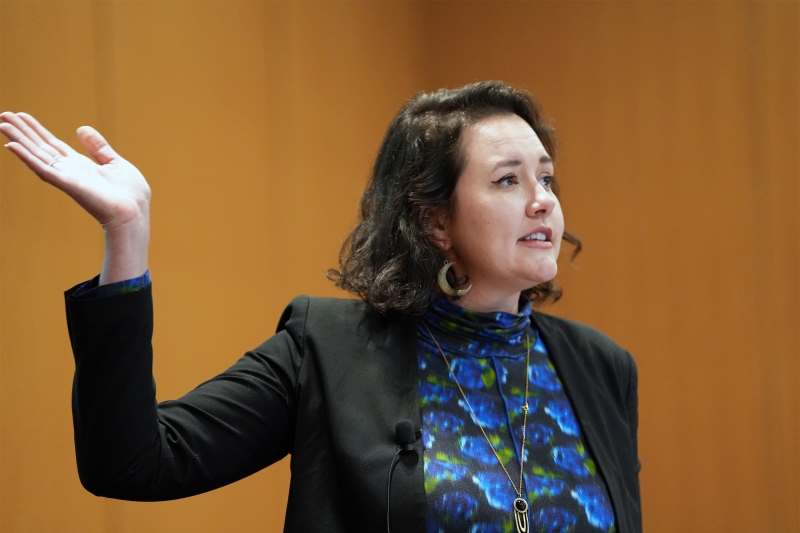 Professor Lauren Hughes presents during the annual Supreme Court Preview.
Lauren Hughes joined W&L Law in 2025 as the director of the Immigrant Rights Clinic. Previously, she was a clinical teaching fellow at the Center for Applied Legal Studies at Georgetown University Law Center and an Immigrant Justice Corps Fellow at the community-based nonprofit Building One Community in Stamford, Connecticut, where she represented clients from a range of countries on their removal cases, asylum applications, and other humanitarian claims.
For Hughes, an interest in immigration law began with a high school Spanish class in Huntsville, Alabama, which she described as her “first peek that the world was bigger than it felt where I lived.” She expanded this interest in college at DePaul University in Chicago, where she studied Latin American political science and minored in Spanish. Chicago’s Spanish-speaking and immigrant communities helped her begin to see how language, politics, and immigration were all connected.
Still, Hughes was not certain that law school would be the next step. She graduated during the aftermath of the recession and decided to spend some time exploring her options. She worked for a year in legal recruiting before pursuing something else she knew she wanted to do: live abroad.
Hughes joined English Opens Doors, a project of the Chilean Ministry of Education and the United Nations Development Program, and spent a year teaching English in a public school in Arica, Chile, near the borders with Peru and Bolivia. The location put questions of migration, national identity, and borders directly in front of her. Many of the students she taught were Peruvian and Bolivian immigrants, while an international dispute between Chile and Bolivia over access to the Pacific Ocean was a regular topic of conversation.
“Living in a different border area was really eye-opening to me to see how these issues are similar and different in other parts of the world,” Hughes said. “Immigration was just constantly a theme that kept coming up.”
Her time in Chile solidified Hughes’s decision to apply to law school, and she ultimately selected Duke Law and its combined J.D./LL.M. program in international and comparative law. The program allowed her to return to Chile to work at a law firm and to study in Geneva. At Duke, she also helped revive a student organization focused on immigration and refugee issues and became deeply involved in the school’s Human Rights Clinic. Hughes worked on projects examining North Carolina’s role in CIA “black sites” and countering violent extremism policies in Europe, experiences that took her to the United Nations in New York as well as Paris and Brussels.
“I just loved my clinic experience, getting to work on real issues, getting to work with international law,” Hughes said. The experience continues to influence her scholarship, where she brings “a human rights lens to the U.S. immigration system and how international law interacts with the U.S. immigration system.”
After law school, Hughes clerked for two years at the U.S. Court of International Trade in New York, where she continued exploring the intersection of domestic and international law. She then joined the Immigrant Justice Corps, a fellowship program that trains and supports new lawyers working in immigration law. She was placed with Building One Community in Stamford, Connecticut, where she practiced removal defense and handled asylum matters, working directly with clients facing the immigration system.
She then joined Georgetown Law’s asylum clinic as a fellow, spending two years learning about pedagogy, student supervision, and clinical teaching while continuing to practice alongside students. Hughes described the experience as a “really great boot camp” for learning to be a clinical teacher in a law school.
That path eventually brought Hughes to W&L Law and Virginia’s Shenandoah Valley. Having previously practiced in the greater New York and Washington, D.C., areas, she encountered many of the same immigration issues here but a very different landscape for legal services. The relative scarcity of immigration lawyers in rural communities was part of what attracted her to W&L.
“There are a few and mighty immigration practitioners in this area, but certainly not enough to fill the need that’s out there,” Hughes said.
That challenge has helped shape Hughes’s vision for the Immigrant Rights Clinic. She wants students to provide high-quality individual representation while also thinking creatively about how the resources of a university can expand access to legal information.
“I never want to compromise quality of representation just to get as many folks served,” Hughes said. “But I think it’s pushed me to get more creative and explore how we can leverage the resources of a big university to get information out to people so they can help themselves, even if they aren’t able to hire a lawyer or work with a lawyer on their immigration case.”
Hughes’s scholarship is developing alongside that clinical work. Her most recent article, “Comparative Visions of a Group Based Asylum System,” published in the Columbia Human Rights Law Review, considers possibilities for future changes in law and policy affecting asylum seekers. Her current work responds to a rapidly changing immigration landscape from a different direction, including mass deportations and third-country removals. During the annual Supreme Court Preview event, she addressed mandatory detention policies and related litigation.
Hughes’s scholarship remains closely connected to the part of the job that originally drew her to clinical teaching: working with students. Hughes said she has been impressed not only by the practical skills students bring to the clinic but by their commitment to its clients.
“In a way, that’s not something I can teach,” she said. “Having students who truly care really gives me energy for the work.”
If you know any W&L faculty who would be great profile subjects, tell us about them! Nominate them for a web profile.

You must be logged in to post a comment.