March 31, 2026
Meet John Reynolds ’26L
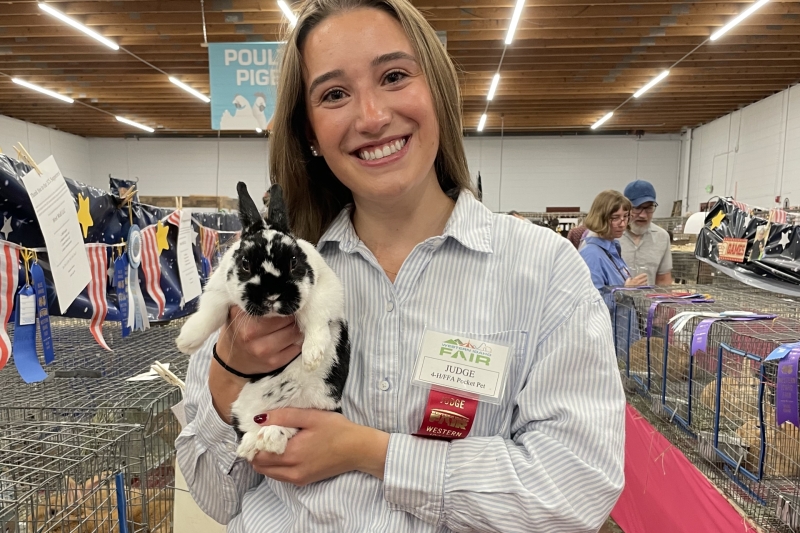 Catalina Clouthier ’28L judging a “pocket pet” competition for 4-H back home in Idaho.
Catalina Clouthier ’28L was just 11 years old when a pair of pet rats set her on an unexpected career path. Her mother agreed to let her keep the animals on one condition: she had to participate in 4-H, a youth development program that introduces young people to agriculture, animal care, and other practical skills.
Clouthier, who grew up in Boise, Idaho, had no family background in farming. But through 4-H, she discovered an agricultural community that welcomed her enthusiasm, taught her about raising livestock, and introduced her to the challenges facing farmers and ranchers. By age 14, she had decided she wanted to become an agricultural attorney.
That early interest took her to the University of Arkansas to study agricultural business, followed by internships with the U.S. Senate Agriculture Committee and the American Farm Bureau Federation in Washington, D.C., experiences that introduced her to the region and W&L Law. Now a second-year student, Clouthier is pursuing her longtime ambition through her work as a research fellow with the National Agricultural Law Center. At W&L, she serves as treasurer of the Environmental Law Society, is a member of the Journal of Civil Rights and Social Justice, and recently helped establish a collegiate women’s rugby team with a fellow law student.
How did raising animals through 4-H lead to an interest in agricultural law?
When I was 11, I got pet rats, and my mom said the stipulation was I had to do 4-H with them. I had never really heard of 4-H, and I loved it. I wanted to put a steer in the backyard, and my parents said no. So, I asked for 30 rabbits instead, and they acquiesced to that.
I raised show rabbits and meat rabbits throughout high school and worked on a multitude of farms through 4-H. I was able to meet people who were real-life farmers, which was really cool to me. The agricultural community really came together to educate me on a way of life I had no idea about, and that I now hold very near and dear to my heart.
In the West, you have water issues, wildfires, and a lot of natural resource debates between development and areas that used to be primarily agricultural. Finding the happy area between those regulations can be very difficult. When I was about 14, I decided that’s what I wanted to do for the rest of my life. I wanted to be an agricultural attorney.
What kind of work are you doing with the National Agricultural Law Center?
The Center’s mission is to be the nation’s leading source of agricultural and food law research and information. A lot of the regulations farmers deal with every day, whether that involves pesticides, water, or air, can be convoluted, even for people with a law background. The idea is to make that information available in a way that somebody can pick up their phone for five minutes and get a grasp of what’s happening.
I’ve worked on a variety of projects, including research into wetlands regulations and how different states address pesticide drift onto neighboring properties. It’s really interesting work because the regulations are always changing, and there are so many different issues affecting agriculture and natural resources.
How are your experiences at W&L Law and the National Agricultural Law Center preparing you for your career?
Agricultural law is a very niche topic area, and that was a concern I had before coming to W&L because there isn’t a specific agricultural law program here. But there are opportunities to study related subjects, including oil and gas law and Indian law.
I’m writing a journal note about mining regulations, and Professor Mackie is my advisor. He’s a national security professor, so he helps me look at things through a more analytical lens and think about the intent behind regulations and how they work. It’s been great to have professors who encourage you no matter what you’re interested in.
The National Agricultural Law Center has also been a great opportunity to develop a background in these ever-evolving issues. Next summer, I’ll be working with Williams Mullen in Columbia, South Carolina, as an environmental and natural resources summer associate. I’m excited about that experience and the different issues I’ll get to work on. I’d love to work with regulatory issues involving agriculture and natural resources, including development and its effects on communities.
What is it about agriculture that has kept you so interested?
Farming is a very hard industry to make money in. When you see farmers constantly showing up year after year, day after day, knowing there might not be a profit at the end of the year for something almost entirely out of their control, I think that’s really inspiring.
I didn’t grow up on a farm, but I had all those rabbits. In high school, the rule was that I couldn’t have my phone in the morning until I’d gone outside and taken care of them. In the winter, I’d have to break the ice in their water and feed them before doing anything else.
I remember going outside every morning, feeling that cold Arctic blast, and how quiet it was with the snow. Getting to take care of those animals was a really grounding experience, and something I miss a lot.
I’ve talked with friends about what we’d do if we weren’t pursuing our current careers, and I’ve never had another answer. This is all I’ve ever wanted to do. I’m very passionate about it. It’s what I love.


You must be logged in to post a comment.