September 30, 2026
Meet a Colleague: Melissa Neal
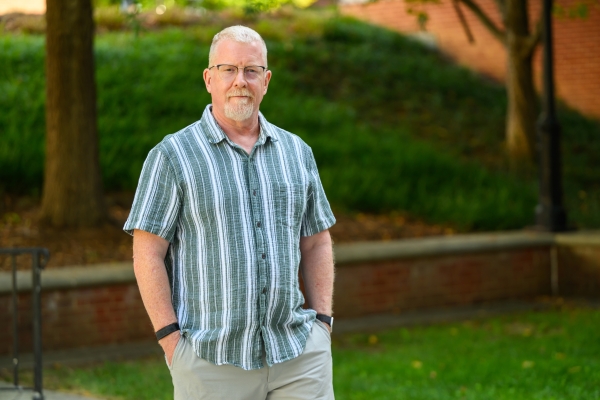 Bob Stewart, professor of cognitive and behavioral science
Q. How long have you worked at W&L?
This year is my 30th year at W&L.
Q. What is your favorite course to teach, and why?
For a few reasons, Psychoactive Drugs and Behavior is my favorite course to teach. The pharmacological content gives me a sneaky way to teach a lot of basic neuroscience, like functional neuroanatomy, how drugs influence the way different neural systems operate, and how those influences manifest as altered perception, thinking and judgement. What’s more important, I think, is that the material allows me to ask students to use scientific fact to evaluate their personal beliefs and values about the issue of drugs, drug users, addiction and the impacts of drugs on the individual and sociopolitical systems. I love how the basic science of the subject provides a framework to guide ethical reasoning across social, political and cultural domains. If I can encourage one student in the class to reconsider their preconceptions and biases about drugs and drug users in light of what they’ve learned about the science, that’s a huge win.
Q. If you chose a different path, what other career would you have?
I was a pretty good drummer and was in a working band throughout high school, so I think 18-year-old Bob Stewart would’ve pursued a career in music. I surmise I’d now be selling used cars for a living, if I’d gone that direction.
Q. Where did you grow up?
I was born and raised in Mendham Borough, which is a small, historic town located in the southeastern New Jersey Highlands.
Q. What three words describe you best?
Loyal, trustworthy and nerdy.
Q. Name one person from history you would like to spend a day with and why.
I’d like to spend a day with E.C. Tolman (1886-1959), who was an important figure in the early history of American psychology. Tolman was an inventive and resourceful scientist, whose research, and the theories that framed it, ran firmly against the grain of the discipline at the time. His empirical and theoretical works were important catalysts for the emergence in the 1950s and 1960s of what we now call cognitive psychology. Beyond his impacts as a scientist, he was a principled leader who publicly and fearlessly stood up against McCarthyism and fought for academic freedom in the lab and classroom. I’d love to spend a day listening to him share the tale of his journey from his upbringing as a Massachusetts Quaker to his career as a pioneer in the science of learning and memory amidst two world wars, an economic depression, and the Red Scare at the dawn of the Nuclear Age and the Cold War. Quite a stretch of history there!
Q. Who is the most famous person you have met and where did you meet them?
When I was in graduate school, I had the privilege of sharing lunch with David Hubel, who, along with his collaborator, Torsten Wiesel, was awarded the 1981 Nobel Prize in Physiology or Medicine for research on the neuroanatomy, neurophysiology and neurobiological development of the visual system. He was humble, gracious and far more interested in discussing my work than his own! His utter lack of ego was inspiring and influenced me powerfully (as did his science!).
Q. What is your biggest pet peeve?
People who drive slowly in the left lane (You can take the boy out of Jersey, but you can’t take the Jersey out of the boy).
Q. What do you like to do away from work?
There’s a lot I love to do away from work! My habibti, Beth, and I love to travel near and far, which we do whenever we can. We also love to hike, see live music of nearly any style, and explore breweries and vineyards around our homes in western Albemarle County. I also love to read, garden, listen to music (classical music and progressive metal, mostly), and cook. Beth has bees, and I’ve discovered I really enjoy maintaining the hives. Finally, I still love to bang on my drums — it’s my favorite way, perhaps counterintuitively, to find solitude and tranquility.
Q. What is your least favorite chore at home?
I’m not a fan of maintaining feline litter boxes. Bottom of the list, for certain.
Q. What is your favorite family holiday tradition?
My home is in a neighborhood with lots of young families and for Halloween, Beth and I get in costume (typically, she’s a witch and I’m Shrek), sit on the front porch and distribute empty calories to the trick-or-treaters. There’s some serious cuteness to be enjoyed!
Q. What is your all-time favorite food or food dish?
I enjoy nearly all cuisines and foods, sea urchin roe excepted. However, I’ve had a few dishes that left really powerful impressions. One that comes to mind as memorable was wild boar ragu with pappardelle in Siena, Italy.
Q. Where would you choose to build your dream home?
Actually, I am in the planning stages to build my dream home on a wooded ridge near Crozet. Nothing too big or too fancy, but exactly the style, configuration and seclusion that I’ve always wanted.
Q. What is your all-time favorite book?
“Atlas Shrugged” by Ayn Rand. Epic even for an epic.
Q. If you could choose one series to binge-watch, what would it be?
“Band of Brothers.” Again.
Q. What is your all-time favorite movie?
“It’s a Wonderful Life.”
Q. What song or artist could you play on repeat?
Barock Project.
Q. Tell us something most people don’t know about you.
I was certified as an apprentice arc welder when I was a junior in high school.


You must be logged in to post a comment.