January 28, 2026
Micah Tongen ’26 Publishes and Presents Research Paper
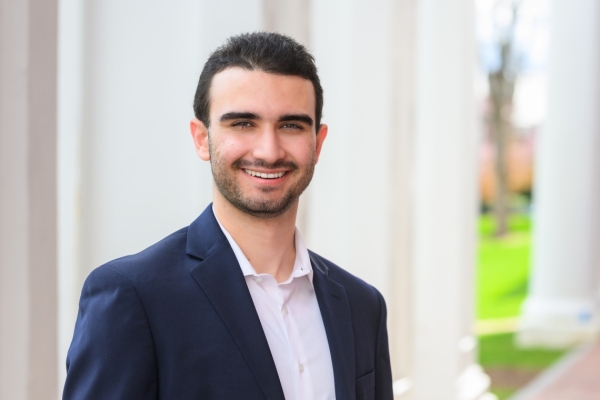
Washington and Lee University student Sarp Sahin ’26 recently published a research article as a co-first author in the peer-reviewed neuroscience journal Brain: A Journal of Neurology.
The paper, titled “Study of blood linear RNA nominates CD55 and DLD as early-stage biomarkers for Parkinson’s Disease,” focuses on finding practical and effective alternatives to developing biomarkers for Parkinson’s diagnosis. The brain tissue is the primary source for studying Parkinson’s disease pathology, but it is scarce, relies on postmortem donation and does not predict disease progression. In contrast, whole blood is easy to obtain, minimally invasive and reflects systemic disease changes. Overall, Sahin’s study shows that a simple blood test could help develop biomarkers for diagnosing Parkinson’s disease before symptoms begin to manifest.
“Publishing our work in Brain is one of my most professionally and personally rewarding achievements,” said Sahin, a chemistry major from Plano, Texas. “Knowing that our work could potentially contribute to earlier and more informed diagnoses through blood-based biomarkers is especially meaningful given how devastating this disease is for patients and their families.”
Sahin’s research process began during a summer internship with NeuroGenomics and Informatics Center (NGI) at Washington University School of Medicine in St. Louis following his first year at W&L. During this internship, Sahin developed a data analysis system to examine RNA sequencing data from postmortem human brain tissue to study changes related to Alzheimer’s disease. Supported by a Johnson Opportunity Grant, Sahin returned to NGI the following summer to concentrate his efforts on Parkinson’s disease, where he conducted the largest combined analysis of blood-based gene expression data in Parkinson’s disease using four independent patient cohorts. Sahin credits the technical preparation and biomolecular insights he gained through courses at W&L as being crucial for his research and writing process.
“Professionally, this research has helped me connect with prospective graduate advisors in the U.K. as I prepare to pursue a research-based Master of Philosophy next year,” said Sahin. “The computational skills I gained in analyzing complex sequencing datasets will allow me to work with more advanced techniques that reveal disease mechanisms at finer resolution and tackle deeper questions in neurodegenerative diseases.”
Sahin is a Goldwater and Johnson Scholar whose research affiliations are with NGI and the Movement Science Lab at Scottish Rite for Children in Dallas. On campus, he serves as president and founder of W&L Remote Area Medical, is an Appalachian Adventure trip leader and is a cellist in the University Orchestra. He is also a spring 2025 initiate of both Phi Beta Kappa and Omicron Delta Kappa. He intends to apply to medical schools and will pursue graduate school in the U.K. next year.


You must be logged in to post a comment.