December 4, 2025
The Perfect Match
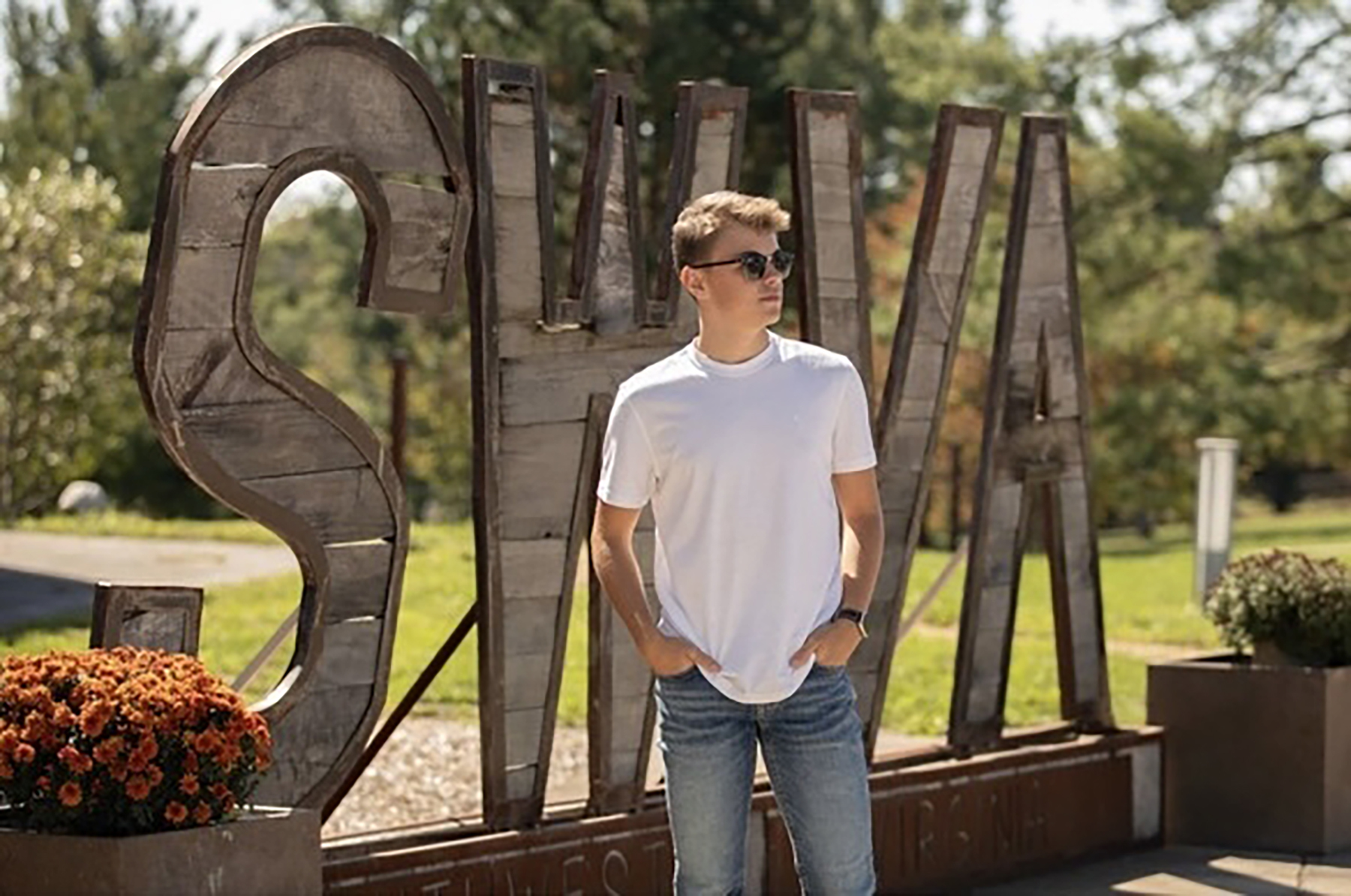 Luke Davis ’28 stands in front of the Southwest Virginia Cultural Center and Marketplace in Abingdon, Virginia.
“No matter where you end up, you can take what you know and shine the light back on the region.”
~ Haley Sigler, associate professor of education and director of W&L’s Education Studies Program
On a Wednesday in March, a 19-year-old from Richlands, Virginia, walked into the Senate office buildings in Washington, D.C. — not to lobby, not to intern, but to watch. Beside him was Haley Sigler, associate professor of education and director of W&L’s Education Studies Program. Across the room were program directors from across Virginia, making their case to congressional staffers one meeting at a time. What brought them all there: a bucket of federal money that Congress has since approved and released — money meant for programs that help rural, low-income students attend college — which at the time had not been allocated. Luke Davis ’28, a first-year student at W&L majoring in politics and minoring in education policy, spent the past semester trying to understand what that meant for the place he grew up.
Davis was working on an independent study with Sigler titled “Federal Education Cuts and Southwest Virginia’s Future,” which examined the potential impact of federal education cuts on Southwest Virginia, with a particular focus on TRIO, a suite of federally funded programs born out of the War on Poverty that includes Upward Bound. Davis also had the opportunity to meet with Morgan Griffith, a representative from the 9th district (Davis’ home district), who serves on the TRIO Caucus.
Upward Bound works by identifying college-eligible students as early as eighth grade, then mentoring them through high school: college tours, help navigating the financial aid process, application fee waivers and money toward college costs at the program’s completion. For many students in economically strained communities, it may be the only systematic guidance they receive toward higher education.
“If it wasn’t for programs like that,” Davis says, “the number of people who went to college from Southwest Virginia would be significantly reduced.”
Davis came to the topic through an unexpected path. He arrived at W&L last fall, planning to major in politics, and found Sigler’s first-year seminar on the Foundations of Education. The two quickly discovered they had something in common: Both grew up in rural Appalachian communities — Davis in Tazewell County, Virginia; Sigler in Lincoln County, West Virginia — and both came of age watching communities shaped by the coal economy slowly lose ground. Conversations continued between the two after the semester ended, and Davis says his focus sharpened into the project he and Sigler tackled that grappled with questions he sought answers to in his home community: What is happening to TRIO programs right now? Who is being affected? And what do the people running these programs think?
Davis performed extensive fieldwork throughout the term, talking to program directors and community stakeholders in Southwest Virginia and trying to document the stakes in concrete terms. One of his key contacts was Brandon Honaker, who directs the TRIO Program at Southwest Virginia Community College — and whose wife was, as it turns out, was a mentor to Davis during his own time there. (Davis obtained an associate’s degree from Southwest Virginia Community College in 2025 before attending W&L.)
That connection was what got Davis and Sigler into the room in the nation’s capital. Honaker invited them to observe a series of meetings with staffers from the offices of Sens. Tim Kaine and Mark Warner and U.S. Rep. Ben Cline — meetings where TRIO program directors from across Virginia were pressing the case that the Department of Education needed to release funds that had been approved but not disbursed.
“We were there witnessing all these people that run programs around the whole state,” Sigler says, “talking about kids that they are actively mentoring right now, whose path to college access depends on continued support from this funding.”
Davis’ path to W&L has been marked by a steadfast commitment to education, and he says that his experiences on campus have only intensified his interest in education policy. While still in high school, he earned his Associate of Arts from Southwest Virginia Community College, graduating from both institutions simultaneously in 2025. Davis’ interest in civic engagement grew alongside his educational trajectory; his Virginia General Assembly internship as a high school student resulted in him serving some 219,000 constituents through Sen. T. Travis Hackworth’s office; he also served as lead campaign strategist for a circuit court clerk’s race, developing the messaging and grassroots outreach that carried a nearly 9,000-vote election. He arrived at W&L as a reclassified first-year with 23 credits and a 4.0 GPA, on track to graduate a year early.
His legislative internships, including his work digitizing thousands of court records as a deputy clerk at the Tazewell County Circuit Court, all point toward the same preoccupation: the systems that govern and shape life in Southwest Virginia, and whether they’re working for the people who depend on them. Outside the classroom, he sits on W&L’s First-Year Residential Experience Board, serves as a community assistant and is involved in W&L’s LEAD program. He lists Southwest Virginia history among his interests, alongside pickleball.
Sigler and Davis recently attended a talk in Lexington by journalist Beth Macy, who has written extensively about her roots in rural Appalachia, and came away thinking about structural ways to build trust and partnerships between academic institutions and rural communities. Davis and Sigler decided to turn their project into an op-ed instead of a traditional academic paper.
“Most people just aren’t as likely to read an academic paper,” Davis says. “What’s the best way I can get what I have learned into discussion?”
Davis says the argument he wants to make is not a partisan one. He believes education is not a left or right issue and says the deeper question underneath the research is one he carries personally. He grew up in a community that helped power the country’s economy via the coal industry for a generation and now watches its young people move away for better opportunities. He chose W&L partly because it was close enough to the mountains that going home still feels possible and going back after law school still feels like a plan.
Sigler has encouraged him to use his voice no matter where his path leads.
“You are a product of the region,” she told him during a recent meeting. “And no matter where you end up, you can take what you know and shine the light back on the region.”

You must be logged in to post a comment.