Studying Salamanders Summer Research Scholars Brian Kim ’26 and Ansley Stotts ’27 have spent their summer conducting field research in a unique outdoor classroom.
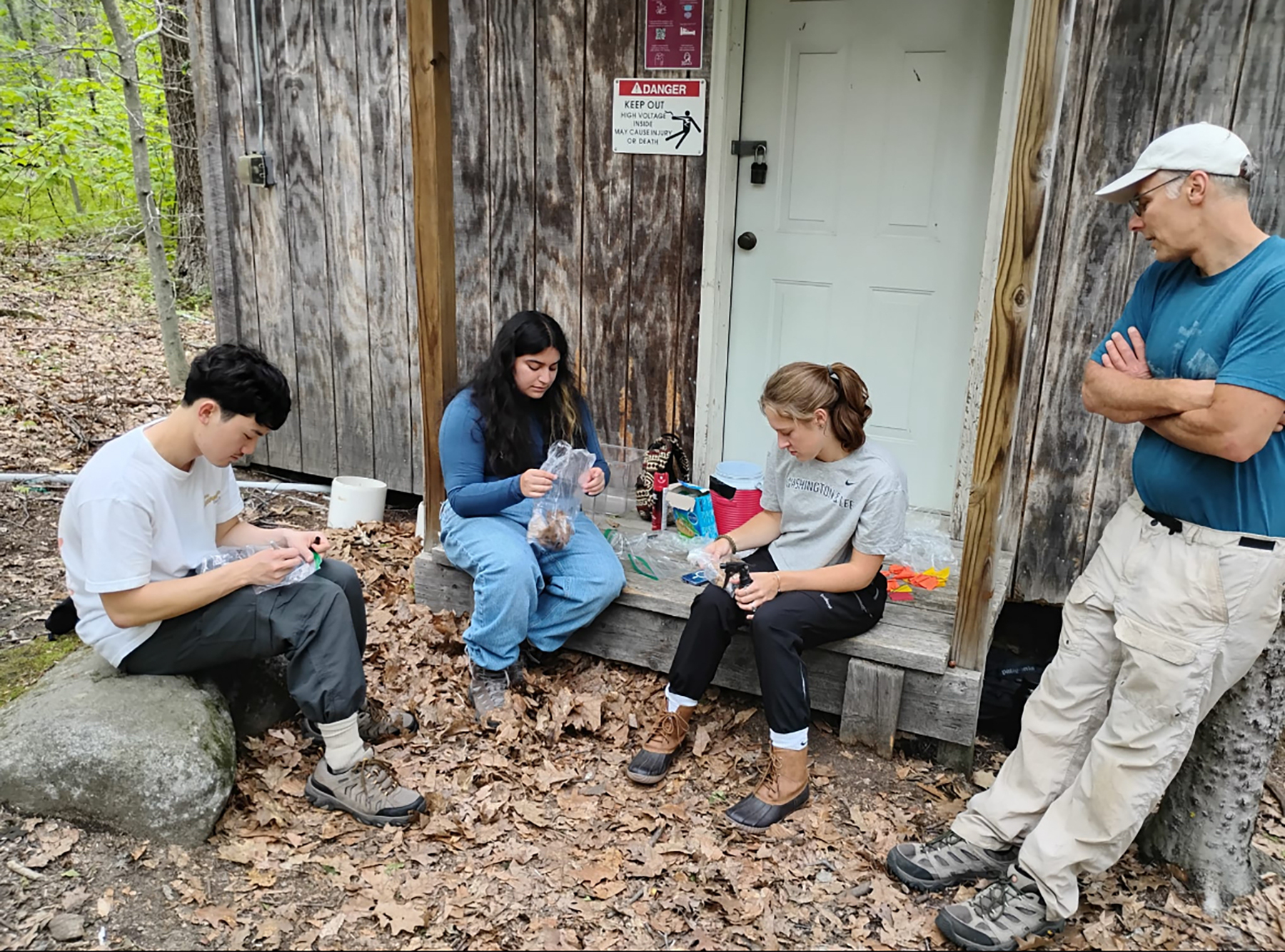 Brain Kim ’26, Ansley Stotts ’27, and David Marsh (along with their Harvard team member) consult on field research at Harvard Forest.
“I’ve always thought of scientific research as a little bit intimidating, but this experience has helped me understand that when I’m so immersed and involved in a study, problem-solving, conducting research and presenting on my findings almost feel like second nature.”
~ Ansley Stotts ’27
This summer, Washington and Lee University students Brian Kim ’26 and Ansley Stotts ’27 traded the familiar woods of Rockbridge County for Harvard Forest, a 4,000-acre outdoor classroom near Petersham, Massachusetts, that allows students from all over the country to conduct summer ecological research through Harvard University. Under the remote guidance of David Marsh, professor of biology, the students are contributing to studies on the impacts of global warming in salamander populations, an opportunity sparked by Marsh’s decades-long interest in the effects of climate change on amphibians.
Kim, a biology major with minors in poverty studies and data science from Charlotte, North Carolina, and Stotts, a Midlothian, Virginia, native double majoring in environmental studies and Spanish, are studying how woodland salamanders respond to soil temperature changes. The field site at Harvard Forest features 18 experimental soil warming plots, some of which are heated. The site is part of a 30-year Harvard Forest project simulating the effects of global warming. With headlamps and thermal cameras in hand, student researchers track and tag the elusive, nocturnal amphibians, measuring their growth and behavior across varying temperatures.
Kim recently participated in research on ground squirrel hibernation cycles with W&L associate professor of biology Jessica LaPrice and says his experience in the lab focusing on thermal regulation translated seamlessly into his summer work with Marsh.
“I’m looking at how salamanders compensate behaviorally for warmer environments, including where they hide or climb to regulate temperature,” Kim says.
He uses thermal imaging to compare the salamanders’ body temperatures with their surroundings, revealing insights into how these cold-blooded creatures might adapt to a warming world. The research team includes Kim, Stotts and a Harvard student. Together, they conduct nightly salamander surveys, then return in the morning to mark, measure and examine the animals for eggs, tail loss and other indicators.
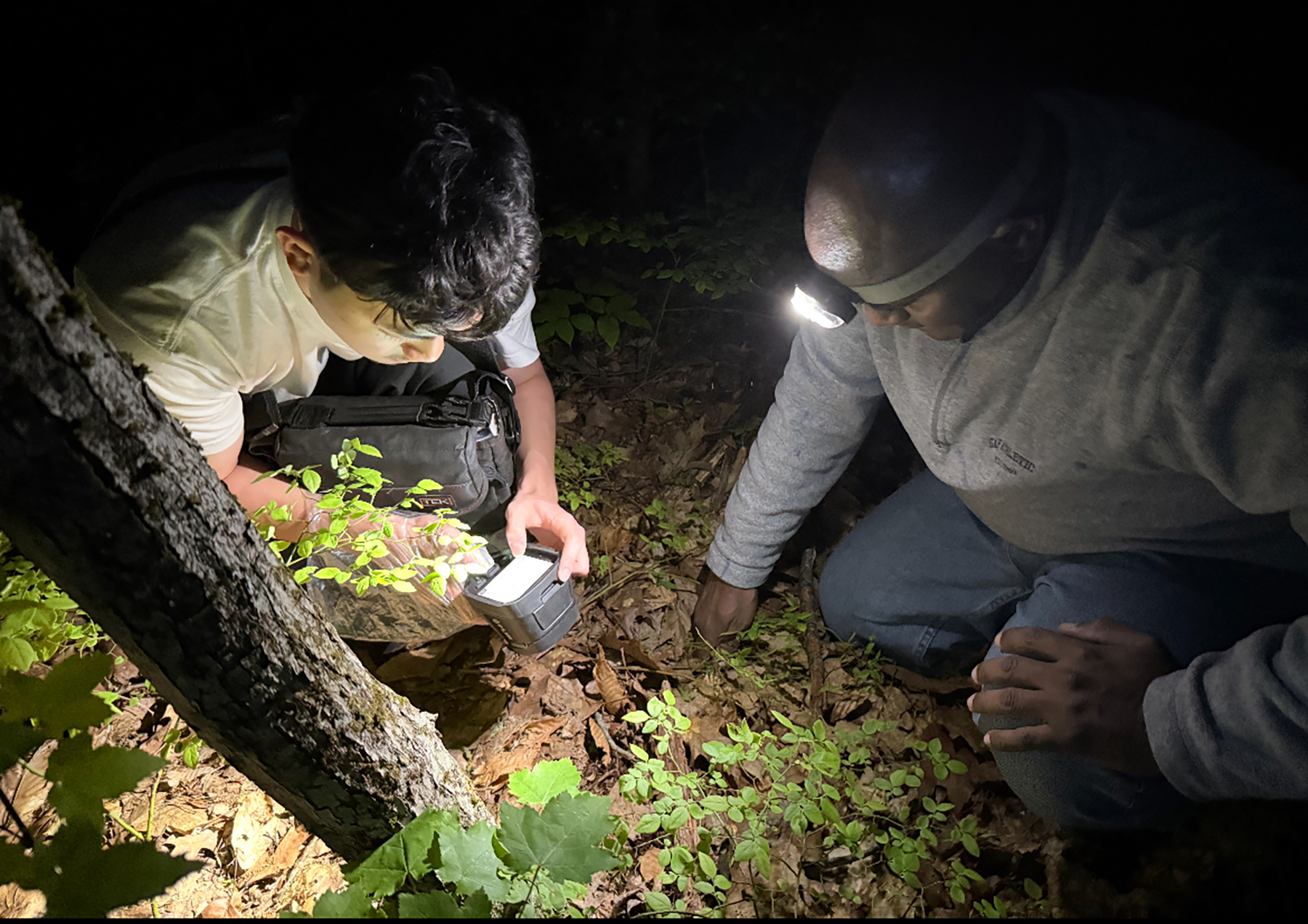 Kim on a nighttime salamander hunt
Stotts’ and Kim’s research overlaps, but the final papers the two produce as the culmination of their project will focus on slightly different areas of study. While Kim is examining how individual salamanders respond behaviorally and physiologically to increased temperatures, Stotts’ research focuses on population-level effects and incorporates data on salamander density, size and reproductive health.
“Because they’re ectotherms, salamanders are really sensitive to temperature,” she says. “Seeing how something as small as a five-degree increase impacts them gives us a tangible view of climate change in action.”
The students are working with Marsh through W&L’s Summer Research Scholars (SRS) program, which supports student participation in collaborative research and creative projects supervised by W&L faculty, in addition to support from a National Science Foundation (NSF) grant. Marsh, who is in his 25th year of supervising SRS students, spent the first few days of Stotts’ and Kim’s arrival onsite with them and meets with the students weekly over Zoom, reviewing their proposals, helping with data analysis plans and providing encouragement.
“I try to match research projects with students’ interests,” says Marsh. Kim plans to study veterinary medicine and is interested in physiology, while Stotts was drawn to conservation and climate issues.
Outside the lab, the pair has built connections with peers from across the country, joining their research cohort for weekend excursions throughout New England. Their research will culminate in a symposium presentation at Harvard Forest. The students say it has been a meaningful experience for both of them, and Marsh hopes their experience will serve as a pilot for future field-based collaborations.
“We’ve been doing a lot of work locally in the Appalachians comparing higher elevation and lower elevation areas as kind of a proxy for cooler and warmer climates, but, in the end, those approaches are somewhat limited, since higher elevation and cooler and lower elevation areas are different in many ways, not just in terms of temperature,” Marsh says. “It’s great to be working on an experimental system where we have areas that are right next to each other and the habitat is almost exactly the same, and the only difference between them is that some of these areas are warmer and some are cooler.”
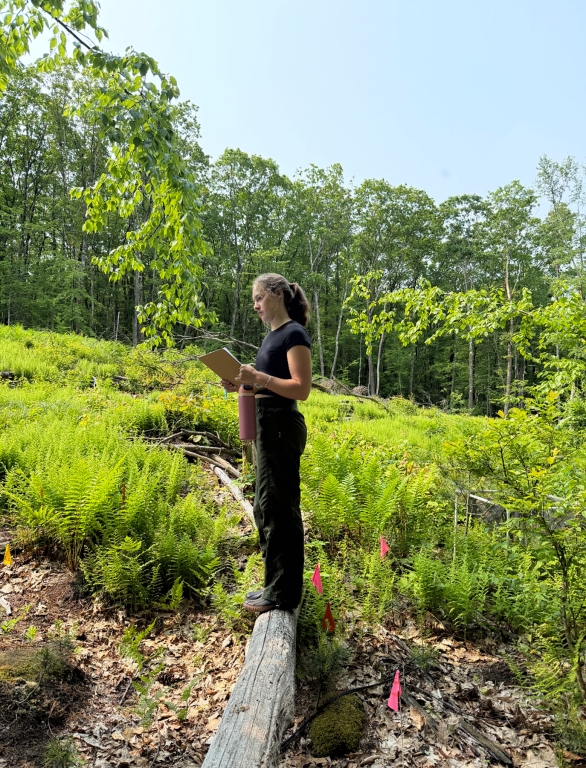 Stotts taking field notes
Kim says he is grateful to Marsh for connecting him with the opportunity.
“It’s been an amazing experience to not only get to do this research, but to see what that looks like at another institution as well,” Kim says.
Stotts, who also applied for W&L’s Johnson Opportunity Grant funding to support her summer experience, says she is looking forward to delving into the data analysis of the team’s findings and that her work in Harvard Forest has allowed her to explore her curiosity about climate change and its impacts on various species. She adds that she is equally excited to share her final research presentation with the cohort of other student researchers in Harvard Forest’s summer program.
“I’ve always thought of scientific research as a little bit intimidating, but this experience has helped me understand that when I’m so immersed and involved in a study, problem-solving, conducting research and presenting on my findings almost feel like second nature,” Stotts said. “It has definitely made any type of research seem more approachable and exciting.”
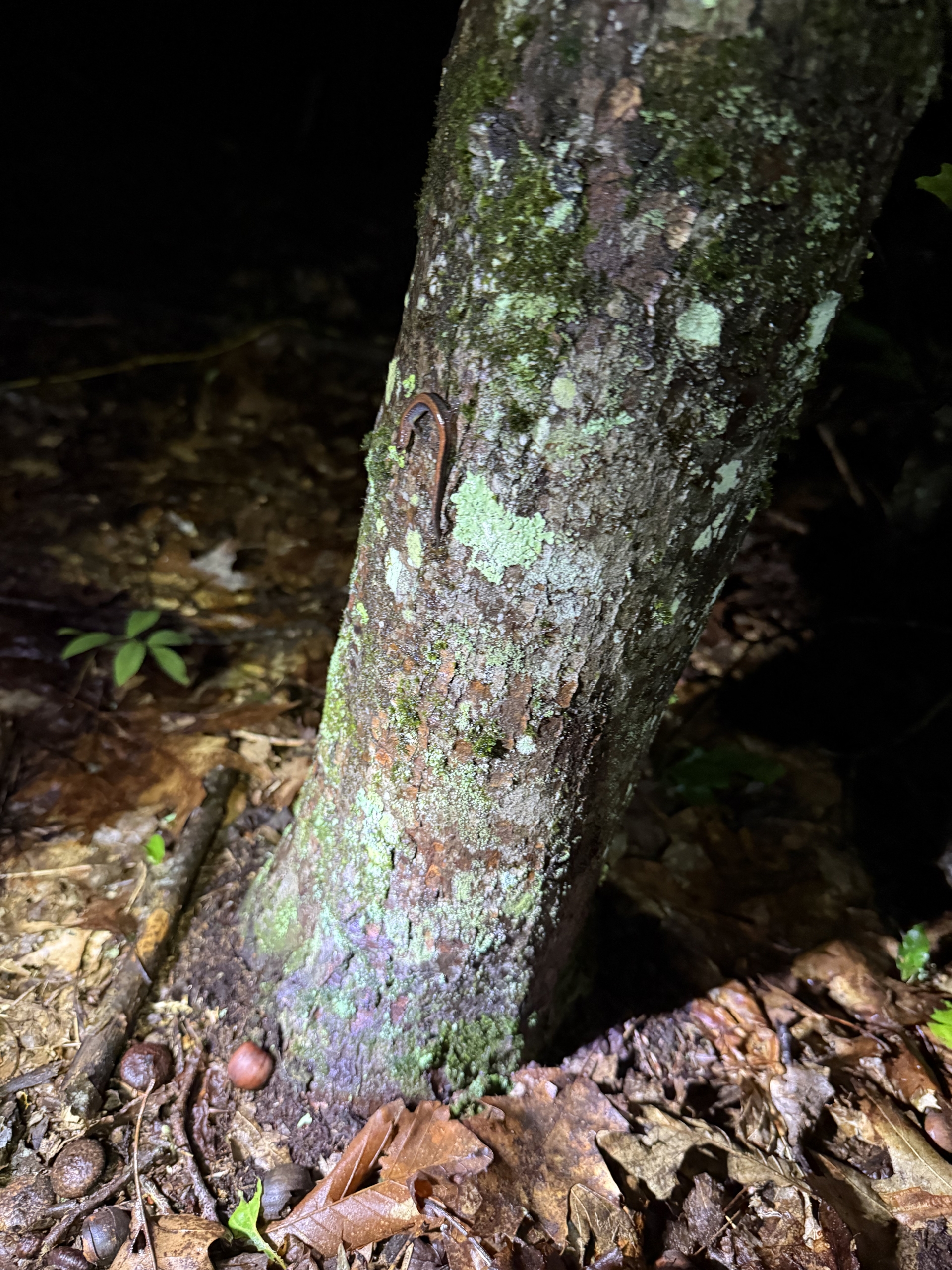 A salamander spotted on one of the team’s outings
If you know any W&L students who would be great profile subjects, tell us about them! Nominate them for a web profile.

You must be logged in to post a comment.