
Tips on Navigating the First-Year Experience Nathan Graves, associate dean for first-year experience, and Leah Beard, assistant dean of student leadership share tips for students, parents and families navigating their first Fall Term at W&L.
 Leah Beard, assistant dean of student leadership, and Nathan Graves, associate dean for first-year experience
As new students begin to find their footing on campus during Fall Term, we sat down with Nathan Graves, associate dean for first-year experience, and Leah Beard, assistant dean of student leadership, to find out what that transition really looks like and how Leading Edge, orientation and the first-year experience at Washington and Lee University are designed to support it.
What are the most common questions you tend to field at the beginning of the year from first-year students and their families?
Graves: Now that classes have started, some of the questions that I’m getting from our students or from families are about the schedule, i.e., “Is my student’s schedule going to help them with their intended major?” I think sometimes there is this idea that there is a specific way a student is supposed to navigate four years of college, because high school is structured that way from year to year. When you come to a place like W&L, students are taking a group of classes that are within maybe an intended major but also have the opportunity for exploration. What I tell all the students I talk with about this is that “Every class you take in your first semester, regardless of what your major changes to or becomes by the time you graduate, will all count toward your degree, so find classes that you enjoy, that are going to challenge you and help you think differently about the world and who you are in that world.” If you can do that in the first few semesters before you declare a major, you’ll have a better chance of finding what it is you think you want to do, whatever careers you wind up having in your life.
Beard: Parents understandably want to know that their student is going to find a successful career path and a job after graduation, and I always like to bring that conversation back to the beauty of the liberal arts. This really is students’ time to explore and learn. We offer so many majors, and students can take those majors and bring them into any career they want to pursue. We see students going on to law school, medical school and other post-graduate endeavors from a variety of different majors. I encourage students to become engaged with our Career and Professional Development (CPD) Office early and interact with them often during their time at W&L. This office can not only help identify potential career path and opportunities but also help students polish their resumes and professional documents, prepare for interviews and much more.
How does the way students engage with support change once they get here?
Graves: Since arriving here, I’ve realized that for a student of the caliber we bring to W&L, they’ve often never had to ask for support in a lot of areas. Many of them have never had to introduce themselves to begin a mentorship conversation, for example; it’s been a natural thing that happened through preexisting relationships with their coaches or their English teacher or someone who was in the Rotary Club with their dad. This is the first time they’re asking for help on their own. Our families are typically the first phone call that happens when something goes wrong, and I think a family member can help their student by encouraging them to respond to the help that’s there. Now is the time to encourage them to draft their own email or write down their own talking points before they get on the phone or stop by someone’s office hours. We see this as a learning opportunity: When they get sick for the first time, when they don’t turn in an assignment for the first time, when they realize they don’t actually know how to structure a paper and could benefit from visiting the Writing Center — giving them the ability to fumble through and advocate for themselves in that moment is going to be really important.
Beard: We really value our partnership with parents during that first year to be OK with being the receiver of that first phone call when things get challenging. I always say that the biggest thing they can do is just listen. Sometimes the student just needs to share everything on their mind, and then you can ask, “Who have you talked to? What are the resources available that might help this situation?” and prompt them to reach out and connect with someone on campus. The mentorship opportunities here are my favorite aspect of W&L: the faculty mentorship, the staff mentorship and the student leadership mentorship. When students come to W&L, they’re immediately connected with their Leading Edge trip leaders, their orientation leaders, the resident advisers on their hall. They already have a network of upper-division students who’ve been through the same experience, and that is intentional because they often feel more comfortable going to them first before seeking out other resources.
W&L Resources
Learn more about the First-Year Experience
What to expect during a student’s first year at W&L
Why is the student leadership piece so central to how W&L approaches the first-year transition?
Graves: From the moment students get to campus, there’s a group of students waiting for them to open their car door and help them move their belongings in. We want students to know that they belong here, not just because they got their acceptance letter, but because they matter here, and they matter enough that we’re going to make move-in day the least stressful we can. Then you meet your Leading Edge trip leader, who walks you through the next five days built around a theme or interest you picked before you met anyone else here, whether that’s hiking, exploring a new city or leadership development. Then you come back to campus and meet your orientation leader, who walks you through the next four days of how you navigate the physical landscape and the policies of our campus. And then you meet your peer connector. This is an upper-division student who doesn’t live in your building but has intentionally decided to spend a couple of hours every week in your residence hall to get to know you and to be available for anyone who needs to talk. The chief difference between a resident adviser and a peer connector is that the RA is making sure the community runs well, while your peer connector is truly just there to be a friend and give advice based on their own experience. We’ve done a good job of threading that needle from the beginning to the end of the orientation experience, so that by the time you’re settled, you’ve met at least four different upper-division students who have told you that you belong here and you matter.
Are there specific moments in the first year where things like homesickness or academic stress tend to crop up most often?
Graves: I always tell parents and families that the student they dropped off in August is not going to be the same student who arrives home for that first break. They’ve navigated independence in a way they’ve never done before. They’ve had a deep dive into their academics and had feedback from faculty on a paper, or a test they studied for in a way they’ve never had to study before. So, when they arrive home, asking them what they’re enjoying most or what’s challenged them the most this semester is better than asking how they’re doing. There’s a lot of pressure that when you go to college, everything’s supposed to be great, and it’s not always going to be great. Open-ended questions like, “What are you experiencing?” help that conversation feel more comfortable. And they’ll probably also just sleep a lot when they get home.
Beard: I love the question of “What’s been challenging you?” because our students will play the comparison game; they look around and think everyone seems successful and happy, but underneath, everyone’s doing the little duck paddle where the feet are going fast underneath what looks like a calm, smooth surface. I don’t think there’s a set timeline when the first year is harder or easier. Midterm and final periods are for sure going to be a higher stressor, but homesickness really depends on the person. Some feel it right at the beginning, some feel it toward the end of the first year, and some don’t experience it at all.
What do you feel it’s most important for first-year students to know as they embark on these first few weeks of college?
Graves: A theme that comes up for me a lot when I talk with first-years is the importance of showing up for others. Did you invite someone to lunch today? Did you ask someone to form a study group and reserve the room at the library so the group can meet in the evening? Did you go to your roommate’s athletic event or see the performance happening in the Lenfest Center? Showing up is just as much about being part of the community as having others show up for you. I tell students that I don’t want you to be a spectator in this arena — above all, be a good friend and be a participant.
Beard: I just want to remind students that it’s OK to ask for help and to prompt them to seek out the resources we have available. Often the academic piece of things feels so big during the first term, and I encounter a lot of students who feel like they should already have it figured out. That’s not the case at all, and we have these resources here to help you: the Harte Center, peer tutoring, the Writing Center, and many others.
First-year students also have the option to enroll in FYE 1000: General Success, a one-term, one-credit course co-facilitated by faculty, staff and student leaders that is designed to help first-year students transition successfully to life on W&L’s campus. What’s changing this year in the FYE 1000 course?
Beard: We recently received a grant from the Educating Character Initiative at Wake Forest University, which is helping us infuse character development into some of our programs. For the FYE 1000 course specifically, we’re integrating intentional opportunities for students to talk about what it means to make decisions using their values and live a life of character, and what that looks like within their leadership style. We’re really excited about it.
Graves: I like the addition because it gives students language about who they are without it being about their major or what they’ve accomplished. It’s about who you are in your core being, and how you show up with friends, or in any setting you’re in.
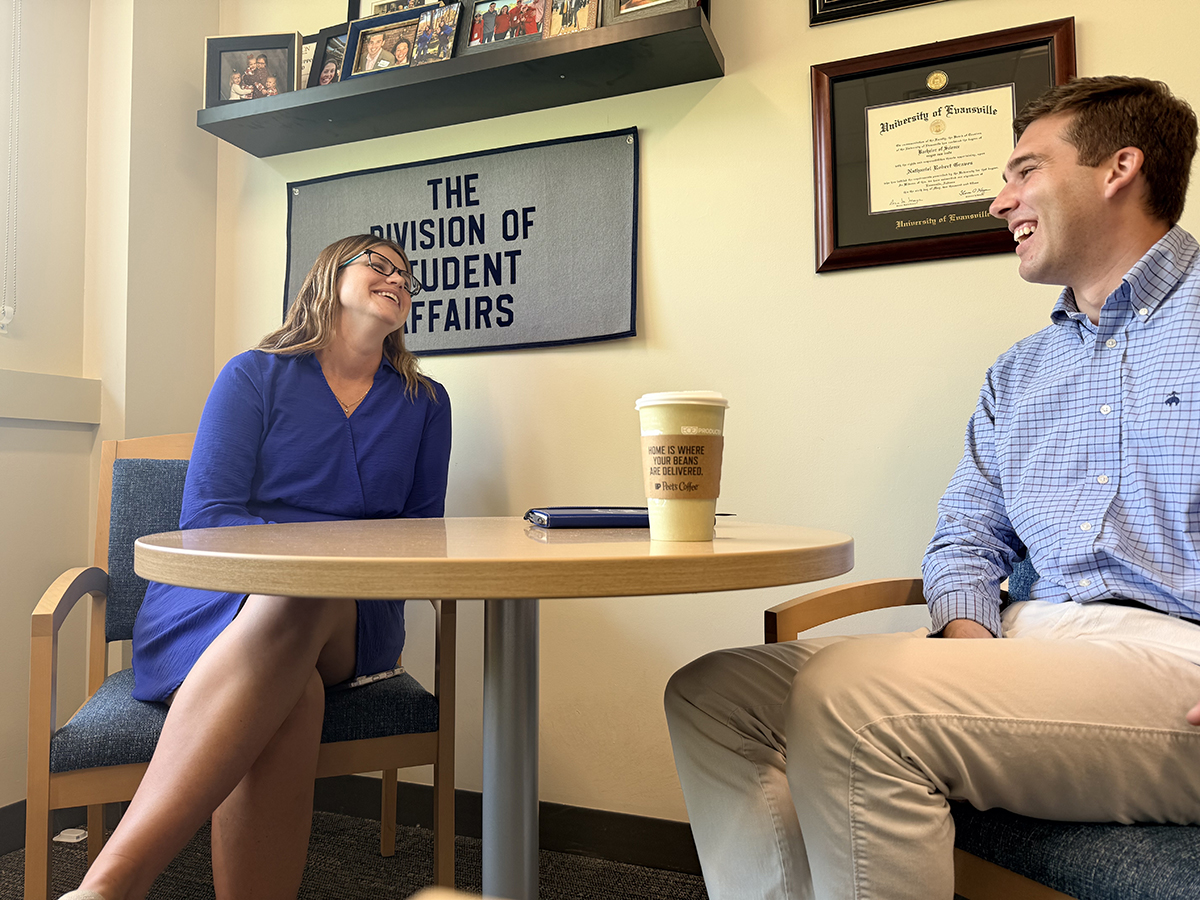 Beard and Graves chat in Graves’ office.
Related Stories

December 8, 2025
The Office of Fraternity and Sorority Life Hosts End-of-Year Banquet

You must be logged in to post a comment.