Where Geology Meets Public Health With a grant from the Keck Geology Consortium, W&L’s Madhumita Chakraborty and a team of students tested private wells and springs throughout Rockbridge County to determine water chemistry and quality.
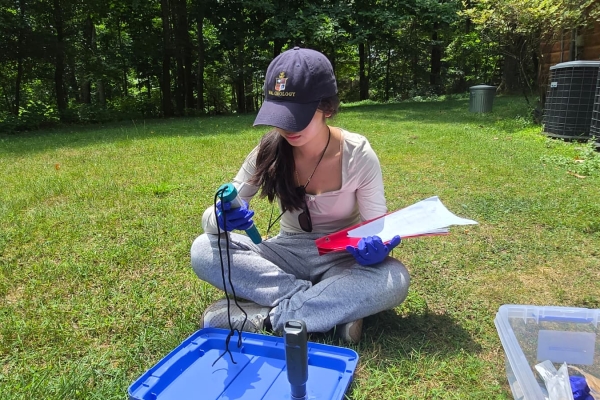 Vi Cao ’28 collected samples from private wells and springs in Rockbridge County to determine water chemistry and quality.
More than 70% of households in Virginia’s Rockbridge County depend on private wells or springs, meaning the groundwater most people in the county rely on is not routinely tested or regulated under the Safe Drinking Water Act, like public water systems are. And because the local aquifer is karst (a type of landscape where the underlying rock formations are partially eroded by water), water moves quickly from the surface into the ground with little natural filtering, creating a highly vulnerable and infrequently monitored system.
Washington and Lee University’s Madhumita Chakraborty, assistant professor of earth and environmental geoscience, spent five weeks this summer conducting research on the local groundwater, working with residents to sample their private wells and springs and testing the water for a wide range of solutes.
This project was funded by a grant from the Keck Geology Consortium, a partnership of 12 liberal arts colleges that supports undergraduate research in the geosciences. The $63,035 grant, through the consortium’s Research Experiences for Undergraduates program, funded a five-week project period and a team of six student researchers, as well as funded the testing of 48 water samples, which involved a wide suite of analyses, from major ions and bacteria to trace metals and several isotopic tracers. The grant also allowed Chakraborty’s team to provide each of the 46 participating households with an individualized water quality report at no cost to the property owner.
“With the Keck grant, Madhumita is mentoring students and training the next generation of scientists to produce high-quality research that directly supports rural communities,” said Lisa Greer, the Harry E. and Mary Jayne Redenbaugh Term Professor and chair of the Department of Earth and Environmental Geoscience. “She has been an invaluable addition to our faculty, and in addition to being a talented and committed teacher, her scholarship delivers real benefits to our community.”
A hydrogeologist, Chakraborty’s work has focused on groundwater chemistry and the quality of drinking water in places where people depend on wells. Prior to joining W&L’s faculty in 2022, she studied arsenic contamination in wells across the Ganges Delta in India and Bangladesh, in close partnership with the communities using that water.
“Rockbridge County looks very different from the Delta, but the underlying question is the same,” Chakraborty said. “How do the rocks, the water and the way people live on the land combine to shape what comes out of a tap?”
With this research, Chakraborty is building a multi-year dataset on the chemistry and quality of groundwater across Rockbridge County, which will provide important information about the groundwater type, how it flows and how suitable it is for drinking. The collected data (starting in 2025) will also provide a holistic understanding of the groundwater system as well as individual reports for the households.
“At the household level, every participating family gets an individualized report on their own water,” Chakraborty said. “That is information they can act on, whether that means treating the water or simply knowing it is fine. For many of these households, it is the first time their water has been tested in years.”
Chakraborty’s summer research team included six students from institutions across the country. W&L students Vi Cao ’28, Wynn Robbins ’28 and Cynthia Ye ’29 were joined by rising sophomores Claire Shin from Franklin & Marshall College, Madeleine Wallenberg from Mount Holyoke College and Sasha Watson from Brown University.
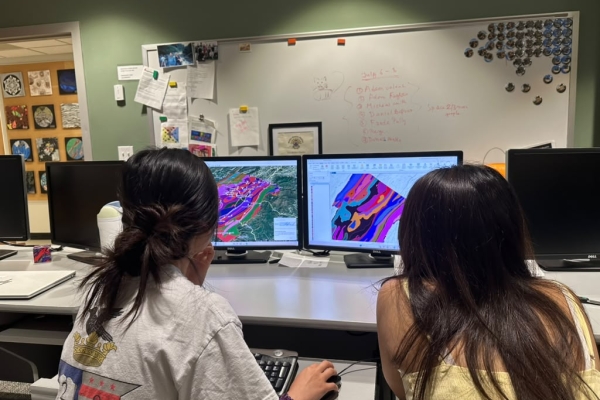 Mapping the spatial data alongside the graphs built from lab results allowed the students to see patterns emerge.
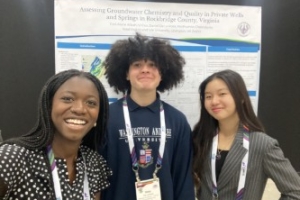
Cao, a double major in earth and environmental geoscience and economics from Hanoi, Vietnam, was drawn to the groundwater research project because it sits at the intersection of environmental science, public health and community engagement. She first became involved with the project in the summer of 2025 and presented her research along with Toni-Marie Alibah ’27 and Daniel De la Rosa ’29 at the Geological Society of America’s (GSA) annual conference in October 2025, where they won second place in the undergraduate research in hydrogeology poster competition. (Cao, Robbins, Ye, Shin, Wallenberg and Watson plan to present their work at this year’s GSA conference, as well.)
This year, Cao served as a mentor for the research team and appreciated being able to share her knowledge with the group and the opportunity to collaborate with both her W&L teammates and the students from other universities.
“This year made me realize how much learning can go both ways,” Cao said. “I enjoyed showing my groupmates the tools and techniques I’ve learned from the year before, but I also learned just as much from them. We each know different things, and bringing those perspectives together made our conversations richer and more fun. Whether we were troubleshooting a lab method, talking through a concept or comparing approaches to problem-solving, it felt good to build a space where everyone could contribute.”
Providing opportunities for hands-on learning and collaboration is central to undergraduate research at W&L. Chakraborty has particularly appreciated watching the students learn the technical skills of field sampling and analysis (including how to handle sample preservation, operate instruments and count bacteria), as well as how to work with people in the community and put what they’ve learned into practice.
“There is a difference between learning about science and doing it,” Chakraborty said. “With this project, they see science in a real-world setting, where the outcome is tangible and goes straight back to the community, and you can’t simulate that in a classroom.”
Chakraborty also believes a liberal arts setting is “unusually well suited” to undergraduate research, particularly collaborative research between faculty and students, because of the hands-on approach they’re able to take with small research groups and shared interdisciplinary perspectives. She enjoyed watching the students grow more confident in themselves and their work, and hopes they come away from this experience proud of themselves and their evolving skillset.
“At the start of the project, it feels like you are leading the students, but by the end, it definitely feels like the students are leading me in many ways,” Chakraborty said. “That shift, from following instructions to owning the research, is the whole point.”

You must be logged in to post a comment.