February 25, 2026
Brian Alexander to Give ‘America at 250’ Lecture at W&L
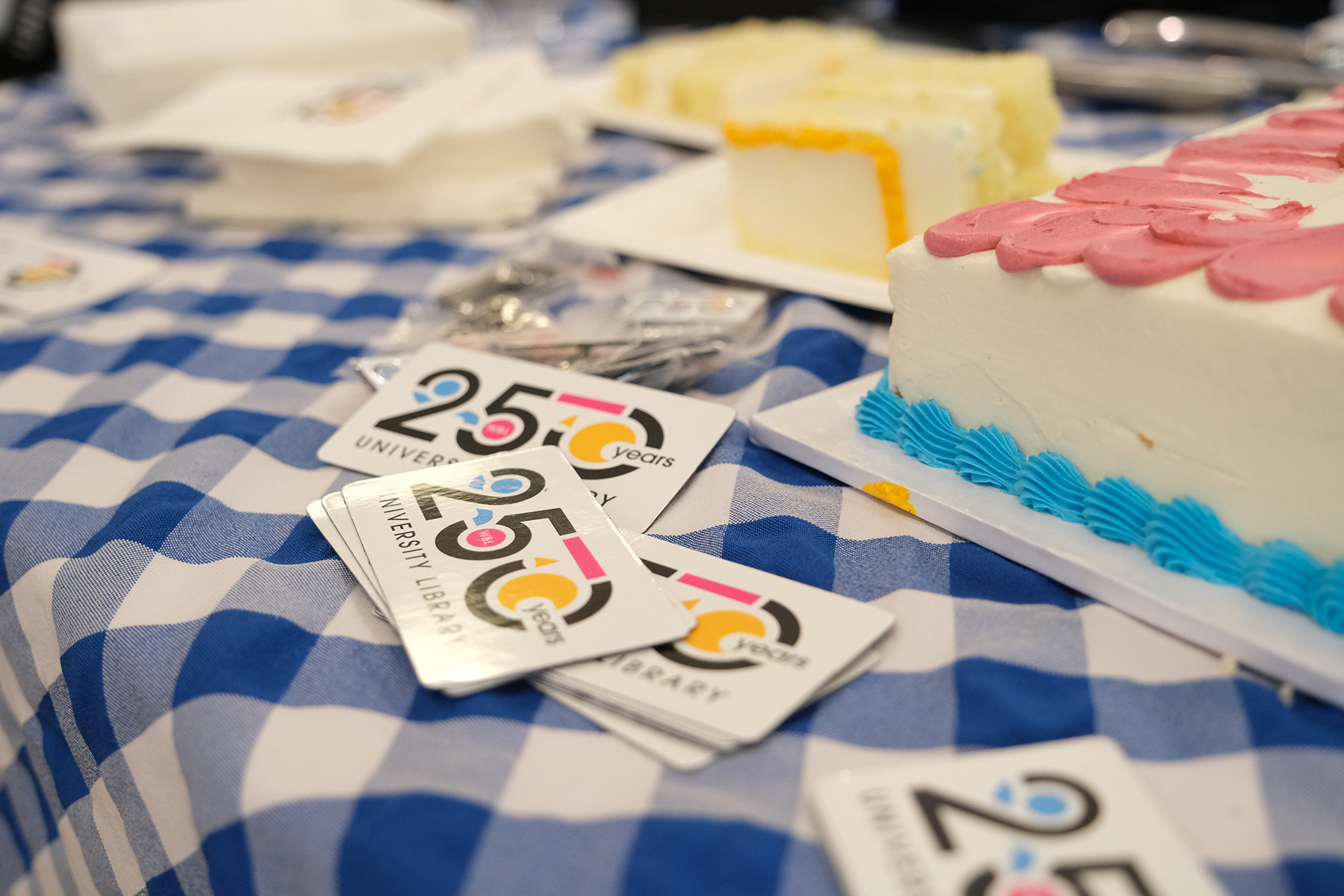 The library’s cake station included free giveaways with the 250th anniversary logo.
“The library is obviously a place for information, but it’s also a place for community.”
~ Emily Cook, associate professor and research and instruction librarian for the humanities
The question G.J. Corey Harmon ’05 posed on the afternoon of March 12, 2026, had, he acknowledged, been asked before. It had first been asked in 1776, when Rector William Graham returned from Philadelphia with a few hundred books and a fledgling institution, known then as Liberty Hall Academy, in which to house them. It was asked again in 1867, when a librarian named John W. Fuller composed a report to the academy Board of Trustees and wondered whether the collection he had built would survive him. It was asked in 1895, when librarian Annie Jo White walked into a library that was open only one hour a day and set about transforming it into something a university community could actually use.
The question — “Who is the library for?” — was the title of Harmon’s keynote webinar, delivered during the celebratory events held March 11-12 in honor of the 250th birthday of the Washington and Lee University library system. Harmon, a member of W&L’s Friends of the Library Board, told the audience that in 250 years, the answer has evolved.
The library’s anniversary festivities kicked off on March 11 with a communal gathering throughout Leyburn Library. Balloons and birthday cards signed by members of the W&L community decorated the main floor of Leyburn, and members of the library’s Library Student Advisory Board (LSAB) manned the cake station, inviting partygoers to don birthday hats and enjoy cake decorated to match the 250th anniversary commemorative T-shirts worn by staff and students. In Special Collections, the Tom Wolfe ’51 Reading Room threw open its doors for a public open house, its freshly renovated shelves and navy-and-cream interior on display alongside some of the materials the library has been preserving for centuries.
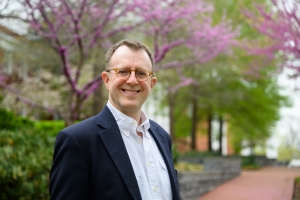
That evening, W&L associate professor of politics Brian Alexander gave a public talk on the book that began his relationship with this library’s collection: a copy of Thomas Jefferson’s “Manual of Parliamentary Practice,” annotated in Jefferson’s own hand, which had been sitting in Special Collections for years before anyone had thought to examine it closely. The event was co-sponsored with the Rockbridge Historical Society as part of the Virginia 250 commemoration, and it attracted an audience that included alumni, Lexington community members and faculty, students and staff. Alexander, a congressional scholar, described how the project began with a spontaneous trip to the library.
“When you’re procrastinating,” he advised the crowd, “go to Special Collections.”
Jefferson’s manual, first published in February 1801, was his attempt to establish rules of order for Congress. The House formally adopted the manual in 1837, and it has been in continuous use by both chambers ever since. W&L’s copy is unusual in that it is one of only three known copies of the manual annotated in Jefferson’s own handwriting. Alexander traced approximately 70 surviving copies of the first edition out of about 100 originally printed. One is in the Royal Library at Windsor Castle. Another was sent by Jefferson to the French intellectual Count Constantin Volney and has “disappeared somewhere into France,” Alexander said. The W&L copy was not among those identified as rare or closely examined until Alexander stumbled upon it.
What his research revealed, among other things, was a bureaucratic error that had persisted for nearly two centuries. In 1837, when the House formally adopted Jefferson’s manual, it adopted the 1801 first edition — not the 1812 second edition, which incorporated additions Jefferson had authorized before his death. The mistake stood uncorrected until the current session of Congress, when the House parliamentarian updated the House rules and manual to include Jefferson’s 1812 revisions.
“The richness of our collection allows this entire journey of scholarship to unfold,” Alexander said. “And it happened because we have a 250-year-old library.”
Harmon’s March 12 talk traced that history in detail. Harmon’s master’s thesis at the University of North Carolina at Chapel Hill documented the library’s development from the late 1930s to the early 2000s, making him, by the university’s own account, one of the few scholars to have formally chronicled its modern history. He is now a librarian at East Carolina University’s Health Sciences Library.
Harmon opened his talk with a voice from 1867. Fuller, then librarian of Washington College, had composed a report to the Board of Trustees in which he wrote: “My own sands of life are nearly run out, and it is only for the true welfare of the college that I thus invite your attention to this subject, hoping that long after the sods of the valley cover my poor remains, your well-filled and well-kept shelves may continue an ornament and a blessing to our beloved institution.”
“We gather in 2026 to celebrate 250 years,” Harmon said, “and I am grateful for the chance to reflect on how Fuller’s hope was realized.”
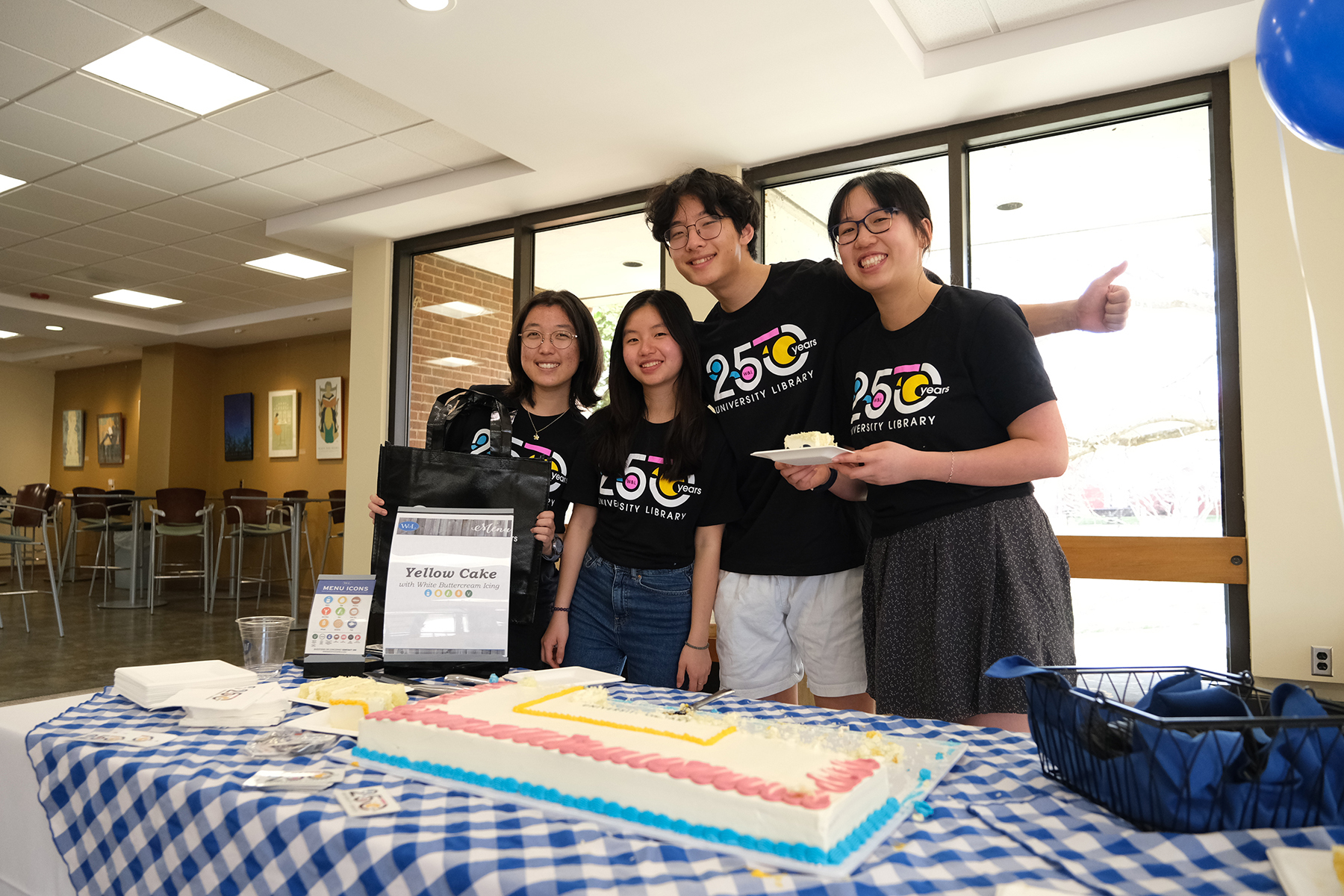 The Library Student Advisory Board serve cake to library visitors on the afternoon of March 11.
A library that has survived 250 years has also done so, in part, because each generation of students has made it their own. At Washington and Lee, the most formal expression of that student ownership is the LSAB, which has met regularly with library staff since the board’s founding in 2019.
“At its core, LSAB is an advisory board that really tries to make sure library initiatives are successful,” said Lucas Kim ’27, an economics major who serves on the board.
In practice, LSAB’s work ranges from the logistical to the creative. Members have stress-tested new self-checkout software, generated updated signage and helped secure board games and seating for the Game Zone. They played a central role in developing the new Sensory Study Room. Around finals week, they host study breaks with snacks and run a “positivity station” where students leave encouraging notes for one another. For the 250th anniversary celebration, LSAB hosted a film screening of the 2019 screen adaptation of “Little Women,” featuring cupcakes, handmade party hats and paper roses crafted from vintage library checkout cards. LSAB co-chair Tom Finnegan ’26 says the event was a joyful way for students engage with the organization.
“The handmade birthday hats not only brought the students together but also provided them with a memento to remember the night, and the bookmarks we distributed, which acted as tickets, also brought a smile to everyone who received one,” Finnegan says. “We are very thankful to Friends of the Library for their sponsorship of the event.”
“The library is obviously a place for information,” said Emily Cook, associate professor and research and instruction librarian for the humanities, who advises the group, “but it’s also a place for community.”
K.T. Vaughan, Hal F. and Barbra Buckner Higginbotham University Librarian, points out that those communities are made visible through partnerships with departments. The ITS Helpdesk, the Writing Center and the Harte Center all now call Leyburn Library home. The ITS Integrative and Quantitative (IQ) Center shares space with Telford Library in the Science Center. Leyburn’s Northen Auditorium, refurbished in 2010, is a vibrant event space that serves the entirety of campus. Vaughan says Leyburn is on pace to exceed 300,000 visits this year, meaning that with a total campus population — faculty, staff and students combined — of roughly 3,000, that translates into everyone on campus coming into the library an average of 100 times a year. The building has become, in Vaughan’s framing, something more than a library: It is the campus’s principal gathering space. Vaughan says she is excited about what the next 250 years hold.
“We were founded several months before the Declaration of Independence was signed,” Vaughan says. “Founding a library at that same moment is this really interesting act of saying that the written word is important. Whether you’re talking about the Declaration, the Constitution, or the Bill of Rights, there’s the idea that the written word is a foundational cornerstone for us as Americans. It makes me really happy that our 250th birthday lines up with the country’s 250th birthday, because I think there’s a lot to celebrate there about not just that the country has survived for 250 years, but that the library has been a part of that success since the beginning.”
The library has created a webpage for its 250th anniversary celebration; stay updated on upcoming events, speakers and a soon-to-be announced exhibit imagining the library’s next 250 years.

You must be logged in to post a comment.