
Laying the Groundwork Alexis Thompson ’27 and Maria Eduarda Gomes Saff Ferreira ’27 have contributed to foundational research under the guidance of assistant professor of cognitive and behavioral science Nikki Lee.
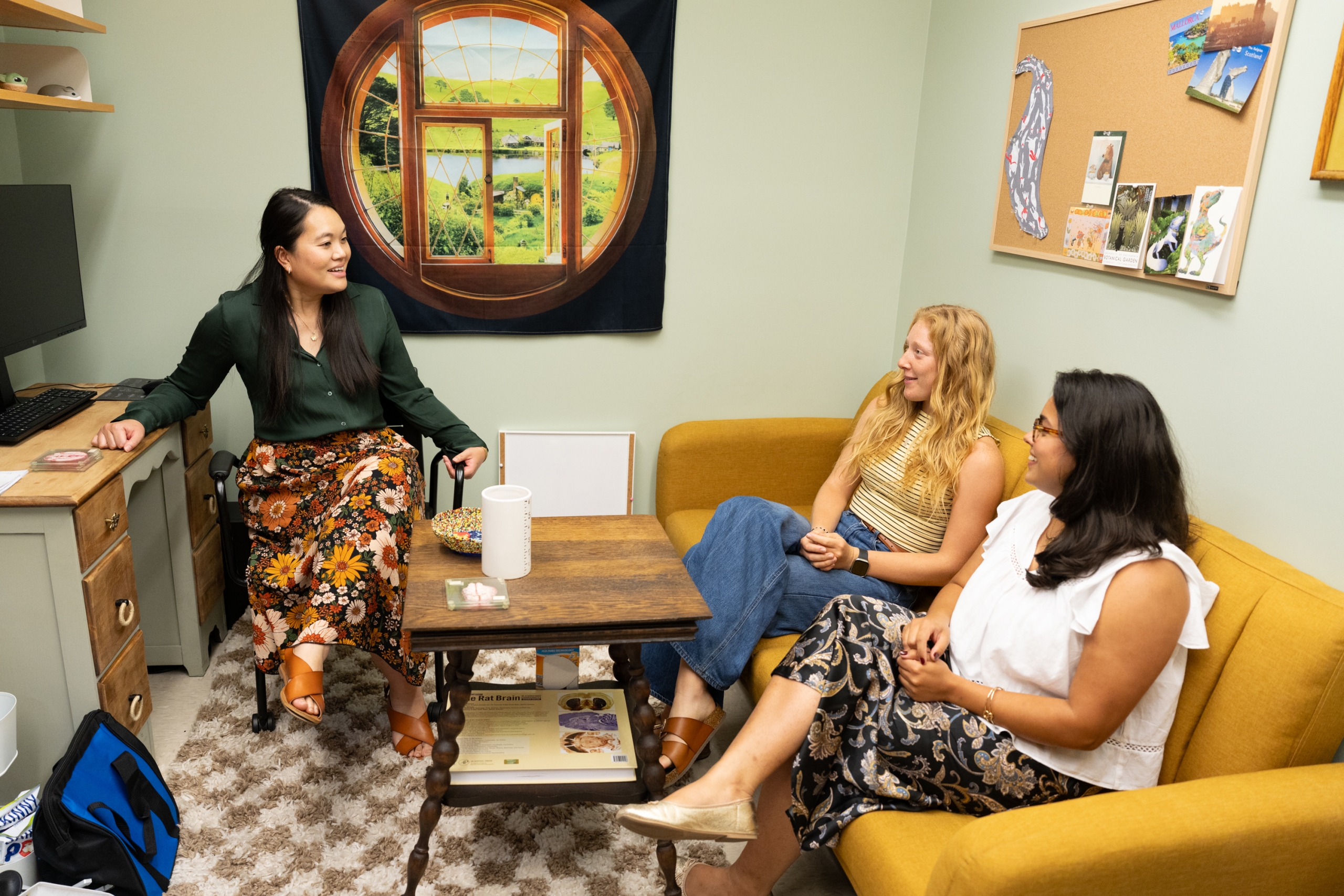 Assistant professor of cognitive and behavioral science Nikki Lee with Alexis Thompson ’27 and Maria Eduarda Gomes Saff Ferreira ’27 at their weekly lab meeting in Lee’s office.
“I now see research as not just a passion, but a responsibility.”
~ Maria Eduarda Gomes Saff Ferreira ’27
For part of the summer, Alexis Thompson ’27 and Maria Eduarda Gomes Saff Ferreira ’27 were up before the sun, setting traps for a relatively understudied species of rodent called the Belding’s ground squirrel. The traps were in service of assistant professor of cognitive and behavioral science Nikki Lee’s research on hormones in the brain and how they shape behavior.
Lee’s particular research interest is natal dispersal, which Lee defines as “when an animal leaves the place of its birth permanently,” usually to seek out mates. Dispersal affects everything from a population’s genetic diversity to how social a species is.
“I study hormones and social behavior, so I’m really interested in what makes an animal social,” Lee says.
In support of her ongoing work in her research lab, Lee was especially interested in spending a month this summer studying dispersal among male juvenile Belding’s ground squirrels, who leave the home burrow (females tend to stay within the family group). By trapping and tagging squirrels at both high- and low-density sites just outside Yosemite National Park, Lee and her students were able to track how far from their home burrows the male ground squirrels traveled and how that might correlate with hormones, such as those related to stress. In the future, Lee is interested in studying how that movement affects survival, since dispersed males don’t have reliable shelter and burn extra energy just to move across the landscape. Lee notes that ground squirrels are less frequently studied than other rodents such as rats and mice that are more commonly used in lab research, making them an intriguing candidate for foundational research.
“One of the goals of the lab is to look at as many non-model species as possible,” she says.
The site where she and her two research students set up shop for two weeks this summer has been utilized by a research team from the University of San Francisco for nearly 30 years, which gave her team access to generations of ground squirrel data on which to build their research. Lee is particularly interested in whether climate change is affecting the ground squirrel’s movement patterns. The team spent a total of four weeks doing research on campus and spent two weeks in Yosemite conducting fieldwork. It was both students’ first time out West. Both students’ summer experience was supported by a Johnson Opportunity Grant, which covers travel, living expenses and other costs associated with participating in a summer project that enhances a student’s studies.
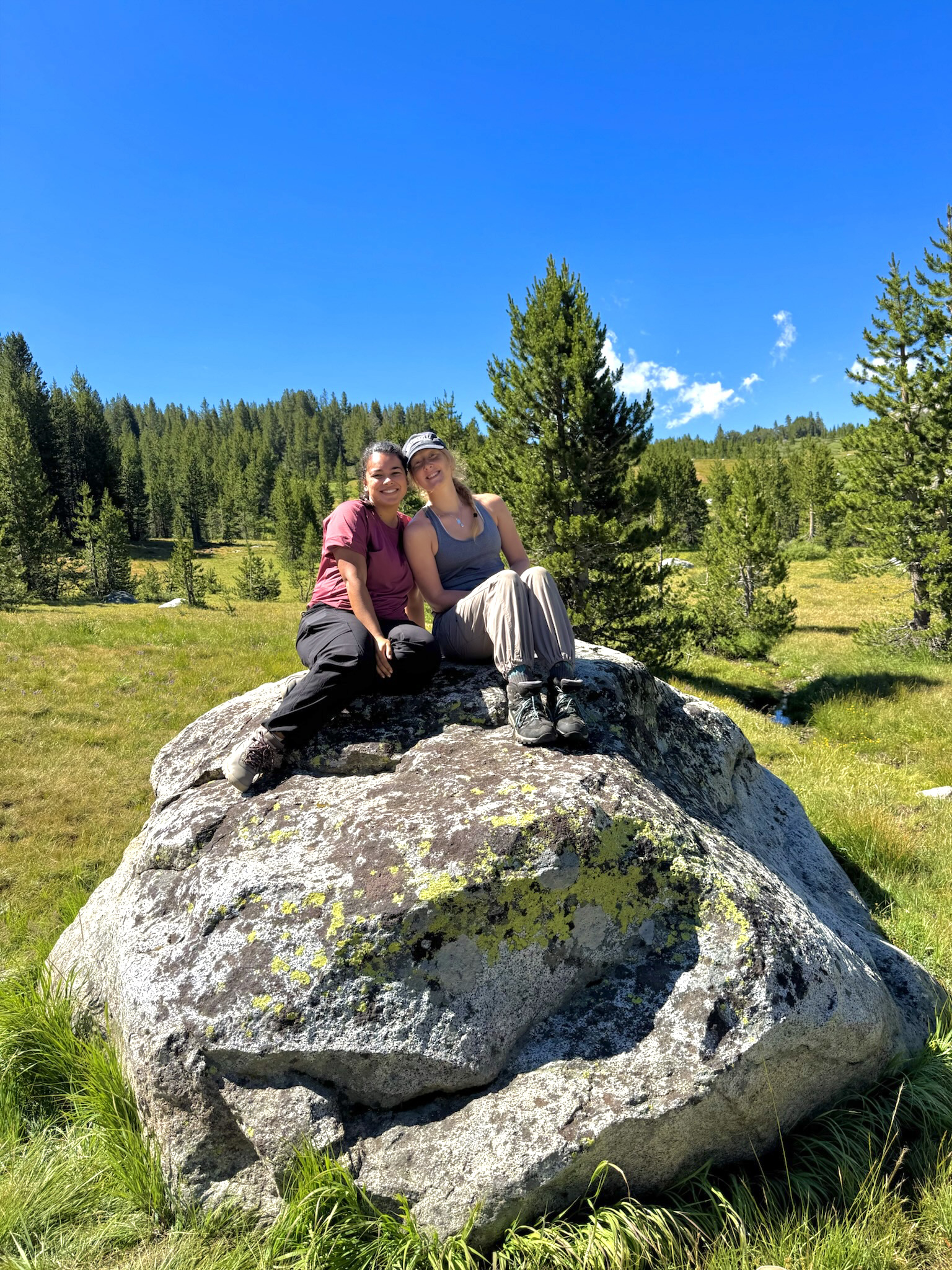 Ferreira and Thompson
Before heading to Yosemite to work with ground squirrels, Thompson spent months in Lee’s lab studying stress and social bonds in prairie voles. She helped record information, a process called behavioral scoring, through watching hours of video footage, tracking how the animals interacted with one another before and after stress in group settings. Thompson logged subtle behaviors like autogrooming (self-soothing when stressed), allogrooming (comforting another animal), huddling and sniffing. That painstaking, frame-by-frame analysis laid the groundwork for the team’s broader efforts to connect stress, social behavior and brain chemistry across multiple species.
This was Lee’s first time taking students into the field to do research, and she says her experiences with Thompson and Ferreira were so productive and positive that she is excited to bring more research students with her for longer periods of time in future summers.
“It honestly got to a point where they were better at everything than I was,” she says.
Lee began teaching at W&L in January 2024. She earned her Ph.D. in neuroscience and behavior from the University of Massachusetts Amherst in 2021, then completed postdoctoral fellowships at Colgate University and, with National Science Foundation funding, at the University of California, Berkeley’s Museum of Vertebrate Zoology, where she studied predictors of dispersal in colonial tuco-tucos, a South American rodent. Her research focuses on the neural and hormonal basis of sociality in rodents, and she has published numerous papers, many with undergraduate co-authors. In 2023, she received the American Society of Mammalogists’ Guy N. Cameron Award and the Society for Behavioral Neuroendocrinology’s WC Young Award.
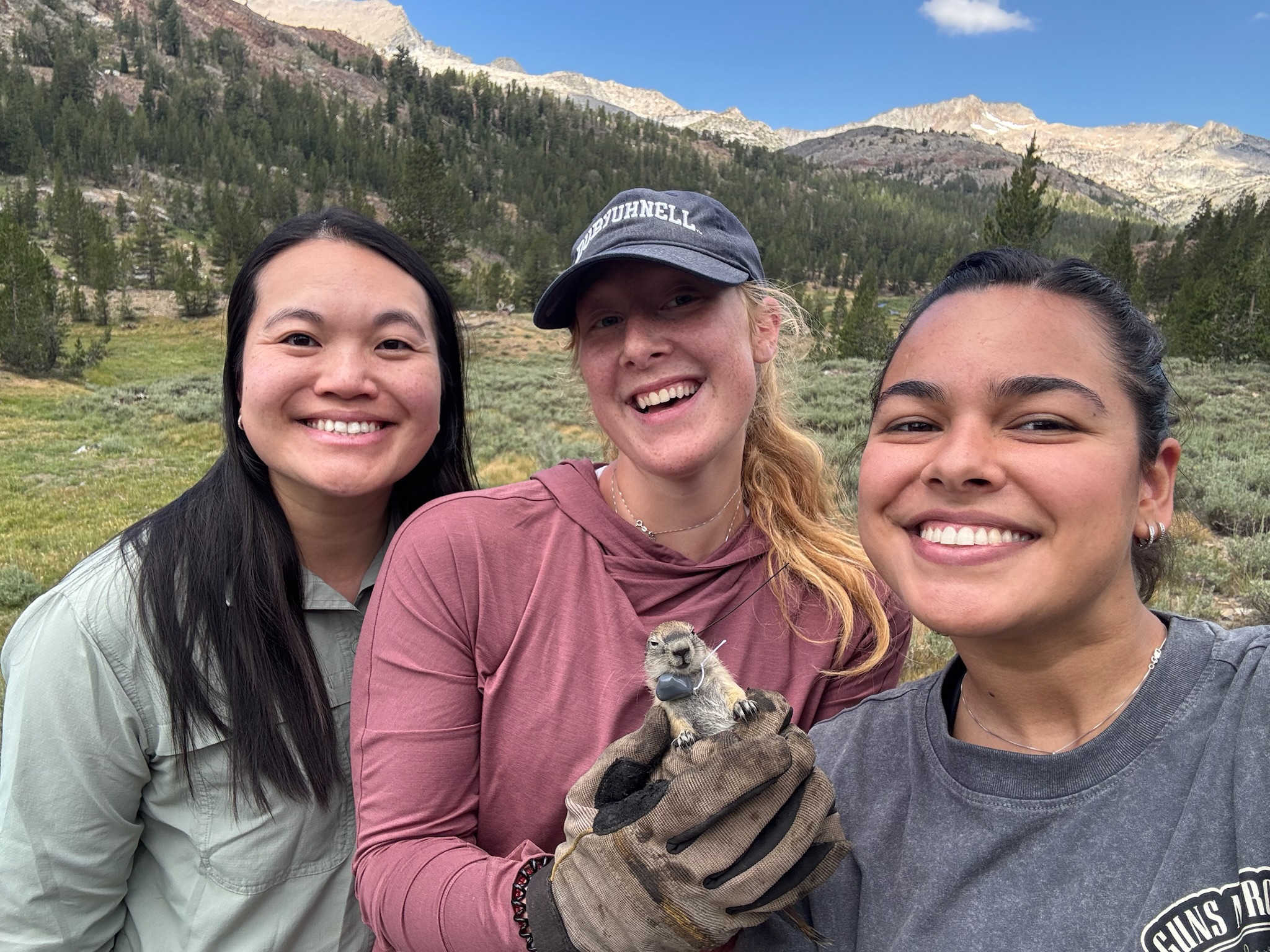 Lee, Thompson and Ferreira perform fieldwork out West.
As Lee’s first research student at W&L, Thompson has grown into an informal anchor in Lee’s lab, training new students, leading much of the lab work and helping shepherd multiple projects at once. She has spent up to seven or eight hours at a time sectioning tiny rat and tuco-tuco brains in a cryostat so the team can later analyze receptors related to social behavior. This fall, she is helping to lay the foundation for expanding the lab’s squirrel research closer to home in Rockbridge County.
“I had an epiphany when I was in Yosemite,” she says. “I realized that if this could be my life, I would so enjoy it. I would be living life to the fullest.”
The realization has led her to begin thinking of where her career might take her beyond medical school. She has had many conversations about the future with Lee, whom she credits with being an open and warm mentor.
“Nikki has such an easygoing personality,” Thompson says, “and she creates a really open environment where you can go and talk to her about anything and everything.”
Like Thompson, Ferreira had Lee for a course on the brain and behavior, and Lee became her adviser during her sophomore year. Ferreira, a neuroscience major with a data science minor from Brazil, is particularly interested in computational neuroscience. She says that her time with Lee in the classroom and the lab has confirmed her interest in pursuing a Ph.D. and a career path in research. Ferreira says that the experience of learning to do scoring in the lab is just as important as the hands-on field research; she says that while her summer experience showed her that she is capable of flexibility, the repetitive nature of lab work has driven home the need for patience and precision to produce quality research, a lesson she thinks will serve her well in the long run.
“You have to do certain things in research that are not going to be the most exciting and groundbreaking, but they are just extremely important to keep things running,” she says. “I now see research as not just a passion, but a responsibility. Passion will take you as far as it can, but you need goals and commitment to keep going.”
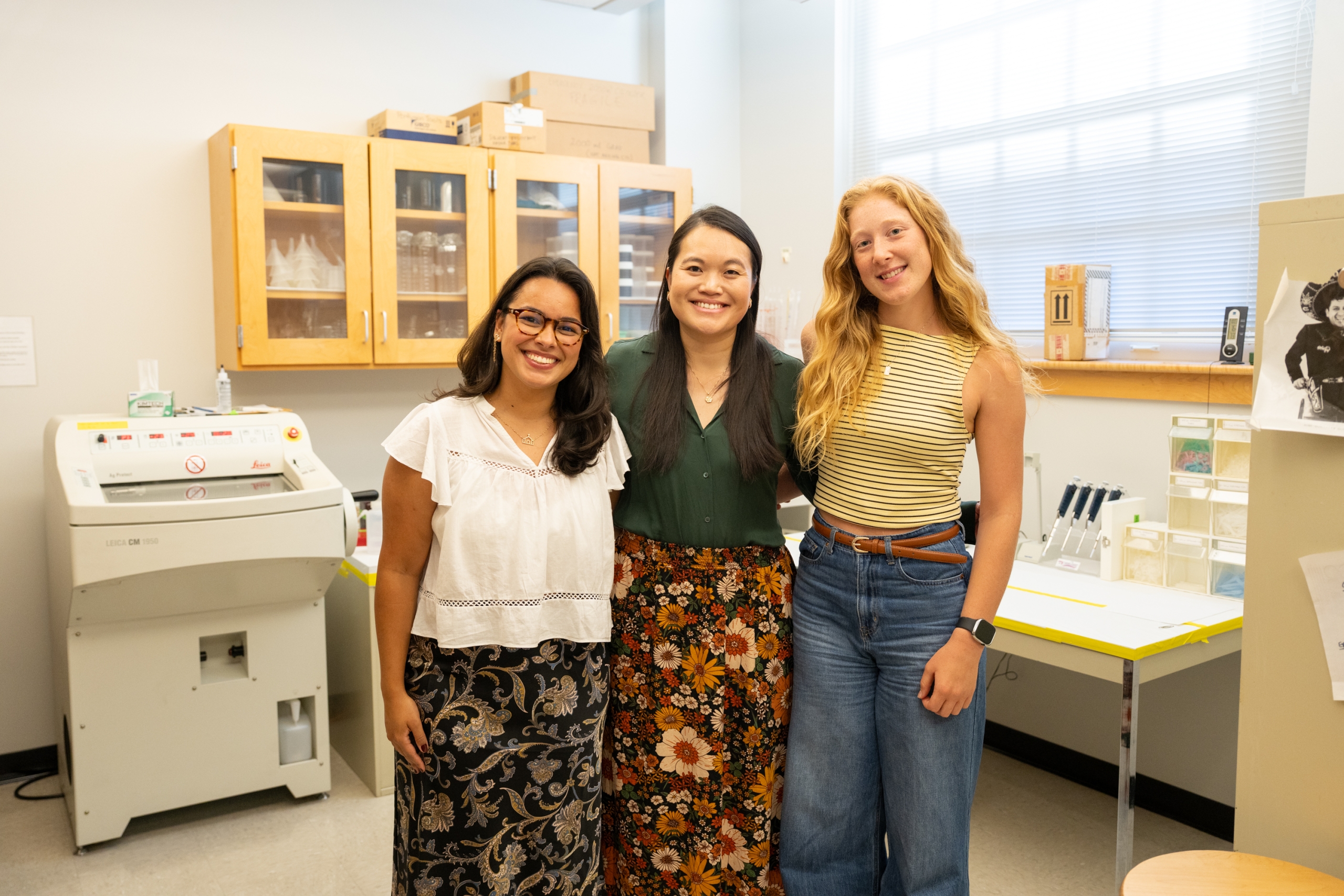 Ferreira, Lee and Thompson in the lab.
If you know any W&L faculty who would be great profile subjects, tell us about them! Nominate them for a web profile.


You must be logged in to post a comment.