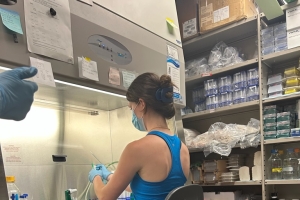
W&L’s DART Fellowship Participants Gain Valuable Experience in Lab Research and Patient Care Maren Barclay ’27, Beamlak Abebe ’28 and Martha Afoakwa ’27 spent their summer in research labs across the country through the DART Fellowship program.
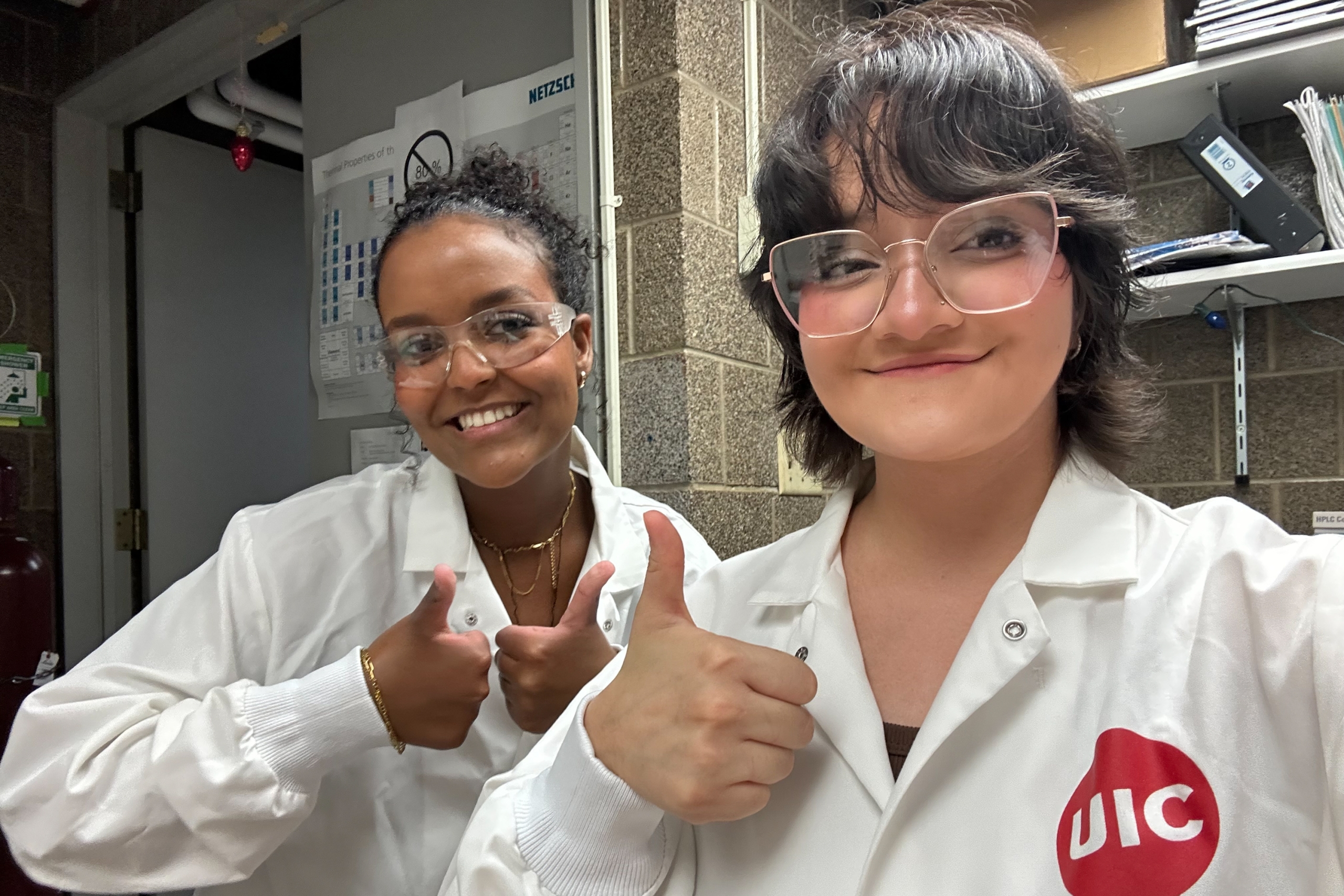 Beamlak Abebe ’28 (left) and her fellow intern pose for a photo in the lab at the University of Illinois Chicago. Abebe spent her summer conducting medical research through W&L’s DART summer internship program.
“The experience in these labs is a high-quality one, and results in students having excellent letters of recommendation from their mentors. It’s an incredibly impactful growing experience for our students.”
~ Bob Stewart, professor of cognitive and behavioral science
This summer, three Washington and Lee students honed their research skills in labs around the country through the Dana’s Angels Research Trust (DART) Fellowship. The program places students in labs studying Niemann-Pick disease type C (NPC), a rare and fatal neurodegenerative disease that mostly affects children. This year, the program connected three fellows — Maren Barclay ’27, Beamlak Abebe ’28 and Martha Afoakwa ’27 — with faculty labs at the National Institutes of Health, the University of Illinois Chicago and the University of Michigan.
Abebe, a biochemistry major, spent the summer in Dr. Stephanie Cologna’s lab at the University of Illinois Chicago, working on the proteomics side of NPC research, studying how the disease-causing mutation changes proteins in liver and brain tissue.
“We were analyzing their proteins,” Abebe says, comparing samples from “an affected rat, a wild-type rat and a heterogeneous [carrier], and seeing how the protein would be affected in those three.” The work meant learning an arsenal of new techniques, from BCA assays to Western blots to mass spectrometry, the last of which Abebe had a head start on, having used a mass spectrometer in a previous W&L chemistry course that examined the chemistry of winemaking during a Spring Term Abroad in South Africa.
Abebe said one of her most valuable experiences this summer happened outside the lab. Abebe’s principal investigator introduced her to one of the few doctors in the U.S. who treats NPC patients directly, and Abebe spent some time shadowing her and observing patients receiving treatment through an active clinical trial, including a 35-year-old NPC patient, a unique case given how rarely patients with the disease live past childhood.
“It just made me more sure of the path I want to go,” Abebe says.
The experience has inspired her to explore M.D./Ph.D. programs at schools like Northwestern University, the University of Chicago and Johns Hopkins University, a track she plans to pursue after a possible gap year or two working as a clinical research coordinator.
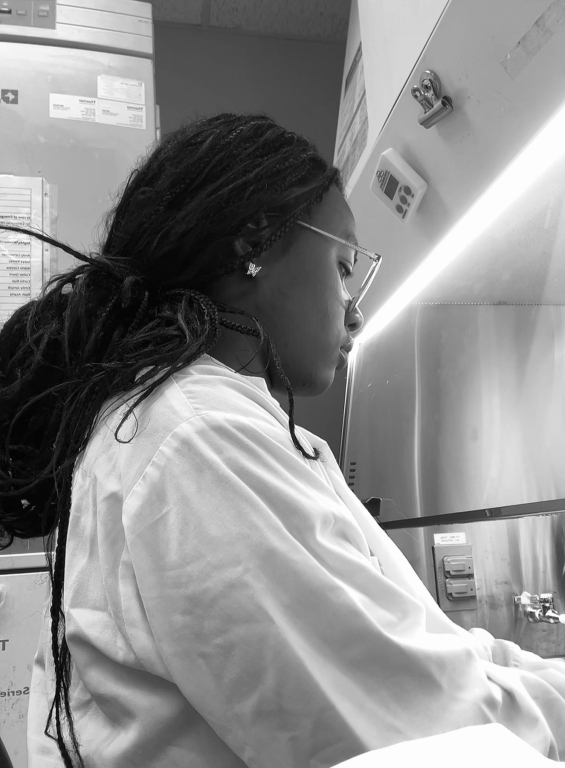 Martha Afoakwa ’27 in the lab during her DART fellowship experience at the University of Michigan.
Afoakwa spent her summer as the only undergraduate in Dr. Andrew Lieberman’s lab at the University of Michigan in Ann Arbor, working on proteostatic therapy approaches to NPC, which are strategies that modify how cells fold proteins rather than replacing the defective gene itself. After a few weeks of training on lab basics like thawing, maintaining, splitting and counting cells, Afoakwa began testing a modified compound developed in the lab, evaluating whether it performed better than earlier versions.
“I was given the independence to make decisions with my research,” she says, adding that the lab team members were excellent guides as she navigated this autonomy in the lab.
Afoakwa said she hadn’t expected to end up researching a disease this rare when she began considering summer internships.
“I had some knowledge of what [NPC] was, but actually getting to spend time in the lab and researching it, I feel like I can now basically talk to someone about it without having to look at a note,” she says.
Like Abebe, the experience has piqued her interest in M.D./Ph.D. programs as she continues to pursue her pre-med coursework at W&L. Beyond the science, Afoakwa says the open and welcoming work culture of Lieberman’s lab made creating relationships with her teammates outside of work a rewarding aspect of the summer; her fellow researchers, all of whom were graduate students, invited her to trivia nights, a local arts fair and a movie night and organized a goodbye ice cream trip and lab team lunch on her last day.
Barclay, a neuroscience major, spent 10 weeks at the NIH research lab in Bethesda, Maryland, working in the lab of Dr. Forbes Porter as part of her neuroscience practicum. Barclay said she was surprised and thrilled to learn she had been accepted into this particular lab, which was highly recommended by Bob Stewart, professor of cognitive and behavioral science and head of the neuroscience program at W&L.
“I applied in December, and then 48 hours later, I heard back,” she says.
Porter’s lab combined bench research with a clinical practice treating NPC patients, which gave Barclay a rare window into both sides of finding solutions for patients battling a rare disease. Her project was the tail end of a larger study on protein isoforms tied to NPC, and it produced what she calls a negative result; details on the experiment will be released when the study is published.
“There actually is not a difference in the isoforms that we were studying,” she says, adding that it is important to note that this study’s outcome was just as valuable as a positive one.
“Even though it doesn’t do what we anticipated it to do, it still is just as important to how we understand this disease and how we understand the brain,” she says.
For Barclay, the summer was a valuable affirmation of her interest in direct patient care. This fall, she will finish her neuroscience practicum with a capstone project in studying hormones and social behavior in assistant professor of cognitive and behavioral science Nikki Lee’s Social Behavior Lab, which examines how hormones impact behavior in various species of rodents. Barclay says she deliberately chose a different kind of neuroscience from the wet-lab pathology work she did at the NIH.
“I think both of those things working in tandem will be a really informative way of understanding the whole of neuroscience,” she says. After graduation, she plans to continue working as a certified nursing assistant, a job she’s held the past two summers, while she applies to physician assistant or nurse practitioner programs.
All three students say that their experience has helped refine their future academic path. And Stewart, who has helped shepherd students into the program for years, has had the opportunity to see multiple alumni benefit professionally from the experience.
“The experience in these labs is a high-quality one, and results in students having excellent letters of recommendation from their mentors,” Stewart says. “It’s an incredibly impactful growing experience for our students.”
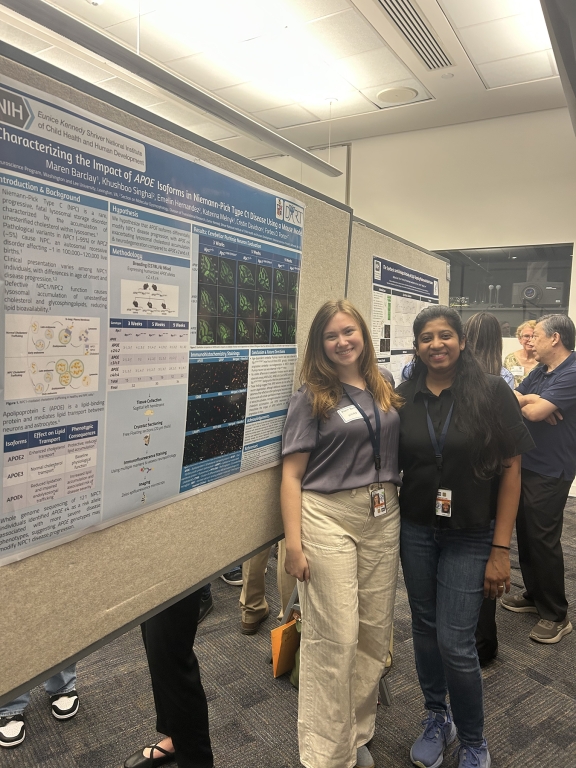 Maren Barclay ’27 with her lab supervisor, Khushboo Singhal, at the National Institutes of Health summer intern poster session in Bethesda, Maryland.

You must be logged in to post a comment.