May 21, 2026
Four Years in Focus
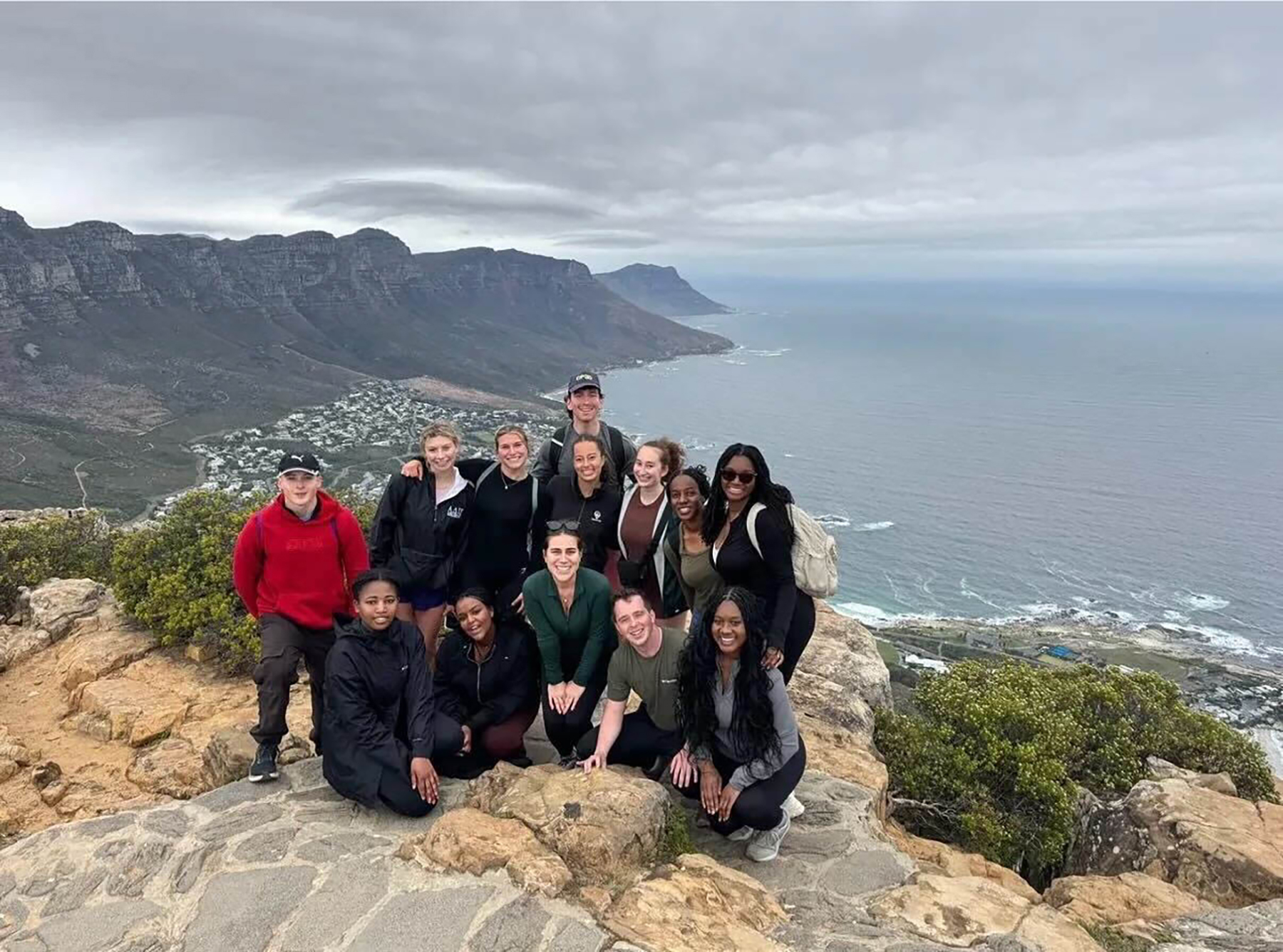 Visiting assistant professor of chemistry Connell Cunningham and professor of English and Africana studies and Associate Provost for Faculty Development Leslie Wingard Cunningham’s Spring Term Abroad students on a hike near Cape Town, South Africa.
“I felt like I was also a student in the class, and that was really fun for me.”
~ Emily Landry, assistant professor of business administration
When Washington and Lee launched Spring Term Abroad in 1971, interdisciplinary study emerged almost immediately as one of its defining features — a natural fit for a shortened term that asked faculty to design courses accessible to anyone, regardless of their major. More than five decades later, that spirit remains very much alive across the 110-plus courses now offered each Spring Term. This year, W&L also sent its highest number of students on Spring Term Abroad, an opportunity for immersive study that has allowed over 60% of W&L students the chance to study abroad before they graduate. Three pairs of W&L faculty created new, never-before-offered courses, which were also designated courses through W&L’s Office of Community-Based Learning (CBL), that blended two disciplines in surprising ways. The professors took students to Ghana, South Africa and the Orkney Islands of Scotland to immerse themselves in communities where their interdisciplinary interests uniquely intersected.
Tech for Good
Bright Frimpong, assistant professor of business administration, and Jonathan Eastwood, the William P. Ames Jr. Professor of Sociology, took a class of W&L students to Ghana to explore questions of culture and economics that intersect with their respective areas of research. Their four-credit Spring Term course, BUS/SOAN 368 Tech for Good, asks how business owners in Ghana are using technology to build trust, solve problems and foster development — “often,” the course description notes, “in ways that challenge Western assumptions.”
The course came together through conversations between Eastwood and Frimpong that sparked collaboration. Frimpong — who holds a Bachelor of Arts from the University of Cape Coast in Ghana and joined the W&L faculty three years ago after getting a Ph.D. in information systems from the University of Texas Rio Grande Valley — quickly found a thinking partner in Eastwood, who has been on the W&L faculty since 2006.
“We’re both really interested in how societies solve problems that require complex cooperation — whether it’s business or politics or anything else — and what are the affordances and disadvantages of technological means to those problems,” Eastwood says.
Both have made trust and cooperation central to their separate research. Eastwood — author of the recent book “Social Structure: Relationships, Representations and Rules” — has spent the last several years studying the apparent rise of interpersonal and institutional distrust in the U.S. and around the world, work he discussed in his Ames professorship inaugural lecture, “Reflections on the Sociology of Cynicism and Distrust,” earlier this year. Frimpong’s own work on crowdfunding keeps circling back to the same question: How do strangers build enough trust to do business with each other, and what gets in the way?
Frimpong says he came at that question from a different direction than Eastwood.
“I wrote a paper that looked at how technology intersects with marginalized cultures,” he says. “We like to think that technology is for good. It helps alleviate inequalities. And if you use it right, it can really do a lot of good in society. But for some societies, we tend to see both good and negative effects. We wanted to explore why this is the case.”
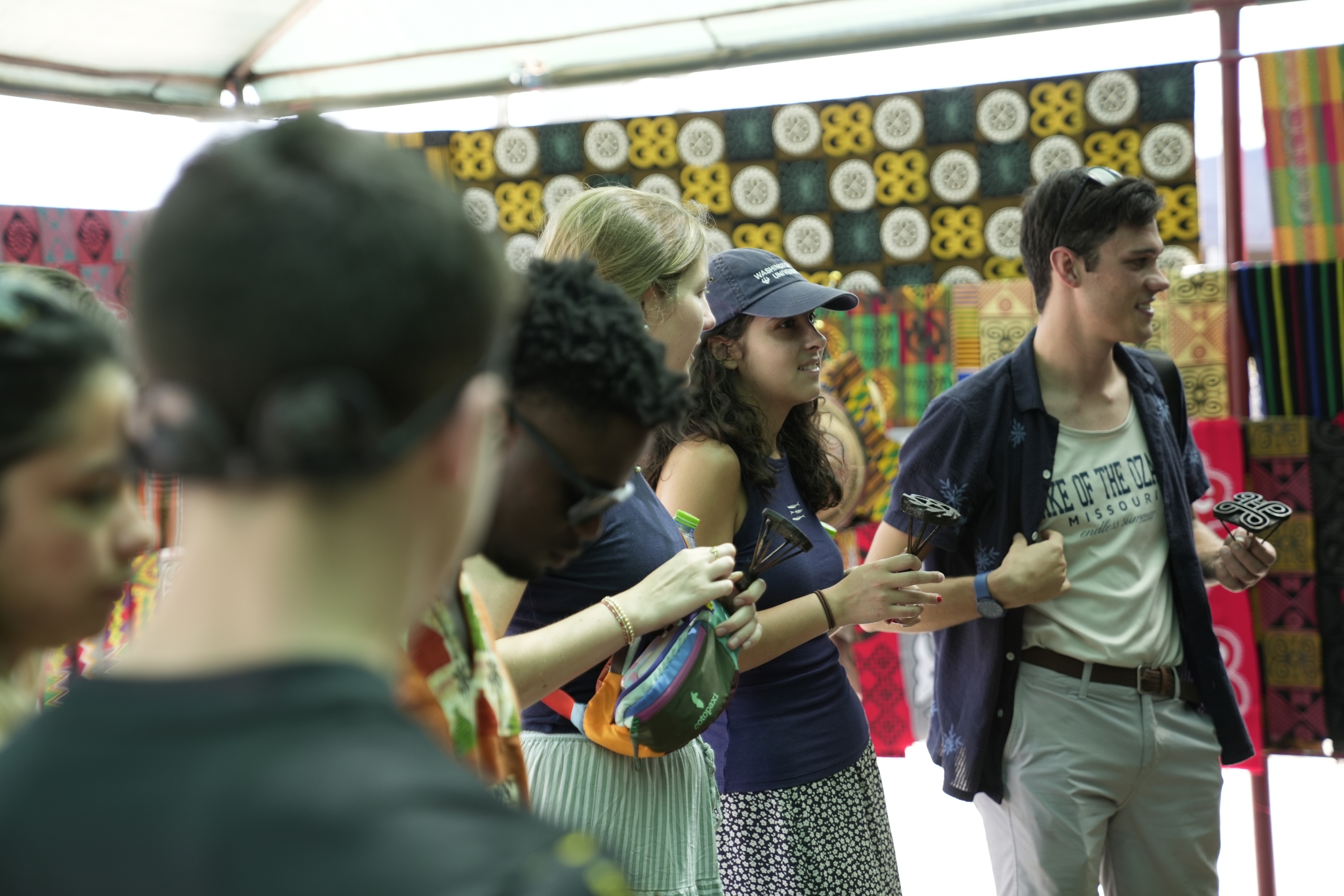 Students in the Tech For Good Spring Term Abroad course visit the premier hubs for authentic kente and Adinkra production located just outside Kumasi in the Ashanti Region of Ghana.
Frimpong says his home country of Ghana is one of the most interesting places in the world to ask that question. Ghana is courting tech jobs while still navigating the institutional legacy of an extractive colonial economy.
“Ghana offers that perspective where we’re trying to embrace the future, but also not necessarily forget the past,” he says.
That contradiction was woven thoughtfully into the course syllabus. Over a one-credit Winter Term prep course, three weeks in Ghana and a final week back at W&L spent producing a digital storytelling project, the class moved between sites that show technology arriving in Ghana and institutions that pre-date it. They visited slave trade castles, the Museum of Science and Technology, the National Lottery Authority and the passport office. They met market women who run rotating credit associations and worked with a community partner that introduces elementary-aged students to technology and computer use. They studied how digital tools, like mobile banking and online marketplaces, interact with deeply rooted social networks. At the science and technology museum, Frimpong asked his students to look at the artifacts and consider that almost all were not native to Ghana.
“That should tell you that technology is a foreign object,” he says. “The country isn’t producing its own technology to assimilate; rather, we try to import foreign tech that has foreign values.”
Crowdfunding is one example of how this plays out, Frimpong says. It works beautifully in cultures where strangers will give to strangers because the platform itself is the trust mechanism. It largely doesn’t work in Ghana.
“People value reciprocity, people value recognition, people value the social capital,” he says. “The platforms don’t necessarily embody that.”
When a friend has a crisis, an app might allow you to send money instead of showing up, which is very different from the way Ghanaians typically approach community support.
“It is a structure that commoditizes the support,” Frimpong says. “If you don’t have money, you are locked out. Meanwhile, in the past, you could offer your services. You could come with your kid. You could run errands. It was a form of social capital. But technology breaks that down.”
The course’s central question, then, is whether there is a way to keep the gains of the technology without flattening what was already working.
Gabe Ketchum ’28, a business administration major from Philadelphia minoring in journalism, said the trip made the interdisciplinary connections obvious in a way no lecture could.
“The lack of literacy and access to economic growth and development is connected to the people-to-people interaction — that’s where the business and the sociology overlap,” he says.
Some of the most lasting impressions had nothing to do with the curriculum. Ketchum, who created a social media vlog documenting his experience, described the welcoming atmosphere and joy among the people the class met — “from top down, as far as age range, from corporate executives to the marketplace workers” — that he expects to remember longest.
Pairing chemistry and culture
Leslie Wingard Cunningham, professor of English and Africana studies and W&L’s associate provost for faculty development, and her husband, Connell Cunningham Jr., visiting assistant professor of chemistry, are accustomed to cross-disciplinary conversations. When they decided to co-teach a Spring Term abroad course together, they leaned into their dynamic as a married couple.
“We’re sort of mimicking with our students what we experience in our own house all the time,” Leslie Wingard Cunningham says.
Their course — cross-listed as AFCA 287 and CHEM 158 and titled Bitter Grapes: The Chemistry and Black Cultural History of Wine in South Africa — brought 17 students to Cape Town, South Africa, including Langa Township, as well as Franschhoek, the Cape Peninsula, Robben Island and Stellenbosch for four weeks under two separate syllabi that shared a single set of excursions. Chemistry students, who completed a Winter Term lab-and-fieldwork foundations class before departing, were asked to apply standard analytical techniques to understand the composition of wines, the evolution of flavor and the process of fermentation. Africana studies students read Black literature, studied theater and visual art at South African museums, engaged guest speakers and fellow students abroad in UNESCO Story Circles about today’s sociopolitical landscape and conducted interviews about the country’s Black-owned wine brands as a symbol of the industry’s transformation. The class worked together on a community-based learning project with local nonprofits and attended the same excursions throughout their time in the country.
The two halves of the class connected through an assignment the Cunninghams designed together: tasting cards loosely modeled after 19th-century Anti-Slavery Alphabet books. The project translates both the chemistry and the culture into plain language. One card might define pinotage, the grape variety native to South Africa. Another might explain the dop system, under which Black wine farm workers were once unfairly paid in alcohol, or examine why ownership in the wine industry remains overwhelmingly white. The class partnered with two community organizations that grew out of the industry’s hardest chapters: the Pebbles Project, which provides early childhood and after-school care for the children of wine farm workers, and the Pinotage Youth Development Academy, which trains young South Africans ages 18 to 25 for hospitality and other careers, including roles as sommeliers at the very wine estates where their families once labored.
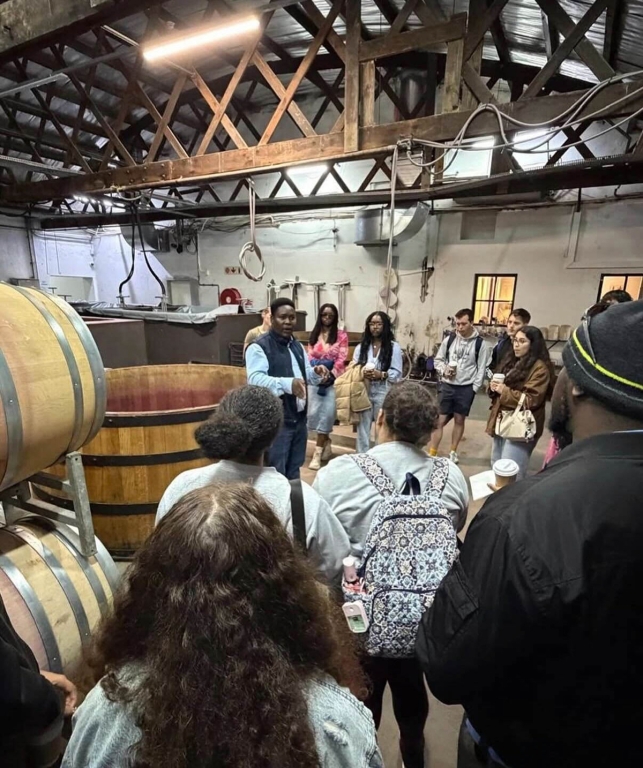 Students meet with a Black South African winemaker during the Bitter Grapes Spring Term Abroad course.
For Thomas Palmer ’28, an economics major from Mamaroneck, New York, the trip was also a personal journey.
“I went to South Africa because I am South African,” he said. “My granny and grandpa live right here in Cape Town. I am surrounded by the places my parents have talked about and learning about my family history as much as I am learning about the wine industry.”
Nava Berwick ’27, a Japanese major with minors in Middle East South Asian studies and religion from Falls Church, Virginia, says she was excited by the opportunity to learn about South Africa’s history through such a unique lens.
“I loved the idea that there was this new and exciting class with the initiative to learn all about South Africa and their history with Apartheid through the lens of their wine industry in two different fields of study,” Berwick says.
“Cooperation, Not a Corporation”
Emily Landry, assistant professor of business administration, conducted a social entrepreneurship course in Cuba for a prior Spring Term Abroad and was eager to find a new context that would allow students to ask the same questions about sustainability, ethics and community. Beth Staples, associate professor of English and editor of Shenandoah, had been looking for the right place to teach creative writing. The two were chatting at a mutual friend’s birthday party when they realized they were describing the same dream course.
What emerged is BUS 366/ENGL 267 Social Enterprise Storytelling — the first business-and-English pairing in Spring Term Abroad. The course consisted of two weeks in the Orkney Islands of Scotland and two on campus. Students earned either business or creative writing course credit.
The premise behind the course is that Orkney sits at an interesting place in the U.K. economy, having quietly become an international testing ground for marine and wind renewable energy on a scale that has reshaped the local economy. A class about how small communities sustain both their culture and their economy, the two professors decided, should incorporate elements that drive the entrepreneurs who have helped kick-start the island’s economy and the rich storytelling culture embedded in the history of their community and of Scotland more broadly.
Two community partners anchored the course. In Kirkwall, Restart Orkney is a for-profit secondhand shop started by the nonprofit Employability Orkney. The shop’s profits support programs to counsel and employ vulnerable residents. In Stromness, Aquatera is a for-profit enterprise with expertise in renewable energy innovation and commercialization. The professors built a program with exposure to a variety of local Orkney enterprises, including two community-owned wind turbine projects. The class spent an evening with renowned Scottish storyteller Tom Muir and learned traditional Scottish dancing with a live cèilidh band. Cultural excursions took students to the Neolithic archeology site of Skara Brae, the Ring of Brodgar and the Standing Stones of Stenness.
Assignments consisted of a mixture of business analysis, qualitative research and creative writing. Staples guided students on how to set a scene, draw a portrait and develop a character on the page, the toolkit that Landry says elevates a competent case study into one that makes a place come alive. Student teams were also asked to write a case study about Aquatera that exploried a real strategic decision the company is currently considering. The case studies, which the faculty and students hope to publish as a collection, could potentially be used by Aquatera to educate future employees.
For the class’s other community partner, Restart Orkney, student teams used data from their qualitative fieldwork to create deliverables for Restart based on identified needs, such as improved web interface prototypes, social media campaigns and a photo gallery of high-quality images that Restart can use in future marketing efforts.
Devon Coyle ’28, an accounting and mathematics double major from Concord, Massachusetts, says she was inspired to bring Orkney’s community spirit and values back to campus with her in the fall.
“On an island, there is a sense of place, purpose and connection,” she says. “The intersection of those three is a perfect place to be within. It’s knowing who you are, knowing your environment and discovering how you can find your proper place to make the area around you a better place.”
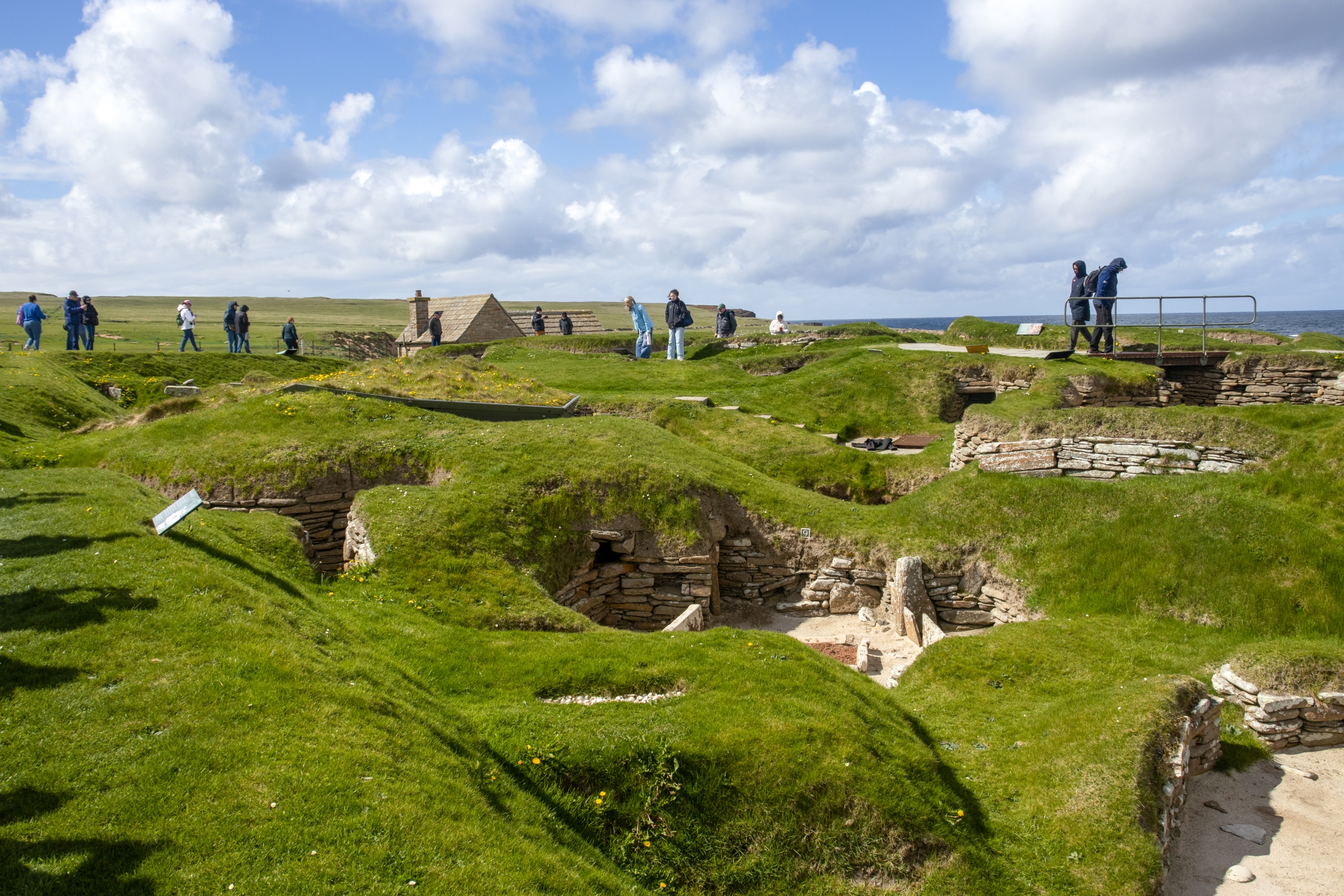 Students visited archaeological sites around the Orkney Islands in Scotland.
Both professors said the most surprising part of the experience was being a student in their own course.
“It was like I was learning alongside my students when Beth was teaching anything about creative writing,” Landry says. “I felt like I was also a student in the class, and that was really fun for me.”
Staples said the partnership reframed her thinking about the disciplines themselves.
“I wouldn’t have had any reason to go talk to business owners in Orkney,” she says. “But business is about people, and creative writing is about people.”
That co-teaching dynamic also shaped what students experienced.
“They got to learn about the history and the stories and the people and the business landscape,” Staples says. “It was really a full picture of this place in a way it wouldn’t have been if it were just one of us.”
Kaia Lain ’28, a double major in accounting and philosophy from New York City, says it was the faculty themselves who sold her on the trip.
“There were so many fun and amazing Spring Term Abroad programs,” she says, “but speaking with both professors and seeing how long they had wanted to make this trip happen because they were just drawn to the people and community made me want to experience it for myself.”
A quote from Gareth Davies, Aquatera’s founder and CEO, kept echoing for Landry through the rest of the trip, a line she said she expects to bring home to W&L classrooms.
“He told the class in his introduction about Aquatera: ‘We are a cooperation, not a corporation,’” she says. “People coming together for a purpose, to bring significance to a community — that’s the best version of business and how I like to teach it.”
Daniel Emmanuel Jakubowski-Lewis ’26, a business administration and creative writing double major and Japanese minor from Roselle, New Jersey, says his experience in the rural coastal island community of Orkney reaffirmed his belief “in the beauty of humanity” and reminded him of the campus he has called home for the last four years.
“Their culture,” he notes, “although 3,500 miles away, emulates the heart of Lexington’s spirit: a place with nature as beautiful as the people who live in it.”
All three of these Spring Term Abroad courses were also designated courses through W&L’s Office of Community-Based Learning (CBL). CBL supports faculty across all disciplines in designing courses built on reciprocal partnerships that aim to benefit students, community partners and the greater good. See examples of recent CBL courses and initiatives.

You must be logged in to post a comment.