February 3, 2026
Educational Odyssey
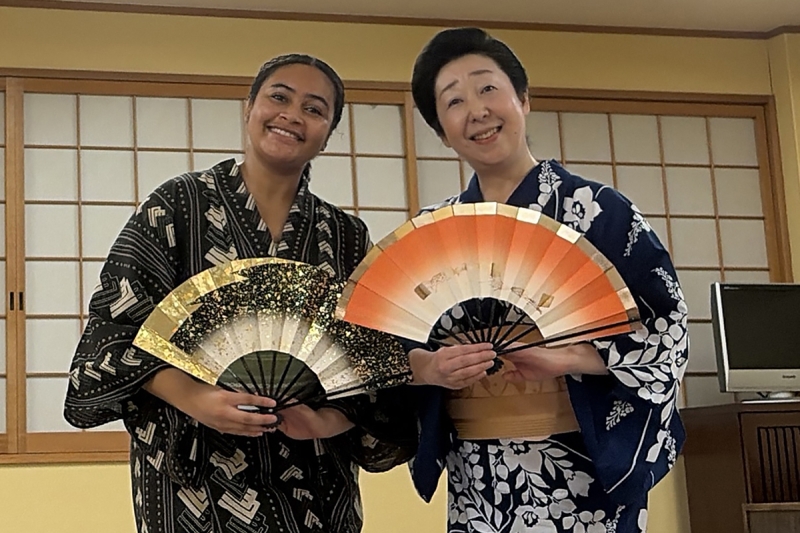 Nava Berwick ’27 with her nihon buyo dance master, Eiren Nishikawa, in Kyoto, Japan.
“The Johnson Opportunity Grant made it possible for me to actualize and dive into ideas I would not have had the opportunity to do otherwise as an undergrad.”
~ Nava Berwick ’27
Falls Church, Virginia, native Nava Berwick ’27 describes herself as “a disciple of traditional Asian dance since the age of 4,” particularly traditional Indonesian dance. This summer, Berwick, a Japanese major with double minors in Middle East and Southeast Asian Studies and religion, embarked on a research project supported by W&L’s Johnson Opportunity Grant to deepen her dance training and research various forms of dance styles across Asia through an interdisciplinary lens.
Since Berwick started training in classical Indonesian dance in 2008, she has added intensive training in Indian dance (specifically Bharatanatyam and Odissi styles) and most recently traditional Japanese dance to her repertoire. She has extensive performance experience, including showcases at the Smithsonian, the National Cathedral, the Embassy of the Republic of Indonesia and ambassador’s residence and other government and educational institutions in the Washington, D.C., area. And she has furthered her study at W&L, as she has twice won the U.S. Department of State’s Critical Language Scholarship for Indonesian language and culture, completing intensive in-country study at the University of Malang in both 2024 and 2025.
Over the summer, Berwick trained in Japan’s cultural capital, Kyoto, and the two royal cities of Surakarta and Yogyakarta in Indonesia in pursuit of her goals of deepening her dance training and exploring questions of culture through dance. She spent Fall Term of her junior year abroad in Kyoto where she added Japanese dance to her repertoire as a student at Columbia University’s intensive Kyoto Consortium for Japanese Studies program; returning to Kyoto for a month this summer allowed her to explore the art form in more depth. She says the Johnson Opportunity Grant allowed her to observe and study traditional Japanese dance in Kyoto firsthand, as well as how Shinto and Buddhist practices shape performance, training and audience experience in real-world settings.
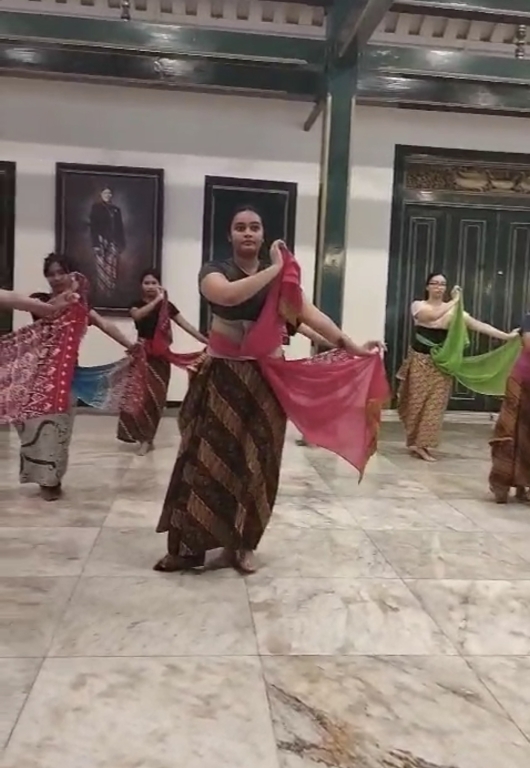 Berwick dancing in the front row at the historic Surakarta royal dance academy, Mangkunegaran.
“The thread connecting my cross-cultural odyssey is an intellectual hunger to examine these classical dances from a more historical and socio-political lens to glean how they affect their societies today,” Berwick says. “The place and impact of these dance arts are especially intriguing when comparing them, as they are Asian but emanate from two completely different cultures. All this fueled my uniquely transnational adventure in Japan and Indonesia.”
In Japan, Berwick studied under a traditional “nihon buyo” dance master, Eiren Nishikawa, focusing on building her expertise at what is known as a “maiko” (geisha) dance, called “The Iris Yukata.” Berwick says she began learning this dance during her semester abroad, noting that she was Nishikawa’s first American student. Nishikawa was also Berwick’s entree into the intricacies of Kyoto’s culture, as she took Berwick to museums and off-the-beaten-path historical sites.
Berwick also interned at Sogoo, a new cultural tourism company in Kyoto, that provides intimate, short-term exposure to traditional cultural practices for local and foreign tourists. She provided translation, marketing, social media, reception and assistant instructor duties, all as the first foreigner to work there and directly contribute to what will be the future of cultural tourism in Japan.
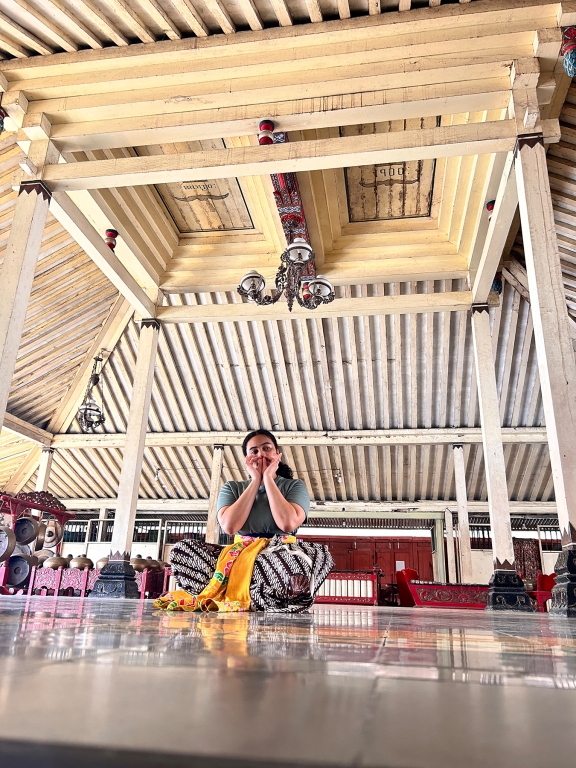 Berwick in a seated position, at the beginning of the Sari Kusuma or “blossoming” dance in Yogyakarta, Indonesia.
In Indonesia, Berwick studied full-time, elite-level Javanese dance from senior masters within the royal courts. Berwick trained on court premises in Surakarta (with masters Theresia Sri Kurniati, Sri Lestari and Ningtyas Puji Kurniastanti) and Yogyakarta (with Heni Pujiastuti), conducted largely in Javanese. Berwick says she is grateful for such a rare opportunity in the world of Indonesian dance.
“It’s rare for outsiders to be given this level of training, and it’s a first to be intensively trained at both royal courts within the same period,” she says.
Berwick’s training in Indonesia began with a personal meeting in Jakarta with Sulistyo Tirtokusumo, a famed royal court dancer who went on to head cultural preservation for Indonesia’s federal government.
“I personally delivered a letter to him from Clare Wolfowitz, the renowned American Indonesia expert and former spouse of the U.S.’ most influential ambassador to Indonesia,” Berwick says. Wolfowitz gained nationwide fame in Indonesia for being the first American to learn a court dance from Tirtokusumo and perform it publicly at the royal palace, or “kraton,” in Surakarta. She is currently on the leadership committee of Santi Budaya, the U.S. Indonesian embassy’s longest-standing community performance arts group, which Berwick grew up in, under the direction of her first teacher, Erna Cinnana Widyastuti.
“The meeting was very special as it was like a passing of the torch to me,” Berwick says.
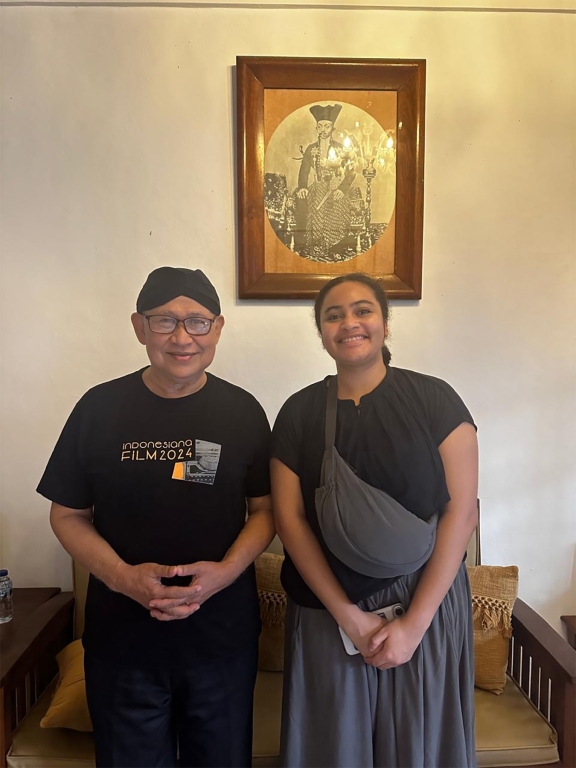 Berwick meeting legendary Javanese dance master Sulistyo Tirtokusumo in Jakarta, who served as the last director general of culture for the Indonesian government.
These field experiences have given her concrete case studies and examples of how religion and social hierarchy intersect, which is the core question of her honors thesis on Japanese dance. The grant-funded experience effectively served as on-the-ground data collection, deepening and refining an intellectual project she says she had already envisioned before coming to W&L. Berwick plans to fold her observations and insights from Japan and comparative reflections from her time in Indonesia into an honors thesis project analyzing how traditional dance both reflects and reinforces Japan’s historical and contemporary social structures. As co-president of the Around the Globe dance club on campus, Berwick plans to bring her practical skills to the club’s campus programming.
Berwick says she has her father to thank for his ongoing encouragement as she pursues the opportunities available to her in college.
“I also had major help and inspiration from my father, Stephan Berwick, who has been a huge supporter of my intellectual pursuits at W&L,” she says. “Honestly, for my whole life he’s been an avid supporter for my learning Indonesian dance at such a young age and ensuring I put all of those years of dance into a meaningful research adventure during my time in college. My father’s definitely a fan of seeing the big picture in everything you do, and I’m grateful to have gained that value from him.”
Berwick says she was grateful that her MESA adviser, Jessie Ball duPont Professor of Religion Timothy Lubin, recommended her for the Johnson Opportunity Grant. Lubin has worked closely with Berwick and says that she was uniquely prepared to pursue the project, having arrived at W&L already strongly committed to the study of South and East Asia, with extensive training in dance traditions from India and Indonesia, as well as in Japanese language study. Berwick studied Buddhism and Sanskrit with Lubin during her first year, and she took his Spring Term Abroad course in Nepal (co-taught with Professor of Economics Shikha Silwal).
“The project itself is well conceived and shows original conception and analysis on her part,” Lubin says. “She has relevant language skills for the countries she plans to work in, such as advanced Japanese, Indonesian, the basics of Sanskrit, expertise in the practice of dance in both cultures and an already-demonstrated capacity to handle the challenges of travel and study in Asia, including in the framework of my STA course in Nepal and Critical Language Scholarship programs in Indonesia.”
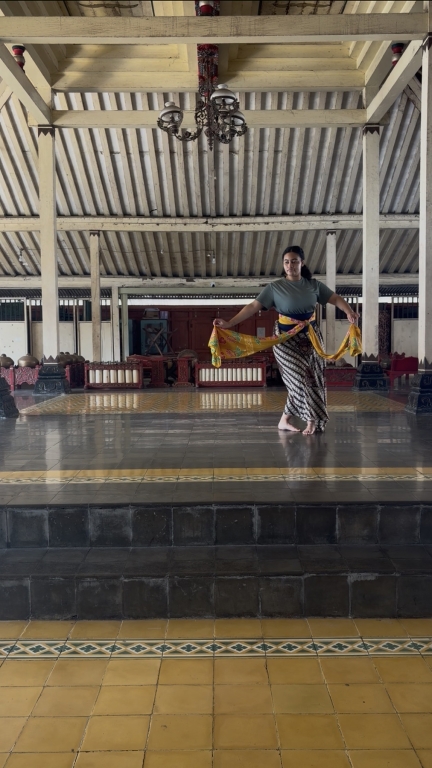 Berwick learning the Yogyakarta royal court “Sari Kusuma,” or “blossoming,” dance.
Lubin notes that the project brings together her ongoing research interest in both cultures in an implicitly comparative context.
“The questions that she brings to the project are important and may be applicable more broadly,” he says. “What is the cultural meaning and the public value of these dance traditions in these countries today? What does framing them as ‘classical’ do? Given their role of elite tastemakers in this framing, how do these traditions relate to broader-based popular dance forms? What is their social reach and salience?”
Lubin also says Berwick’s project aligns with the grant’s core mission.
“Johnson Opportunity Grants play a crucial role in W&L education: They provide funding that both stimulates and responds to students’ creative thinking and energies to learn on the ground in the wider world beyond campus,” Lubin says. “The open-ended nature of the program is its greatest feature. Students are invited to make a case for a project that might not fit the parameters of more ends-oriented, credential-generating or discipline-centered programs.”
“The Johnson Opportunity Grant made it possible for me to actualize and dive into ideas I would not have had the opportunity to do otherwise as an undergrad,” Berwick says. “It gave me the rare chance to design a transnational field research project focused on an intellectual niche I’ve harbored since high school.”
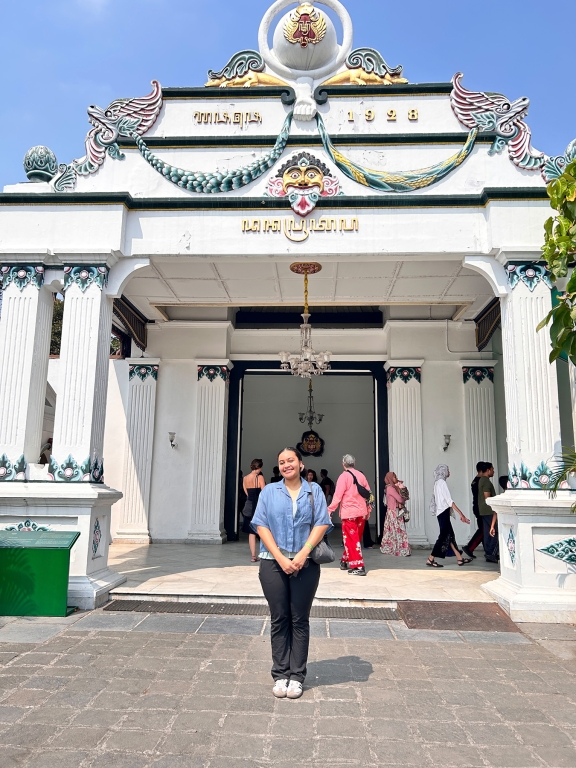 Berwick at one of two main gates leading inside the sacred Royal Kraton (Palace) of Yogyakarta, Indonesia.
If you know any W&L students who would be great profile subjects, tell us about them! Nominate them for a web profile.
The Johnson Opportunity Grant program has supported a wide range of summer experiences:
Chris Paudel ’28 set out to challenge himself — and cultural stereotypes — through a mountaineering expedition in his home country of Nepal.
Sofia Iuteri ’27 expanded the reach of the nonprofit she founded at 16.
Meredith Harron ’26 trained and performed with the Mediterranean Opera Festival in Caltagirone, Sicily.
Ryan Doty ’26 traced his family lineage across Europe through poetry and photography.
Marcie Bernard ’25 explored the different avenues of veterinary medicine in the Amazon Rainforest.



You must be logged in to post a comment.