February 11, 2026
Winter 2026 Update on Campus Construction Projects
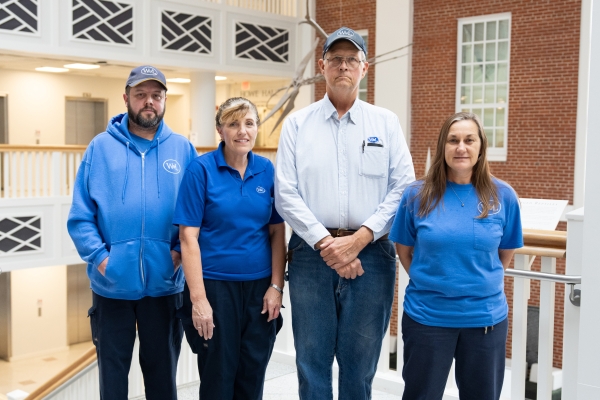 The Science Center custodial crew spent nearly 12 years working together. Pictured left to right are Chad Davis, Joyce Zimbro, Bobby Rhodenizer and Kim Hartless.
By the first signs of morning activity on the Washington and Lee University campus, their work is mostly done. The trash is gone, the floors are mopped and the classrooms are spotless and ready for learning. If W&L’s custodial crews have done their jobs well, few people will give it a second thought.
Though mostly unseen, this skilled and hardworking group plays a central role in helping the university fulfill its mission. Most of W&L’s custodians arrive well before sunrise, working overnight so they won’t interfere with the day’s activities.
University Facilities employs 61 full-time custodians across 11 teams. Eight teams clean the academic and administrative buildings, and three take care of the residence halls and the sorority and fraternity houses. The Department of Athletics and Physical Education employs six more custodians, who care for facilities such as the Duchossois Athletic and Recreation Center and Wilson Field.
Together, the crews care for over 100 buildings totaling more than 2.4 million square feet.
“It’s a lot of sweat — trying to get things done, regardless of the building you are working on,” said Janie Hotinger, custodial manager in University Facilities. “You know you only have so many hours to get the job done.”
Divide and Conquer
Tracy Huffer, director of operations and maintenance in University Facilities, oversees the custodial operation, with Hotinger serving as the custodial manager. She manages three custodial supervisors: Dreama Monahan and Nicole St. Clair, who lead the academic and administrative crews, and Greg Roberts, who guides the residential crews. All four were promoted from within, providing firsthand knowledge of the challenges their teams face.
Each team has a lead, and the size of each team depends on the building or buildings it covers. The Washington and Lee School of Law, at nearly 95,000 square feet, and the W&L Science Center, at just over 92,000 square feet, each have a dedicated team of four custodians. A team of similar size elsewhere may be responsible for as many as eight smaller buildings.
The academic and administrative crews arrive at 2 a.m. and finish by 10 a.m. The residential crews work from 6 a.m. to 2:30 p.m., with one team responsible for all of the residence halls, one for the sorority houses and another for the fraternity houses.
The overnight crews follow the same order in every academic building.
“When they come in at 2 a.m., they will start classrooms and restrooms right away,” Hotinger said. “They need to try to get everything done, including the common areas, before students begin arriving. Once classes start, there’s no more vacuuming — we shouldn’t do anything to disturb the classes.”
The residential areas bring their own challenges.
“We have to work around the students’ schedules and their personal items in many cases,” Roberts said. “It’s their house — the hallways, common rooms and dining rooms. Of course, they’re going to leave things lying around like we all do at home, and the crews need to determine whether they move something or work around it.”
Most of the time, the teams work independently. But when the snow falls, the crews trade their mops for shovels and help when needed elsewhere. The same happens in the event of an emergency. In May 2018, Bobby Rhodenizer, custodian in the Science Center, discovered water on the second floor and followed it to the source three floors above, where the water treatment system had failed.
“That was one of those days where you let everything else go,” Rhodenizer said. “Pretty much the entire custodial team came to the Science Center that day to help us clean up all the water.”
“It was such a huge amount of water, something like 30,000 or 40,000 gallons,” said Bill Hamilton, the John T. Perry Professor Jr. in Research Science. “It had been dumping for a long time, and facilities got the right people here to help with the cleanup. Fortunately, it was summer. There was a lot of overtime to make sure we could dry out and start functioning. It’s times like that when you realize what good people you have working with you on this campus.”
No Summer Break
For much of campus, summer spells time away or a chance to catch up on projects. For the custodial teams, it brings some of the most demanding work of the year.
“In summer, this school doesn’t shut down. It goes all year-round,” Huffer said. “And summer is actually probably more challenging than the academic year because of all the juggling we have to do with building turnovers.”
Summer camps for high school students have grown, and with late stays, early arrivals and an abundance of research students, campus is still a wave of activity all summer long. “Housing turnover is very challenging for these guys,” Huffer said.
Academic crews join the residential teams to turn over residence hall rooms, including the 343 rooms in Gaines and Graham-Lees halls that are turned over when unused. Summer is also when crews strip and wax tile floors and deep clean carpets.
“Most of the buildings are free, but some have camps in them,” Monahan said. “Once the campers are gone at the end of July, you’ve only got four weeks to get your building ready. It’s like moving chess pieces around the board trying to figure out who can clean what and when during the summer.”
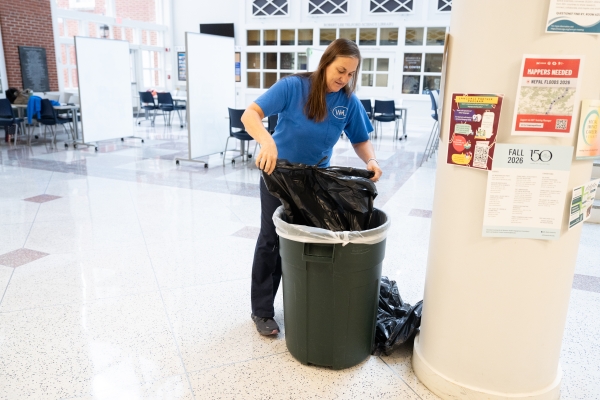 Kim Hartless
Pride in Cleanliness
The proof is in the results. W&L’s custodial teams care deeply about the quality of their work. In February 2026, Core America, an independent consulting firm that works with more than 250 colleges and universities, released an assessment of W&L’s custodial program. Its inspectors checked 3,339 items in 195 rooms across 26 buildings, and W&L earned an overall quality score of 91.6%. Many of the observed buildings reached the top level on the cleanliness scale used by APPA: Leadership in Educational Facilities, the professional association for college facilities leaders, a standard it calls orderly spotlessness.” Compared with nine peer institutions, W&L scored the highest.
“Even though we received great scores, there were things we learned from the report that we could improve on,” Huffer said. “Before the assessment, Janie oversaw 39 employees on her own, which is a lot. We took the report’s information and made some necessary adjustments to the reporting structure by dividing the group, adding two new supervisor positions and promoting Janie to custodial manager.”
As for the boots on the ground, the report confirmed what most already knew — W&L’s custodians do quality work.
“You take pride in your buildings,” Monahan said. “When I started as a custodian, I know I took pride in cleaning the walls and shampooing the carpet. You can really see a difference from the work that you’re doing, and you can feel good about that.”
Staying Power
That pride may help explain why so many stay. In September 2026, the College and University Professional Association for Human Resources (CUPA-HR), the association for higher education HR professionals, reported that custodians and housekeepers at colleges and universities had a median of three years or fewer in their positions. At W&L, the median custodian has been with the university about five years, and nearly 40% have been here 10 years or more.
“It’s not uncommon here because W&L is really good to its employees,” Hotinger said of the longevity enjoyed by many custodians. “Sometimes it takes a bit of time to find the right combination for our teams, but unless someone is retiring or going on a medical leave, our teams usually stick together.”
This was especially the case for the Science Center team, which features a four-person team that spent nearly 12 years together. They developed an unbreakable camaraderie that lasted until Rhodenizer’s retirement last month. Joyce Zimbro serves as the team lead for the Science Center team and is in her 22nd year at W&L. Her sister, Kathy Wallace, spent 45 years with the university, the final 35 of them cleaning Washington Hall. Long before she retired three years ago. Wallace recommended that Zimbro join the team as well.
“After having my daughter, I decided to leave my job at Mohawk Industries in Glasgow, Virginia,” Zimbro said. “I babysat and cleaned houses for a little bit before Kathy talked me into coming. She said, ‘If you want your daughter to go to college, you need to come here to work.’ I got in just under the wire on receiving the 90% tuition benefit.”
Zimbro’s tenure is one of many that surpass 20 years. Bernard Butler, W&L’s longest-tenured custodian, joined the university in 1979 and has been a team lead for the past 15 of his 47 years. Carol Hostetter, team lead for the sorority houses, has logged 38 years, and Betty Porterfield has spent 33 years caring for campus.
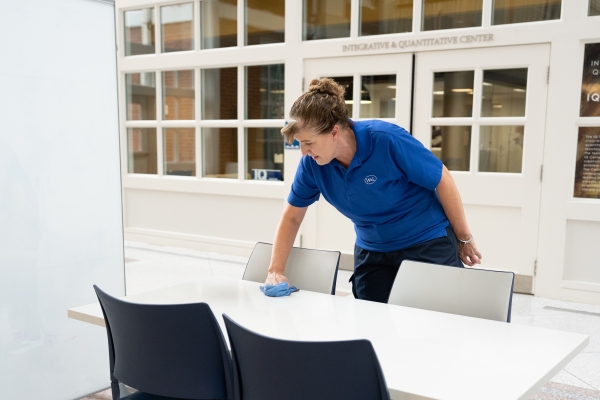 Joyce Zimbro
A Team of Their Own
Nearly a decade after Zimbro started her W&L career, she was joined by three others who once called Mohawk home. Chad Davis and Rhodenizer joined the Science Center custodial team one week apart in January 2015, and Kim Hartless started that April. Zimbro left Mohawk well before the others, but Hartless, Davis and Rhodenizer overlapped there.
“It’s kind of crazy that we all worked at the same facility at some point in time,” Hartless said. “Chad and I worked in the same department for a while. It’s kind of fate that we ended up working here on the same team.”
The team was inseparable, maintaining one of the largest and most challenging buildings on campus. Their accountability to one another and pride in their work helped sustain their longstanding relationship.
“We are respectful to each other, and no one is worried about doing more than someone else,” said Hartless. “If one of us needs help, you can ask one of the others and they will help you — we are a team.”
That teamwork extends beyond the daily cleaning activities. When Davis’ wife, Fern, battled colon cancer, the others picked up the slack.
“I had to take some time off when she was in the hospital, and they understood and covered for me,” said Davis, whose wife died in 2021. Davis continues to provide care for his son, Chad Davis Jr., who has autism, and occasionally needs to leave work to be with him. There again the team steps up to help.
“It’s kind of like a family,” Zimbro said of her team. “It was tough when Chad lost his wife. I don’t even know how he got through it. I know that he hated having to miss so much time, but the whole team was so understanding to help him get through it.”
A Challenging Building
As the second-largest building custodians maintain, the Science Center brings its own challenges. Its architecture is somewhat quirky, requiring the team to divide into sections while also coming together to clean the Great Hall.
Rhodenizer, for example, started his rounds on the second floor, which houses the Physics and Engineering Department, since it is usually the busiest. He always began with the classrooms on the right of the hallway and then cleaned the offices on the left, working his way down the hall until he finishes.
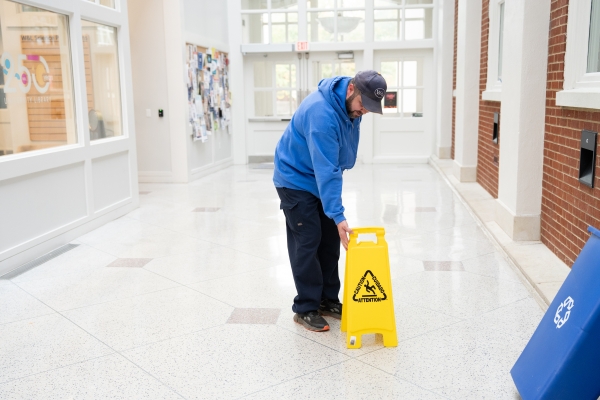 Chad Davis
He would then head up to the third and fourth floors where the Biology Department is located, doing the same before finishing in the Telford Science Library.
The custodians also pick up on the nuances and patterns that can be helpful in determining the best cleaning processes.
“Once you learn the building and what is used on a daily basis, you understand that there may be rooms that are only used on certain days of the week,” said Hartless. “Each year is different, but you can find a rhythm to it.”
And then there are the laboratories. The custodians must work around chemicals and biological materials and are trained to recognize potential hazards.
“I know to be cautious of the chemicals in the chemistry lab, and we were even trained on the rooms with radiation in them,” Zimbro said. “There are fume hoods that have alarms that frequently go off, and we need to contact Public Safety to come cut them off.”
Hamilton frequently reminds faculty, staff and students alike to be careful when disposing of hazardous materials.
“Our custodians need to trust that what gets disposed in a garbage can is not sharp and isn’t a biohazard,” said Hamilton. “Part of our teaching in the lab is that we use the red biohazard bags and special containers for sharp objects. The main reason is that we don’t want our custodians to get hurt.”
Living organisms also reside in the Science Center, and on occasion they turn up outside of their enclosures. Over the years, the team has encountered snakes, frogs, crabs and crayfish that have needed to be ushered back into their appropriate places.
The same unpredictability applies to the students, some of whom make the building home for the night.
“I used to see a student asleep on the third floor all the time,” said Davis. “I’d generally try to let him sleep, but sometimes he would wake up, and occasionally we’d chat.”
More Than a Job
The faculty, staff and students in the Science Center have all developed their own relationships with the custodial team. However, those who arrive early have formed the tightest bonds.
Joel Kuehner, director of engineering and professor of physics and engineering, is one such early riser. According to Zimbro, “his smile and face is one of the first we see every morning. He always stops to converse with us and tells us how much he appreciates us. It really makes our morning,” she said.
Davis’ cleaning schedule often takes him to the upper floors, where he is responsible for many of the chemistry labs, classrooms and offices. There, he often sees Matt Tuchler, head of the Chemistry and Biochemistry Department and associate professor of chemistry.
“Matt is a good guy, and I really like him,” Davis said. “He’ll ask for my opinion sometimes, and he’ll talk to you no matter where he is or what he is doing.”
The positive interactions are mutual.
“That’s the nice thing about getting in super early,” Tuchler said. “I’ll bump into Chad, and we end up having conversations.”
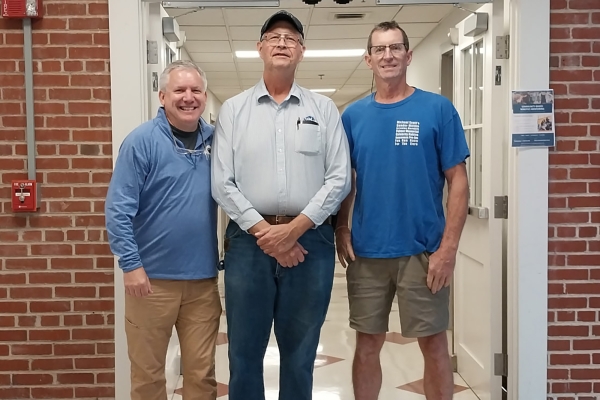 Bill Hamilton (left) and Mike Hepner, lab technician (right), pose with Bobby Rhodenizer on the day of his retirement
Hamilton also arrives early most mornings, and his conversations with Rhodenizer often turned to Rhodenizer’s large garden at home.
“I’ve helped him out by doing some soil analysis over the years, looking for nitrogen and phosphorus and making some recommendations on things,” Hamilton said. “It’s been fun to talk about.”
Hartless and Julie Woodzicka, the William R. Kenan Jr. Professor of Cognitive and Behavioral Science and department head, are gardeners as well. Hartless frequently offers Woodzicka gardening advice such as when to plant, and she often starts peppers for her from seed. The two friends have shared cucumber seeds as well.
“I look forward to seeing Kim, and having a discussion with her is always a nice way to start my day,” Woodzicka said. “We talk a lot about gardening — she offers so much more in that respect than I do — and we talk about family. I’ve met her husband, Jason, and have heard so much about her son, Cole, that I feel like I know him, too.”
The faculty and staff of the Science Center showed their appreciation for the team’s work when they hosted a gathering for Rhodenizer’s last shift on Oct. 9, a day that elicited a variety of emotions for students, faculty and staff, especially the building’s custodial team.
“It’s going to be odd and sad without him,” said Hartless before Rhodenizer’s retirement. “But I’m happy for Bob. He deserves to retire and enjoy his life.”
According to Rhodenizer, he’ll find ways to enjoy himself.
“I spent 32 years working in a plant mostly seven days a week,” he said. “I’m not worried what I’m going to do, maybe cut firewood or work on my garden. I know whatever I do I’ll enjoy it.”
For the remaining team members, they continue to care for the building and the people that mean so much to them.
“When I finish cleaning a room, turn out the lights and close the door, I have the satisfaction of knowing the room is ready for the professor or student or anyone else who needs it,” Zimbro said. “I know that it’s one less thing for them to worry about and they can go about their business.”
Hotinger said that same spirit runs through every crew on campus.
“I’m proud of this entire team, all 61 custodians we manage in University Facilities,” she said. “Every single one of them holds a special part in everything we do.”
Number of custodians: 61
Percentage of facilities workforce: 44%
Hours worked: 1,830 man-hours per week
Buildings maintained: 108 buildings
Square footage maintained: 2,414,378
Residence hall rooms cleaned annually: 343
Cleaning solution used annually: 852 gallons
Multi-fold paper towels used annually: 24,000 packs
Toilet paper stocked annually: 60,000 rolls

You must be logged in to post a comment.