
May 12, 2026
W&L Economics Professor Co-Authors Paper in Science
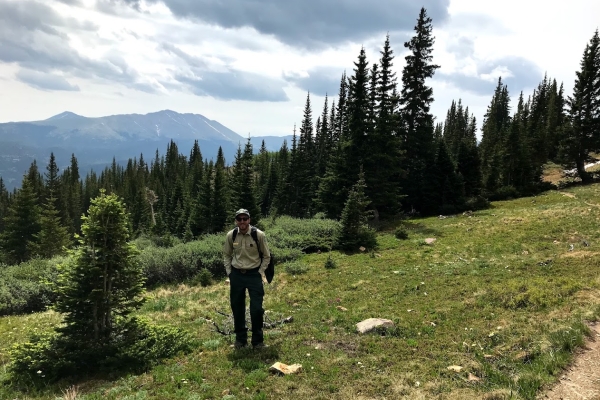 Cal Bryan, assistant professor of economics, spent several seasons with the U.S. Forest Service in the Rocky Mountains.
Wildfires are making headlines across the United States. Fueled by widespread drought conditions and high temperatures, recent fires have burned tens of thousands of acres across Utah, Colorado and Minnesota. And, closer to home, a fire in Rockbridge County first discovered on July 5 has grown to 108 acres by July 14, according to the U.S. Forest Service. A response team of more than 120 people are working to contain and suppress the fire.
Washington and Lee University’s Cal Bryan, assistant professor of economics, studies the effectiveness of specific firefighting strategies in halting or delaying wildfire spread. Bryan has a unique background for this field of study: Earlier in his professional life, he worked for several seasons with the U.S. Forest Service in the Rocky Mountains, serving as a trail crew supervisor and wildland firefighter. Below, he discusses wildfire management and prevention, and what the public should know about wildfires growing increasingly severe and complex.
How do firefighters respond to and control the spread of a wildfire?
The first step in managing any wildfire is to assess the conditions of the wildfire and the landscape it threatens, because that will dictate the plan of attack (“suppression strategy”). Broadly speaking, the goal is to contain the wildfire by removing as much fuel around the fire’s perimeter as possible to limit the areas to which it could spread. A lot of the firefighters dispatched to an incident will scrape any vegetation off the ground (“dig line”) and cut down any trees that might sustain the fire’s growth. Other objectives might include reducing the intensity of flames or protecting valuable assets like homes and businesses.
Do firefighting tactics change depending on the terrain the wildfire is on?
Absolutely, the terrain will be a massive influence on suppression strategy. Wildfire managers (“incident commanders” or ICs) are likely to be more reluctant about sending firefighters to dig line in an area with more steep or rockier terrain. This is partially because the strategy could be less effective, but mostly because it’s unsafe for firefighters. ICs might instead choose to focus the suppression strategy around using aerial firefighting resources like helicopters, scoopers or large airtankers.
Are wildfires getting worse?
Wildfires are indeed getting much worse. We’ve actually seen a relatively stable number of wildfires across the country over the last several decades, but what we’ve observed is an increasing level of severity and complexity in the actual fires. This reflects a combination of factors, including decades of fuel accumulation from past forest and wildfire management, hotter and drier conditions that make vegetation more flammable, and continued growth in residential and business development within wildfire-prone areas. The result is that many fires today are more difficult, more dangerous and more expensive to suppress than they were a few decades ago.
What should you do if a wildfire is reported in your area?
Preparedness is key. Make sure you have a “go-bag” ready with any essentials (identification, medications, water, phone chargers, first aid kit, any pet/child necessities and other important keepsakes). Have an evacuation plan (What transportation will you take? What roads/route will you use? What are your backup options in case of road closures?). Monitor any news sources you have available, including local news or social media, and listen for an evacuation notice in your area. Finally – avoid being outdoors if possible and turn on any indoor air purifiers to help mitigate smoke inhalation within your home.
How does wildfire smoke affect people and wildlife?
A lot of fire, health, and economic researchers are still trying to capture the full extent of damages from wildfire smoke. This is true for both people and animal populations. Intuitively, we know that it can cause a lot of damage to the lungs. All signs have recently been pointing toward a very stark impact on brain health, with sharp declines in cognitive function when exposed to wildfire smoke. As previously mentioned, the best way to avoid these harmful effects is to stay indoors with the windows closed, while running an air purifier with proper filters.
How can wildfires be prevented?
It seems counterintuitive, but wildfire is an important ecological process that helps many forests regenerate by removing old vegetation and creating conditions for new growth. I suggest we should be less concerned with preventing wildfires as a whole, and more concerned with preventing “wildfire damages.” People can help prevent human-caused fires by fully extinguishing campfires, securing vehicle trailer chains that could spark nearby vegetation and properly disposing of fireworks. If your home is located in a wildfire-prone area, the best way to prevent excess property damage is to take proper care of your yard by regularly mowing, trimming hanging branches from trees, and to consider clearing any bushes, trees or shrubs from the immediate perimeter of your home.

You must be logged in to post a comment.