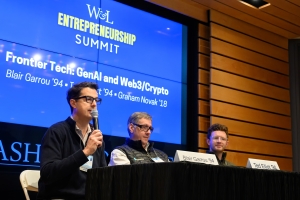
Where Tradition Meets Entrepreneurship: The University Store’s Student and Alumni Connection The University Store has become an unexpected incubator, offering a platform to launch and grow entrepreneurial ventures.
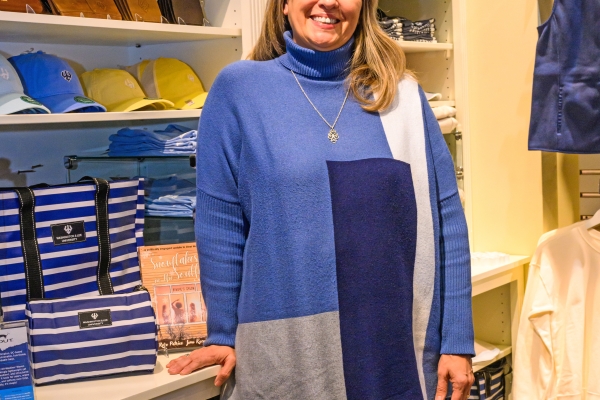 University Store Director April Washburn has worked with a variety of students and alumni to feature products in the store.
Walk into the Washington and Lee University Store and you might assume you’re browsing a typical collegiate shop: shelves and racks full of hats and shirts, drinkware and collectables. But look closer, and you’ll discover something far more meaningful. Behind many of the products lies a story of connection, entrepreneurship and a deep commitment to celebrating the W&L community.
April Washburn, the store’s director, understands this better than anyone. For her, the University Store is not simply a retail operation but rather an extension of the institution’s educational mission and a reflection of the people who have walked across campus for generations.
“The store belongs to the students past, present and future,” said Washburn. “I believe that it does reflect them accurately, but there’s always room for improvement.”
That philosophy of continuous improvement, and of listening carefully to what the W&L community wants, has shaped every aspect of how the store operates. It has also created a pipeline for alumni and student entrepreneurs who are eager to see their products on shelves that hold special meaning to them.
The alumni connection runs deep. Some products are carried because an alumnus owns the business. Others arrived because a graduate suggested them or happened to work for the company. Throughout a typical academic year, Washburn communicates regularly with students, parents and alumni, taking all recommendations under consideration.
L2 Brands, formerly known as Legacy, represents perhaps the longest-running alumni partnership. Paige Wingert ’87 and his law school roommate, Mark Landgren, founded Legacy in 1992 while both were attending Dickinson Law School. Neither were pleased with the hat selections at the Dickinson College bookstore, and both had attended small undergraduate institutions. Their initial business plan focused on marketing their products to similarly sized schools rich in tradition and history. W&L was among the first stores they approached regarding their products.
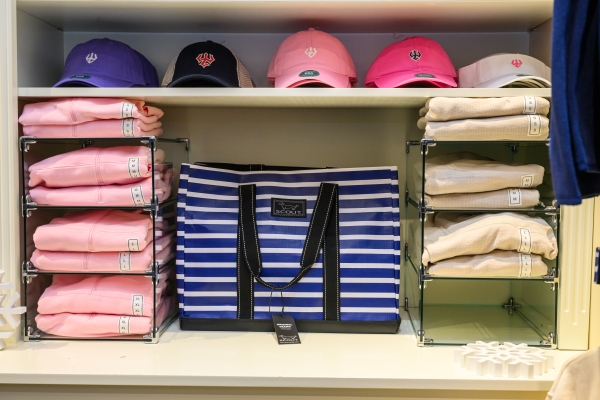 Legacy hats and SCOUT bags on display in the University Store.
“I was already familiar with the hat selection in the bookstore and was confident that our hats would be popular,” Wingert recalled, noting that the relationship likely wouldn’t have continued for long if the product didn’t sell well. “I think that the fact that it has grown and become a significant account for more than 30 years speaks to both Legacy (L2) and the University Store evolving to meet changing customer preferences and expectations.”
Having Legacy products available at his alma mater carries a deep personal significance for Wingert.
“As a graduate, W&L had a profound impact on me not only educationally, but in shaping my value system and who I would become,” he said. “If Legacy were a successful collegiate brand, but not available for students and alumni at my alma mater, it would be an empty feeling.”
Matt Bartini ’12, founder and CEO of Mayor Clothing, traversed a different path toward inclusion in the University Store. In 2019, he reached out to W&L’s Office of General Counsel about collegiate licensing protocols, and that initial interaction led to a connection with Washburn. What followed was a collaboration that drew on the university’s entrepreneurial ecosystem. Working with Jack Jones ’21 and Missy Barro ’21 through what was then known as the Venture Club (now the Connolly Entrepreneurship Society), Bartini developed Good Ol’ Dubyuhnell, a custom button-down shirt featuring iconic scenes of W&L’s campus rendered in ink pen drawings. The design emerged from extensive market research, which included surveying hundreds of students about their favorite campus scenes and the colors that epitomized W&L. The result was a shirt specifically designed to be carried in the store.
Bartini has since expanded the partnership based on customer feedback he’s received from his association with the University Store. “Alums constantly text me photos of them wearing Mayor’s products and our products on display in the University Store. I save them all,” he said.
That feedback has led directly to product evolution and additional development. Alumni noted that the larger print on the original button-down created more of a novelty piece for special occasions.
“That led us to take the same custom print idea and apply it to the popular microprint polo style to be worn as an everyday piece,” Bartini explained. “Same idea, significantly more wears.”
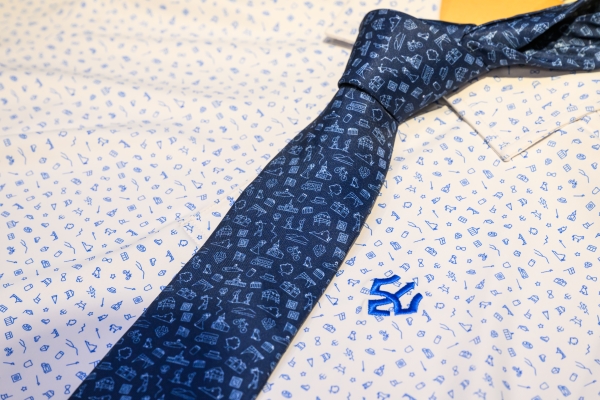 W&L-branded Mayor polo shirt and tie
Today, Mayor’s product line in the store includes ties, aprons, tablecloths and napkins, in addition to the polo and iconic button-down options. His association with the University Store also led to expansion into other retail locations.
“I’ve now visited or done business with hundreds of college stores, and the W&L store is by far the nicest,” said Bartini. “It is much more similar to a pro shop in a high-end country club or luxury resort than the typical campus bookstore.”
That observation helped shape Mayor’s broader business strategy, leading the company into the golf market as well.
Current students have found the store equally willing to take chances on their ventures. Washburn met with Jay Margalus, director of the Connolly Center for Entrepreneurship, last spring after students expressed interest in pitching products.
“For years, I thought it would be such a great thing to partner with our students through something like the Entrepreneurship Summit to see what products are out there or even try them out,” said Washburn. “We really could be like a trial run for these student products or companies with a product that makes sense for us to carry. We are an excellent source to provide valuable feedback about what people think about a product.”
One of the first products to emerge from this collaboration was “The Experience Exchange,” a magazine created by Sofia Iuteri ’27 that explores sustainability, nature and self-discovery through creative writing and storytelling. The response exceeded expectations, and the store has had to reorder multiple times. Iuteri has since published a second edition.
“It has been very popular, and I foresee that continuing to be the case,” Washburn said. For her, success stories like Iuteri’s represent exactly what she hopes to see more of in the years ahead. “I see our role as being a part of the university’s educational process. These connections can begin with a simple conversation, and I encourage students to approach us. They should not be afraid to ask.”
Maddie Weber ’21 built her pajama company, Sleepy Saturday, on skills she developed as a student. While at W&L, she worked as a rep for University Tees, designing custom apparel for Greek organizations and various campus groups. She taught herself Adobe Illustrator and Photoshop and facilitated more than $200,000 in apparel sales over two years.
“That experience showed me both that I understood design and taste, and that people were willing to pay for it,” she said. Like many Williams School of Commerce, Economics and Politics graduates, Weber started her professional career in investment banking. However, it didn’t take long before she yearned to engage her creative side, which manifested itself in the development of a pajama brand.
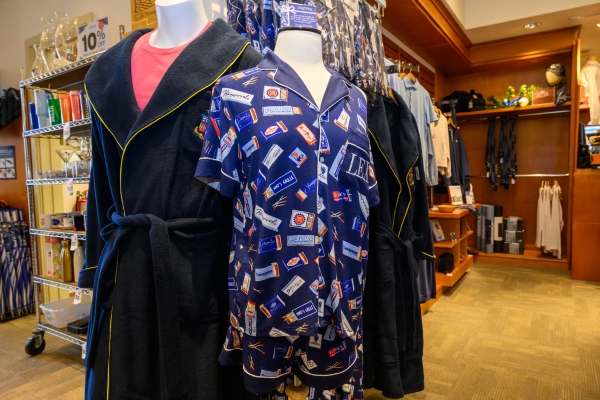 Sleepy Saturday’s pajamas are among many products from alumni-based companies featured in the store.
“I wanted to build a product that felt premium but still allowed room for playful, community-based artwork. Pajamas felt like the perfect intersection: a luxury product where pattern design could shine without feeling gimmicky,” said Weber. “My experience in the Williams School was essential. Taking classes that emphasized structured problem-solving, clear communication and entrepreneurship helped me navigate product creation, pricing and client management. The analytical rigor from the Williams School paired with the hands-on creative experience from University Tees became the backbone of Sleepy Saturday.”
Weber then approached the University Store with her pajama concept that featured iconic Lexington businesses as vintage matchbox illustrations. Washburn helped guide Weber through the entire process, which included securing written permission from each restaurant included in the print before producing a physical sample.
“It was a great example of how simply taking the initiative, creating the product before being asked, can open doors,” said Weber.
The store became one of her earliest collegiate retail partners, and its trust in her product gave her credibility as she expanded to top-notch resort partners including Deer Valley, Omni Resorts and Sun Valley.
“Having my product in the University Store is meaningful not just because it’s my alma mater, but because it shows current students that there are many ways to build a fulfilling career,” Weber said.
The University Store also serves as a home for SCOUT bags, co-founded by Ben Johns ’78, who serves as the company president. Among his trusted employees is Mary Jo Slidell ’98, who performs corporate and event sales for the business. Slidell originally reached out to the university in 2022 to introduce the company’s products and later met with Washburn while visiting campus.
“Email is easy, but nothing can replace personal interaction,” said Slidell, who describes her first interactions with Washburn as warm and welcoming. She sent samples of the company’s colorful and lightweight carry-alls with the trident logo and said she had an order within a month. Washburn even connected her with the store manager at Davidson College, where Slidell’s oldest daughter is currently a sophomore. This led to additional product placement in the collegiate sector.
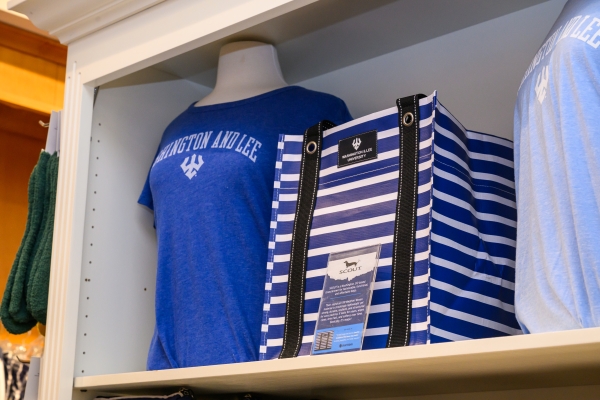 W&L-branded SCOUT bags can also be found on the University Store shelves.
The evaluation process for considering new products in the W&L store balances openness with practicality. Washburn and her team consider how products fit with their existing brand mix and price points, whether they fill a niche that students, parents and alumni want, and whether quality meets the store’s standards. Because the store’s products feature the university’s branding and logos, working with a licensing company is essential to ensure that vendors are vetted, insured and compliant with fair labor laws.
Product suggestions don’t disappear if they can’t be accommodated immediately. The store keeps detailed records and follows up when opportunities arise. Yeti serves as a prime example.
“There was a lot of demand for Yeti products, and it probably took me three years to get it,” Washburn said, “but we are now one of their top-selling collegiate accounts.”
Products that do make it onto the shelves face a straightforward success metric.
“In general, if a product takes more than one year to sell out, then it’s not super successful,” Washburn explained. “But if you sell out fairly quick and we need to do a reorder, then perhaps the relationship continues.”
The store provides regular sales reports to its partners, information that Weber credits with helping her make instrumental choices about her company’s products.
“The W&L University Store’s data helped validate that our bamboo-viscose fabric and tailored, flattering fit resonated strongly with a collegiate audience,” she said.
The store employs nearly 30 work-study students and invites them to provide feedback when vendors visit campus. And Washburn noted that the sales team has noticed something distinctive about W&L customers.
“They aren’t super loud or overdone — they are subtle,” she said. “They don’t typically want 50 logos on a shirt. I would describe it as a ‘quiet celebration.’”
The store’s support extends beyond simply stocking the products. Washburn and her team are happy to help students and entrepreneurs think through the practical aspects of bringing a product to market, including packaging, delivery methods and presentation.
“I can take students through the store, talk about the different packaging or even have classes come in and have a look around,” she said. “I see the store as a possible extension of the classroom, and if they want to use it, I encourage them to come on in.”
For alumni or students with products to pitch or products they would like to see featured, the path forward is simple: send an email to store@wlu.edu.
“We are not afraid of suggestions,” Washburn emphasized. “We can’t accommodate everything, but we want to know what people think we should carry. And, if we are missing the mark, we want to get better.”
Both Bartini and Weber offer practical advice for those hoping to follow in their footsteps.
“If your target market is Washington and Lee students and alums, there is no better place to feature your products than the University Store,” said Bartini.
Weber recommends patience and persistence.
“Start before you feel ready. You will hear ‘no’ more often than ‘yes,’ but once one respected partner takes a chance on you, others follow,” she said.
Wingert, drawing on more than three decades of experience in the collegiate market, recommends extensive preparation.
“If you think you have a new or innovative product that would do well in the college market, start with extensive competitive research to understand who may already be offering the same or a similar product,” he said, “and spend a lot of time thinking about what makes it better or unique from the competition.”
That willingness to take chances, on new ideas, new products and new partnerships, reflects something essential about the University Store’s identity. It is, in many ways, a microcosm of the W&L community itself — rooted in tradition but always evolving, proud of its past but invested in its future and, above all, connected by the people who have called this place home.
For Johns, seeing SCOUT bags on those shelves captures exactly what makes these partnerships meaningful.
“It’s truly a full circle moment for me, starting with Dr. [Larry] Lamont’s marketing class, which flipped a creative switch in me, to now seeing our SCOUT bags proudly displayed in the University Store,” he said. “It puts a smile on my face.”
If you know any W&L alumni who would be great profile subjects, tell us about them! Nominate them for a web profile.
Related Stories

December 5, 2025
Midnight Breakfast: A Tradition Worth Staying Up For

You must be logged in to post a comment.