April 22, 2026
Making Civic Magic
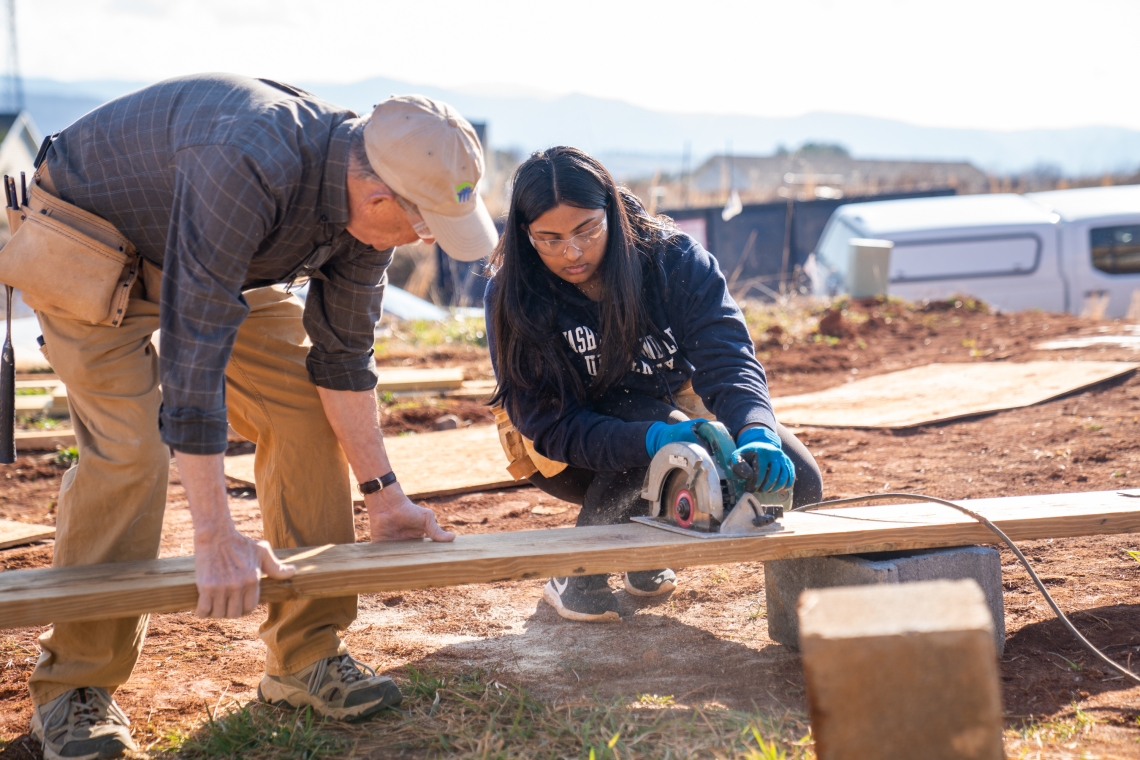 Sai Chebrolu ’26 working with Rockbridge Area Habitat for Humanity as part of the service hours required in the Bonner Program.
“It’s an incredible honor to sit with students in the pivotal moments of their lives and think about what really matters to them and how their gifts are going to meet the hungers of the world.”
~ Marisa Charley, associate director of the Shepherd Program and Bonner Program director
Washington and Lee University is one of nearly 70 colleges and universities within the national Bonner Foundation network, a collection of higher education institutions dedicated to sharing the values of service and leadership with students. The W&L Bonner Program, which is celebrating 25 years at W&L, is offered through The Shepherd Program, which began in 1997 and focuses on the various causes and consequences of poverty, as well as the collective responsibility to address the problems associated with poverty in ways that respect the dignity of every person. Bonner Scholars are expected to participate in the Bonner Program all four years at W&L. The experience includes completing 1,800 hours of service and leadership training, typically comprised of 280 hours during each academic year and service experiences during the summer. Bonner Scholars also participate in activities including orientation and first-year service trips. And they are expected to complete a senior service capstone prior to graduation. There are currently 43 undergraduate students participating in the program at W&L.
The Bonner Program was created in 1990 by the Corella & Bertram F. Bonner Foundation to transform students, communities and campuses through service. Harlan Beckley, Fletcher Otey Thomas Professor of Religion emeritus at W&L, was instrumental in bringing the Bonner Program to campus during his tenure as the founding director of the Shepherd Program, a role he held from 1997 to 2013. The program has grown to become the largest privately funded, service-based college scholarship program in the country. Each year, campuses in the Bonner network recruit up to 25 new students with demonstrated financial need and an ethic of service. In turn, these students receive four years of financial aid support and an opportunity to participate in an intensive, developmental community engagement experience. Collectively, Bonner Programs engage more than 3,000 students annually at over 65 college campuses nationwide.
Marisa Charley has served as W&L’s Bonner Program director for 14 years and says she is honored to have been a part of the program for 20 years, including her time as a Bonner during her undergraduate years at Allegheny College. Charley teaches courses such as POV 202 and a course called the Civic Life, which helped create an initiative called Civic Health Club in partnership with local businesses last semester. Charley was recently awarded a grant by Project Pericles, a nonprofit organization focused on civic engagement, intended to support educators who are incorporating civic engagement and active participation in civic life into their curriculum. Charley points out that what makes W&L’s Bonner Program unique is its positioning within the academic framework of the Shepherd Program.
“The way the Shepherd mission shapes our understanding of our work and the context of that work is a hallmark of our program,” Charley says.
Charley says one of the most valuable aspects of the program is its emphasis on reflection.
“To me, that’s where the real education happens – when we’re in that reflection state, making meaning of the world around us,” Charley says.
Students in the program are encouraged to approach their Bonner experience through layered projects that value collaboration rooted in their coursework. One such example is a recent partnership with the Street Medicine Institute, whose founder, Jim Withers, visited campus last year to speak to students and meet student leaders within the Bonner Program. After connecting her POV 101 class with the institute, Bonner Kristina Ayers ’25 took on a senior capstone project with fellow Bonners Boris Pekar ’27 and Alexis Thompson ’27. Together, they built the first international database of street medicine providers, which grew from an expected 600 to 800 entries to nearly 2,000. It now powers a GIS-mapped directory on the institute’s website that helps providers coordinate care and spot gaps in service. Thompson said the work gave her hope that passionate people can drive systemic change, and Pekar is now considering policy or public health study on the way to a career in medicine. For Charley, the project confirms what she sees in her students: They are “really hungry for the opportunity to do meaningful work,” she says.
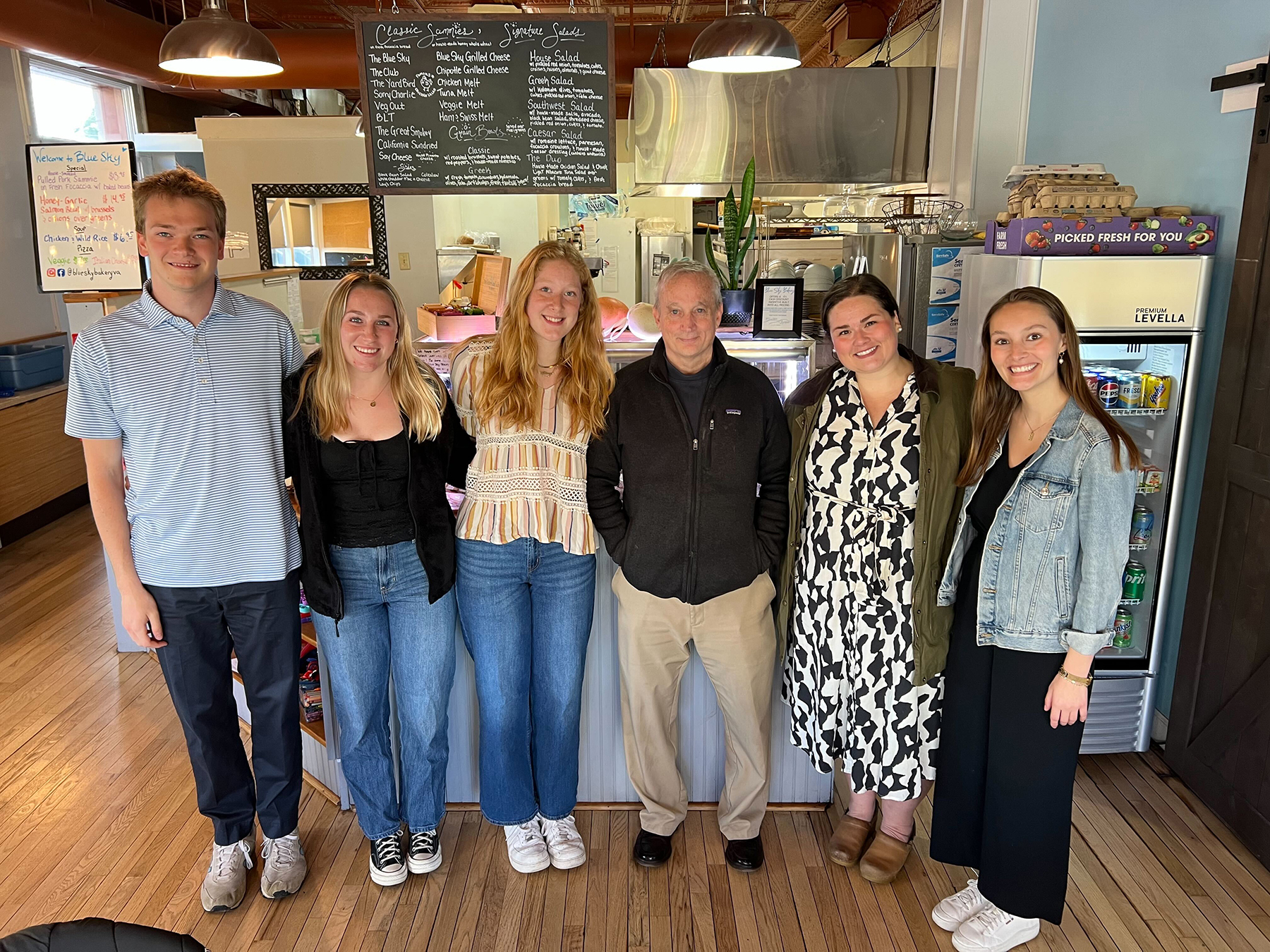 Charley (second from right) and her students take Street Medicine Institute founder Jim Withers to lunch at Blue Sky Bakery in Lexington.
“Students are really interested in solutions and want to see members of their community as multi-dimensional instead of flattening them into a political perspective,” Charley says. “If we don’t do this, we run the risk of spending the whole term simply reinforcing our own biases, and that isn’t what we’re here for.”
Charley also encourages students to connect with the larger Bonner network through attending annual conferences and finding other ways to stay in touch with the work being done on other campuses.
“W&L is part of a national network where students can travel to conferences twice a year and have the opportunity to work with other Bonners and connect with an alumni network that is thousands of Bonners strong, all of whom can’t wait to pick up the phone when another Bonner calls them,” Charley says.
Ella Powers ’22 says that her time in the Bonner Program helped her connect her passion for health to the service work that was integral to her college experience and that her time in Bonner and the Shepherd Program more broadly opened her eyes to the interdisciplinary layers of discussing poverty.
“I was in classes with people who were looking at these issues from an economic perspective, from a transportation and city planning perspective – all these different disciplines and lenses,” she says. “And I’m now in a position where I can see all of those lenses affecting people in real time.”
Powers is a lead patient care specialist at the Neighborhood Resilience Project in Pittsburgh, Pennsylvania, assisting with day-to-day operations at the organization’s free health clinic, which provides primary, dental and behavioral care at no cost to uninsured adults. Powers, a cognitive and behavioral science major with a minor in poverty and human capability studies, says Bonner helped connect her interests in health and service to tangible community work and taught her to see poverty and health as interdisciplinary issues shaped by factors such as economics and city planning.
“Bonner and Shepherd allowed me to see how interdisciplinary poverty is and how interdisciplinary the struggles are that people face,” Powers says.
Katie Yurechko ’24 is a current Ph.D. student in computer science at Princeton University and says her Bonner experience imbued her with a human-centered approach to technology, especially in her dissertation research on how targeted algorithms impact vulnerable communities. She adds that the skills and understanding she acquired through the Bonner Program provide a framework that transcends any one major or career path.
“It can elevate whatever you’re doing,” Yurechko says, “and I deeply believe in that. Shepherd, and the Bonner Program, in particular, are so thoroughly interdisciplinary that there are students across STEM and business and the arts and humanities who are equally involved. It connects everything: your courses, your extracurriculars, the people that you meet. The program just shapes you and the ways that you view the world and the kinds of questions you’re able to ask.”
Eddie Hernandez ’30, a first-year Bonner student from Lawrenceville, Georgia, says he has already been profoundly impacted by Charley’s mentorship and insight.
“Professor Charley constantly challenges me to think more deeply about the issues I see in our community,” he says. “She’s changed how I approach problems; she’s taught me not to be afraid of asking questions or making mistakes; and she always encourages me to stay curious and open-minded. Also, because she was a Bonner herself, she understands what the program asks of us.”
Hernandez says that Bonner played a large role in his decision to attend W&L. He credits the program with deepening his understanding of some of the challenges within the Lexington and Rockbridge area.
“In just my two months here, I have been able to gain a deeper understanding of some struggles in the community beyond campus thanks to Bonner,” Hernandez says, “and I also get to be part of the solution to some of those problems.”
Charley says that this sentiment is at the heart of her work in the program.
“It’s an incredible honor to sit with students in the pivotal moments of their lives and think about what really matters to them and how their gifts are going to meet the hungers of the world,” Charley says. “I could think of nothing more purposeful. I liken this work to planting sequoia seeds; it’s the work of planting a crop I won’t live to harvest. I may not get to see the world that will one day exist because our students walked side by side with us through this program, but I know it’s a better world.”
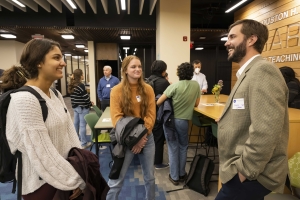
 Gabe Miller ’25, Charlie Mlce ’25, Jessica Pachuca ’25, and Shannon Tozier ’25 get to know one another at Bonner Orientation 2021.

You must be logged in to post a comment.