
September 11, 2026
Zanita Akinkugbe ’27: Summer in Pictures
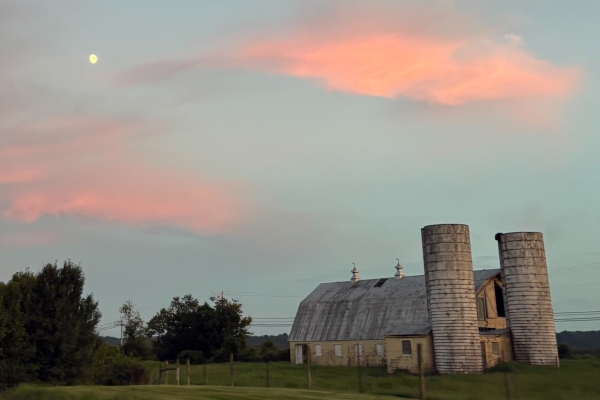 Elisabeth Nicholson ’27 has long admired Wendell Berry’s work, and spent the summer interning at the Berry Center in Port Royal, Kentucky.
The start of Fall Term is a busy time of year on Washington and Lee University’s campus, as students find their rhythm navigating classes and extracurriculars and catching up with their friends after a summer apart.
But for many students, summer experiences continue to influence their time at W&L, allowing them to bring new perspectives to their lives on campus. For Elisabeth Nicholson ’27 and Riley Mitchelson ’27, the summer ahead of their senior year was spent learning about the importance of land stewardship and how we can better commune with the natural world.
Nicholson spent the summer at the Berry Center in Port Royal, Kentucky, and Mitchelson served as a research and development intern at Hozho Voices of Healing Center in Crownpoint, New Mexico. Although their internships differed in landscape, both Nicholson and Mitchelson came away from their experiences with a new appreciation for the communities working to build a more positive relationship with the environment.
“I have had a deep admiration for Wendell Berry’s work since I was very young, especially his poem ‘Manifesto: The Mad Farmer Liberation Front,’” said Nicholson, an English and creative writing double major with a minor in Chinese. “Berry’s reverence for land and the tight communities who steward it has continually inspired me to search for a way of fulfilling my responsibility as a human in this world.”
Berry, who died in August 2026, was known for his deep reverence of the land and defense of agrarian values, which are showcased in his poetry, fiction and essays. His depictions of place and interconnectedness particularly resonated with Nicholson because of her own experience with learning what it means to be rooted to a place, having grown up among the nomads of the Tibetan plateau before moving with her family to Tobaccoville, North Carolina, where they own a farm called NOMAD. The farm is a tribute to the lifestyle the family adopted during their decade living in Tibet, prioritizing community, clean food and ethical farming and livestock practices.
NOMAD’s farming philosophy gave Nicholson a unique perspective during her internship at the Berry Center, which was funded by a Johnson Opportunity Grant (grants awarded on a competitive basis that are open to all rising sophomores, juniors and seniors). She particularly appreciated the opportunity to witness firsthand the landscape and community in Port Royal that influenced Berry’s writings, and to visit sites that parallel the fictionalized community of Port William, which is the setting for a series of Berry’s interconnected stories and novels. As part of the internship, Nicholson attended a reading-in-place event of the novel “Jayber Crow,” which she found to be “an incredibly inspiring an edifying experience” as she and the other attendees discussed the symbolism and themes found in the book.
“It was incredible to stand in the woods and engage with the philosophical musings of professors, farmers and Berry followers who gathered for this event,” Nicholson said. “I was moved by Berry’s community and its recalling of an affection for and longing to be back in my own home place of Tobaccoville. Berry’s ability to stir this affection for land makes possible more sincere stewardship of the world, and I am thankful to the Johnson Opportunity Grant for making this experience possible and inspiring my future endeavors in environmental literature.”
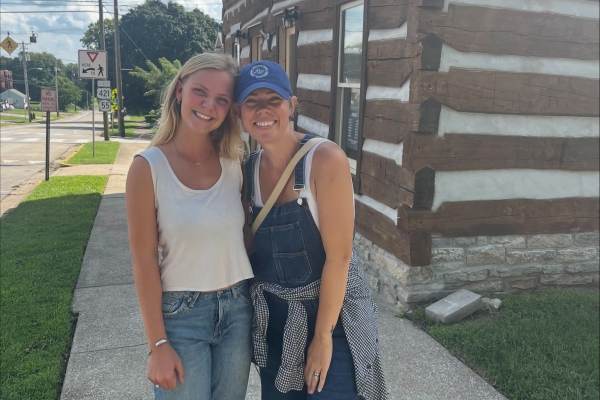 Nicholson’s (pictured left) commitment to land stewardship stems from her childhood on the Tibetan plateau and has been cultivated by her family’s North Carolina farm and her time at the Berry Center.
Mitchelson’s internship at Hozho Voices of Healing Center also grew out of his passion for land stewardship, and he appreciated the opportunity to pursue work that is rooted in ethical land use while learning from the Indigenous communities the center serves. And, like Nicholson, Mitchelson was able to draw on his own experience for his work at the Healing Center.
“I grew up working on a cattle farm in rural Nelson County, Virginia, so when Fran Elrod [associate director of the Shepherd Program] mentioned the Hozho Center, I knew it was something I wanted to be a part of,” said Mitchelson, who completed the internship through the Shepherd Program for the Interdisciplinary Study of Poverty and Human Capability, which incorporates engagement and service into students’ academic and extracurricular lives. “While the environment was completely different, I could utilize the skills I learned growing up while learning new ones that I can bring back home, which made the experience all the more rewarding.”
The center — which is run by Elrod’s parents, Terrel and Alta — proved to be a distinctly rewarding experience for Mitchelson, and the emphasis on experiential learning paved the way for him to fully immerse himself in the daily operations of the center and surrounding communities. He attended a Mayan fire ceremony in Albuquerque, New Mexico, on his first day at the center, then was sent to a camping retreat in the mountains of Santa Fe, New Mexico, the following week, followed by a conference in Flagstaff, Arizona. During days at the center, he would feed the animals at 8 a.m. and do farm work until lunchtime — which could range from building a ramp for the 90 Navajo-Churro sheep to use, to getting more comfortable using the tractor — and finish the day working on the center’s finances and grant proposals.
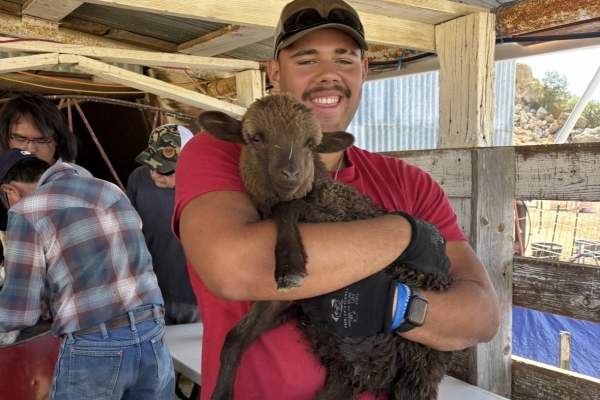 Interning at the Hozho Voices of Healing Center allowed Riley Mitchelson ’27 to learn about ethical land use and the local Indigenous communities’ culture and history.
In addition to learning about traditional agricultural practices, Mitchelson deepened his understanding of the local Indigenous communities’ culture and history through the Hozho Center’s initiatives to help communities focus on their oral histories and traditions and to empower them to care for and steward the land, rebuilding the historical relationship and sense of pride. Mitchelson is also writing his honors thesis on the housing crisis in the Navajo nation and appreciated the opportunity to witness firsthand the complexities that keep the Navajo people in poverty.
“I have always had a passion for land stewardship, which is what inspired me to double major in politics and environmental studies and explore the question of who has access to land and why,” Mitchelson said. “The U.S. government has a long history of compromising minority communities’ relationship with the land, whether that’s through redlining, forced displacement or even internment. I came to the center to see its effects firsthand and learn how this specific community is working to move past their historical trauma, while dealing with modern policy that seeks to hold them back.”
However, he felt W&L helped him bridge the cultural divides, and he credits the Speaking Tradition with helping him make relationships in an unfamiliar space.
“The Navajo (or the Diné) is a community that has long been taken advantage of, and so coming to them as someone with no Navajo blood is daunting, but I have been able to push past the awkwardness and anxiety to create lasting relationships with the people who live here,” Mitchelson said. “I find it important to remember that most people are anxious or stressed, especially on the reservation, so a simple ‘hello’ or ‘how are you?’ can really break down walls and prove to people you’re interested in getting to know them.”
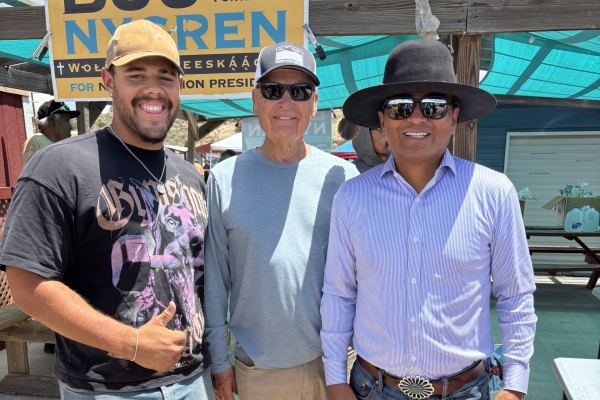 Mitchelson, pictured here with his internship advisor and the former president of the Navajo Nation, credits W&L’s Speaking Tradition with helping him build relationships at the center.
While the work at the center was wide-ranging and certainly “out of the box,” Mitchelson is confident it has made him a more well-rounded individual and uniquely prepared him to pursue graduate studies in law, international relations or urban design. He is particularly grateful for the support he received from Lorri Olan, director of career and professional development – pre-law and engagement initiatives lead, who assured him that an internship at the center would be not only an unforgettable experience, but one that employers will be interested in hearing about.
“The support from Lorri and the entirety of the Shepherd Program has been a game changer for my growth, and I am so thankful for that,” Mitchelson said. “They don’t try to mold students into one set thing but rather show us how we can mold the system to our own needs.”
If you know any W&L students who would be great profile subjects, tell us about them! Nominate them for a web profile.



You must be logged in to post a comment.