A Full-Circle Summer Four rising sophomores spent their summer cooking, gardening, delivering food and grant writing for Campus Kitchen at Washington and Lee.
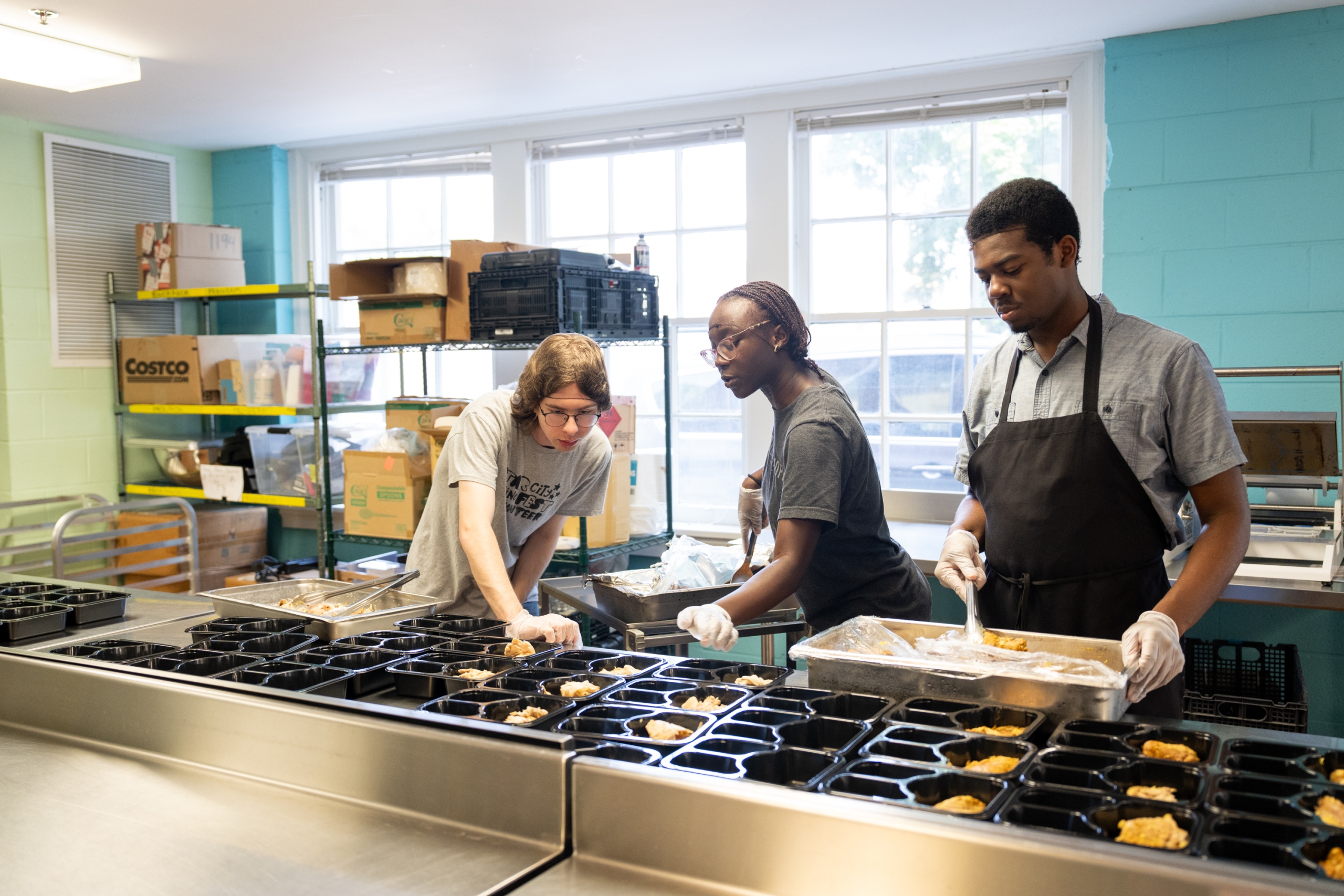 Shaliyah Rose ’29 (middle) welcomes students in the Advanced Immersion and Mentoring (AIM) program to a Campus Kitchen shift.
“I do believe it’s helping not only the community but also the future of Lexington and Rockbridge County.”
~ Kara Moon ’29
Most mornings this summer, before much of Lexington was awake, four Washington and Lee sophomores had already split up the day’s many tasks in the campus garden, gotten behind the wheel of the delivery van headed for Glasgow or Buena Vista, Virginia, or packed meals to freeze in Campus Kitchen’s deep freezers. This year’s Campus Kitchen summer crew — Kara Moon ’29, Jana Rhodes ’29, Zaima Islam ’29 and Shaliyah Rose ’29, — were responsible for accomplishing everything Campus Kitchen does across a full school year, an impressive undertaking for four people instead of the roughly 300 student volunteers who usually split the load throughout the academic year.
Ryan Brink, assistant director of the Shepherd Program and Campus Kitchen coordinator, says that structure provides summer interns with an impactful bird’s-eye view of how Campus Kitchen operates that prepares students to be leaders within the organization.
“During the school year, each student might be doing one cooking shift per week, and they may not be seeing where that food goes or where it comes from,” said Brink. “Over the summer, they’re picking up the food and seeing the process all the way through cooking and delivery. They get to really take ownership.”
That ownership translates into a better experience for Campus Kitchen’s constituents, Brink says.
“For example, a student responsible for meal-planning for the week now knows and has a relationship with the people the food is going to, often chatting with them over lunch, and learns that a particular client loves mac and cheese, so mac and cheese goes into the rotation more often,” Brink says.
Campus Kitchen was founded in the spring of 2006, when Ingrid Easton ’06 brought the model to Lexington after a summer internship with DC Central Kitchen. That makes this coming year the program’s 20th anniversary, which coincides with the Shepherd Program’s 30th anniversary and the Bonner Program’s 25th anniversary. W&L is marking all three with a joint reunion weekend Nov. 6–8, when the biannual Social Impact Career Summit will feature additional programming marking the anniversary: alumni panels, Campus Kitchen shift for returning grads and a look back at nearly two decades of a program that has grown from one student’s idea into a fixture of the county’s food-relief network.
This summer’s four interns arrived at Campus Kitchen by different routes. Rose, a math and accounting double major from Hollywood, Florida, got involved when a friend needed extra hands for a shift and called her. Rhodes, an environmental studies major from Chiang Mai, Thailand, who ran her own baking business back home for a decade, joined through Hunger Fighters, a first-year cohort program she found appealing precisely because it let her keep cooking even as a first-year student in a residence hall. Islam, a business administration and computer science double major from New York City, applied for the summer internship in part because she is pursuing the minor and had done similar service work for two years before college. Moon, who is considering sociology and cognitive and behavioral science as a prospective double major, also joined Hunger Fighters after discovering the Shepherd Program while researching colleges from her home in San Jose, California.
Hunger Fighters and its companion program geared toward broader service work, Good Nabors, are designed as a kind of on-ramp for students interested in how to address food issues in their surrounding community. Open to first-years, it groups 10 to 20 students committed to learning more about the causes and consequences of food insecurity through a combination of direct service and educational opportunities. Students commit to a weekly Campus Kitchen shift alongside a year of speakers, documentary screenings and discussions, plus individual check-ins with Brink. Brink said the program, now in its seventh year, has become something of a leadership pipeline for Campus Kitchen. Many students who go through it end up pursuing the poverty studies minor or a summer internship, whether they ever join the leadership team. Three of this summer’s four interns joined Campus Kitchen’s leadership team in March 2026.
The summer interns’ work each year typically ranges well beyond the kitchen itself. Summer mornings often start in the campus garden, which supplies fresh produce for the program throughout the growing season. Deliveries of frozen meals to Rockbridge County communities where grocery access is limited took up a large portion of the team’s time this summer, with routes running throughout the county. Rose points out that Campus Kitchen interns also serve the important role of informal ambassadors for W&L, often becoming the most consistent and visible point of contact between the university and the county residents interacting with the program.
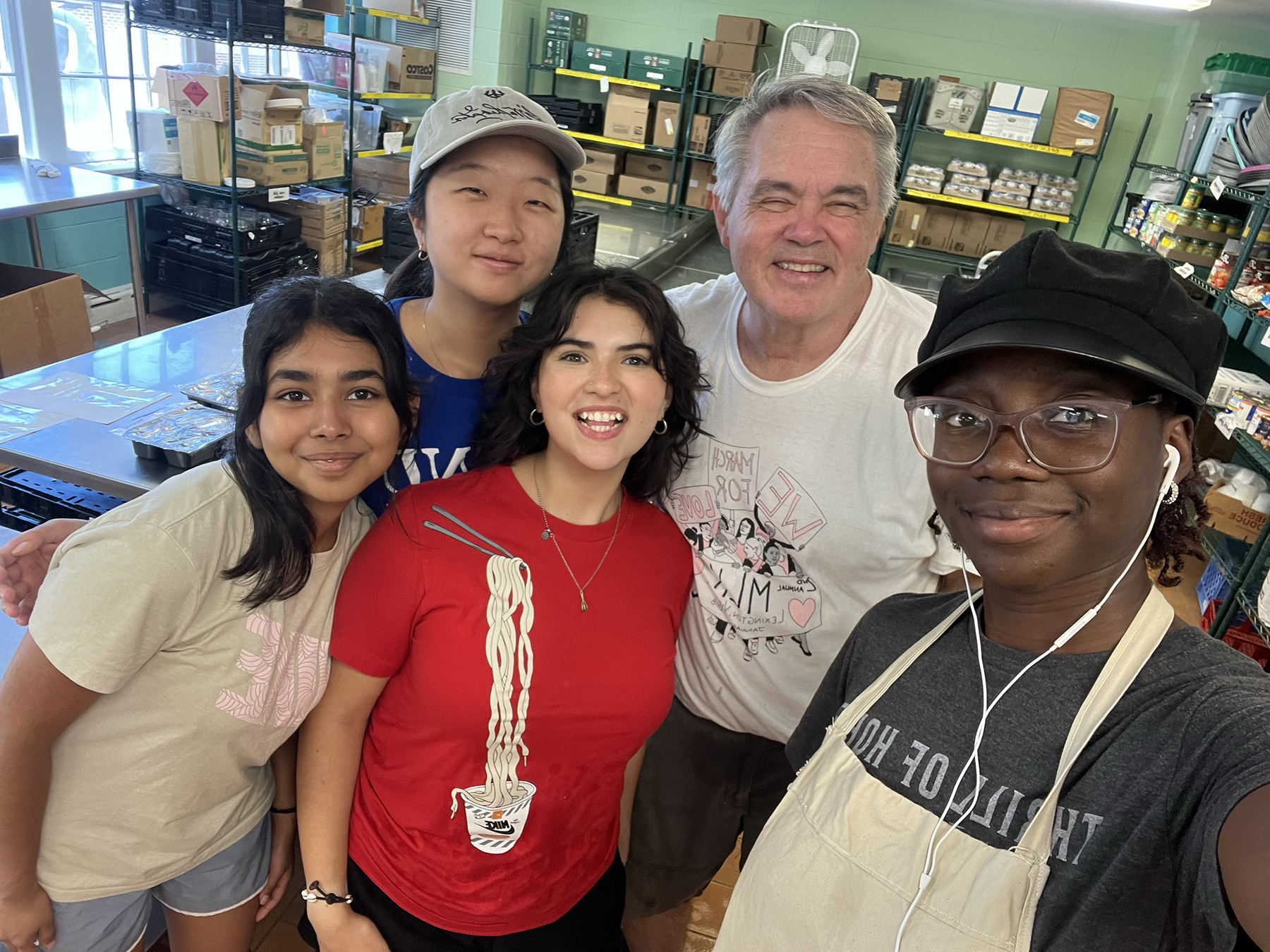 The summer 2026 team poses for a photo with volunteer and W&L retiree Scott Dittman.
Interns were also encouraged to work on special projects tailored to their academic interests. Moon helped design a new nutrition education program for local schools and other constitutions that Campus Kitchen will launch this fall, working through the organization’s On and Off Campus Committee to deepen community partnerships. Rhodes split her time between leading Campus Kitchen shifts and strengthening ties with community partners, from working at the local farmers market, volunteering at Main Street Lexington’s Freedom Food Festival event and assisting with cleanup at Boxerwood Gardens’ summer concert events. Rhodes also made weekly visits to a day center for adults with developmental disabilities. Rose took on the behind-the-scenes work of grant writing and budgeting, learning how to craft stronger proposals and refine Campus Kitchen’s budget so the program can sustain and expand its impact across Rockbridge County. Islam focused on community meal programs and regional outreach, while researching data comparing how food insecurity plays out in smaller rural communities versus big cities. Brink says he is particularly appreciative of those interns with business and accounting backgrounds and their work to build out more formal systems for tracking the kitchen’s expenses and revenue, the kind of institutional data tracking that there is often little bandwidth to restructure during the school year.
Islam pointed to a benefit of the summer experience that went beyond her own academic and leadership growth: the alumni network.
“There are so many alumni who have done this program working in fields that I want to explore,” she said, describing conversations with former volunteers and staff who’ve stayed connected to Lexington. Islam adds that the day-to-day interactions with everyone involved in the program have been just as valuable. “It’s been really helpful to learn how to talk to people of all different ages and backgrounds and social statuses.”
The summer has also reshaped how some of the students see the area around them. Rhodes, who also took the Shepherd Program’s introductory community-based learning course last spring, said the class and her summer experience both pushed her to think harder about the ethics of service. Islam, who grew up in New York, said the delivery routes gave her a version of Rockbridge County she wouldn’t have found on campus.
“It’s another way to meet people you just wouldn’t,” she says.
After their summer experience, the group says they are ready for a productive and meaningful academic year given that the organization will soon be gearing up for the reunion weekend marking 20 years of a program that started with a summer internship not unlike the one that they’ve just completed. Moon added that students interested in getting involved with Campus Kitchen should keep in mind that they do not have to be on the leadership team to make a difference.
“You can do an hour shift per week, which is not a huge commitment,” she says, “and I do believe it’s helping not only the community but also the future of Lexington and Rockbridge County.”
Additional Funding
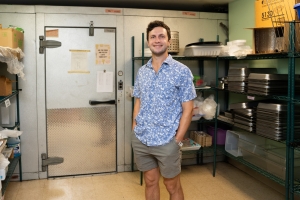
Campus Kitchen recently received a $45,000 grant to install a new walk-in refrigerator and freezer.
And W&L’s new Full Circle Food Initiative to reduce food waste on campus received a $324,829 grant in April from the Virginia Department of Environmental Quality.

You must be logged in to post a comment.