January 15, 2026
W&L’s Campus Kitchen Hosts 14th Annual Souper Bowl
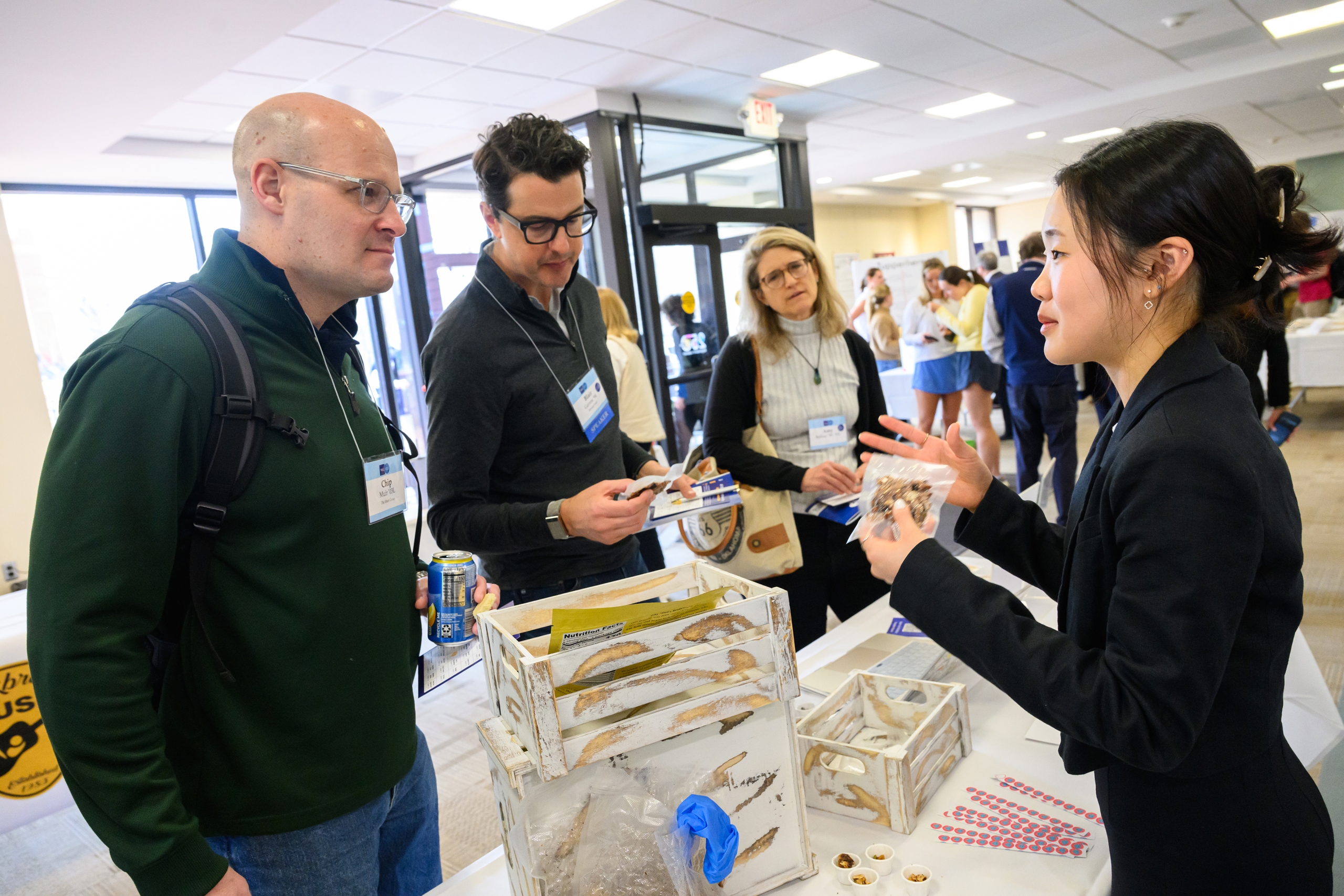 Anna Lee ’28 shares the granola she makes at the Student Showcase during the Entrepreneurship Summit in Leyburn Library.
On Saturday mornings, while most of campus is still asleep, sophomore Anna Lee ’28 is in the Campus Kitchen at Washington and Lee University packaging granola bound for the shelves of Café 77, located in Elrod Commons. The space is borrowed, but thanks to a new arrangement between Campus Kitchen and the J. Lawrence Connolly Center for Entrepreneurship, it is officially hers for a block of hours each week. It is also the reason her business exists in its current form.
Lee, a business administration major double-minoring in entrepreneurship and strategic communication, launched her granola company last summer with funding from W&L’s entrepreneurship department, working out of her parents’ kitchen and selling at farmers markets in Ohio. Granola qualifies as a cottage food in Virginia, which means it can be made at home as long as it is sold directly to customers. When Jay Margalus, Johnson Professor of Entrepreneurship and director of the Connolly Center, encouraged her to bring the business to Lexington, she set her sights on Café 77. However, university requirements dictate that granola sold through a third-party retailer has to be prepared in a commercial kitchen.
Turns out, a closer-to-home solution was already in plain sight. The Campus Kitchen at Washington and Lee, a key component of the Shepherd Program for the Interdisciplinary Study of Poverty and Human Capability that turns surplus food into hundreds of meals a week for Rockbridge County neighbors, is a fully certified commercial space.
Campus Kitchen is a student-run organization that works to address food insecurity and food waste in Lexington and Rockbridge County by delivering prepared meals and distributing groceries to those in need. The Connolly Center is an interdisciplinary center at W&L intended to help students from across campus learn how to turn their creative ideas into successful business ventures, offering coursework, pitch competitions, speaker events and mentorship opportunities supported by faculty and alumni. Jay Margalus, the Johnson Professor of Entrepreneurship and Leadership and director of the Connolly Center, and Ryan Brink, assistant director of the Shepherd Program and Campus Kitchen coordinator, saw an opportunity for the Connolly Center and Campus Kitchen to support one another, students and the surrounding community, particularly given that Larry Connolly ’79, the center’s namesake, has also been a longtime supporter of the Shepherd Program in various capacities over the years.
For Brink, the model came straight from the nonprofit playbook.
“This is an established business practice that nonprofits around the state use,” he says, “where they are recognizing that they have this infrastructure that is valuable to different businesses. They have openings and opportunities to use it beyond their current operations, and so they can generate revenue for their work by renting out the space and equipment.” Under the agreement, the Connolly Center pays the Campus Kitchen a set fee for an exclusive multi-hour block on Saturdays. Those funds flow back into Campus Kitchen’s programs, feeding the surrounding community.
Lee was the first to take advantage.
“It was kind of like a mutual win-win,” she says, “because they would be getting some funds to support Campus Kitchen, but then we would also have access to a kitchen facility.” She keeps her own shelf inside the facility, runs her process every week and now produces under conditions approved by the Virginia Department of Agriculture and Consumer Services.
The pipeline is already widening. This Spring Term, a history class used the kitchen three mornings a week — the first time, Brink notes, that a formal process has existed for academic use of the space. Bigger ideas are circulating, including a rotating student-run food truck that would use the Campus Kitchen as a prep space before traveling to sites around Rockbridge County. Margalus says he is connecting with more and more alumni with food-based businesses and hopes to see opportunities expand on and off campus for students interested in entrepreneurial ventures in this area.
Lee is now balancing Café 77 production with a newly launched e-commerce site and a marketing push on Instagram. Brink says he expects her to grow into a mentor for the next wave of student food entrepreneurs.
“I’ve always loved baking,” she says. “I think I’ve been baking since I was in third grade.”
For Margalus, the partnership is also a kind of homecoming for the donor whose name is on the center. Connolly and his family established the Connolly Center for Entrepreneurship with a gift to the university in 2013.
“Larry Connolly is aware of it,” Margalus says, “and he’s very happy about it, because it’s kind of a full-circle thing.”

You must be logged in to post a comment.