September 3, 2026
Discovery Through Dance
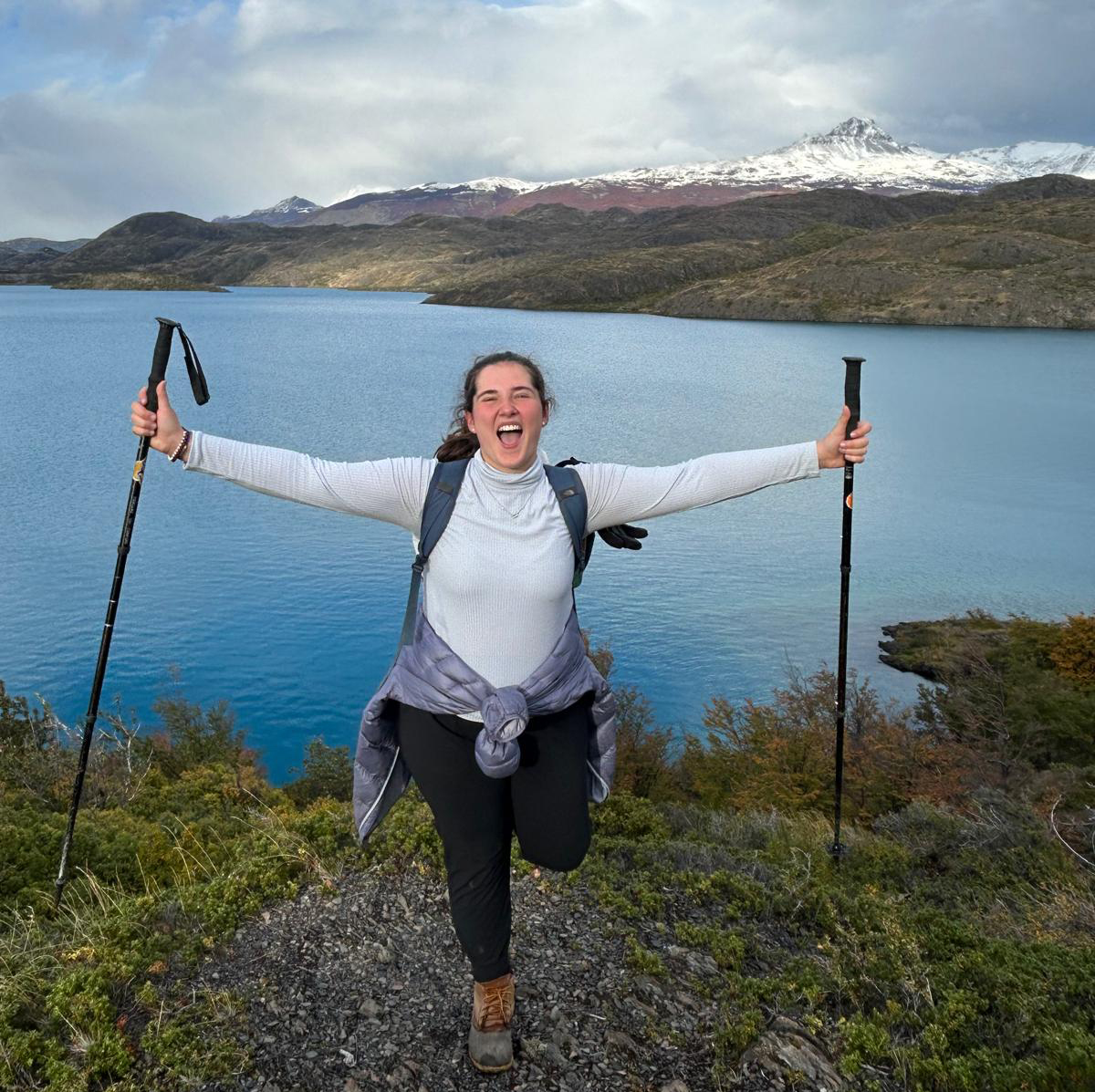
“The fact that so many students and professors would be so welcoming to someone who’s not even from their country was such a gift.”
~ Grace Rustay ’27
Grace Rustay ’27 had been in Chile for about three weeks during Winter Term 2026 and on campus at the Pontificia Universidad Católica de Chile, or PUC, for two, when she lassoed – literally – her first adventure.
“During my first week at PUC, there was a club fair,” she says. “I signed up for all the clubs I could.” The following week, she received an email from an environmental group. They were holding a fundraiser to reforest parts of the Bío Bío province in southern Chile, which had suffered some of the strongest wildfires on record in January 2026. The fundraiser included a bake sale and student talent performances to raise money to allow volunteers to replant 100 acres of native species. When asked to participate in the event, Rustay said “of course!” and dusted off a dormant skill to lend a hand.
“At my summer camp growing up, they taught us how to lasso,” says Rustay, who performed lassoing demonstrations during the fundraiser.
Rustay believes the story encapsulates a central theme of her semester abroad — to say yes to new opportunities. She credits her approach to advice she received from associate professor of politics Brian Alexander during her time as a Washington Term student in 2025.
“Professor Alexander taught us that when incredible opportunities come your way, you have to say yes,” she says.
Rustay, an economics and politics double major with a minor in Latin American and Caribbean studies, brought to her study abroad experience the unique advantage of being a polyglot (she speaks Spanish as well as four Indigenous South American languages), although she views her language acquisition as somewhat accidental in the beginning.
“I picked up Spanish when I was little,” says the Houston native, “because I grew up around a lot of Spanish speakers, and I wanted to know what they were talking about and be able to talk with them.”
The Path to PUC
In high school, Rustay’s language fluency proved to be an asset as she became involved with environmental advocacy in her community, such as replanting prairie grass along Houston’s bayous. She often spoke with constituents in Spanish. At W&L, Rustay says Ellen Mayock, the Ernest Williams II Professor of Romance Languages, pushed her further in her language skills.
“Without Professor Mayock, I would not have had the confidence to do this,” Rustay says, referring to her Spanish immersion in Chile.
A remote research stint with the Virtual Student Federal Service Program during the 2024-2025 academic year studying threats to environmental defenders across Latin America sparked an interest in further language study. Rustay says her inspiration was in gaining access to, and fully representing, people whose concerns and perspectives rarely make it into policy rooms.
“I ended up picking up the basics in four Indigenous languages from that experience,” she says, “Nahuatl and Mixtec, which are central and southern Mexico, and then Quechua and Aymara, which is kind of the Inca diaspora, covering Peru, Ecuador, a little bit of Chile and Bolivia.”
The decision to study mining law abroad in a pre-law program, specifically in Chile, can also be traced to her Washington Term experience working with the International Conservation Caucus Foundation.
“My colleagues kept saying, ‘You need to go to Chile, you need to understand the Chilean legal system,’” she says. “It’s something the United States has a lot to learn from, and a lot of other Latin American countries are trying to emulate pieces of it.”
Chilean universities admit by placement score, and Rustay sat for a modified version of the PAES, the Chilean equivalent of the SAT, to demonstrate her competence in Spanish and for the academic rigor required for the law program. Rustay was thrilled to have the opportunity to take courses in mining law and political law at PUC and audited a course on water law and Chilean institutions.
This coursework feeds directly into the W&L honors capstone she is currently writing on water rights in Chile as they relate to data center development around the Santiago metropolitan region.
Her first exposure to the issue came while studying at PUC. Through the Vocalía de Justicia Climática, or the Climate Justice Club, she attended a symposium put on by the Third Environmental Tribunal, whose jurisdiction stretches from the central to Arctic regions of Chile. At this conference, students, policymakers and practicing lawyers from across the country debated amendments to the newly revised 2022 water code. Several policymakers who had crafted the water code were physically in the room.
“This experience made me realize I had made the right choice,” Rustay said. “It felt a little bit like Hamilton, like I was in ‘the room where it happens.’”
Rustay was tapped to serve as the international coordinator for Acacia, the university’s newly created environmental law society. Rustay also began editing for PUC’s Environmental Law Review and expects a byline on a piece built from her own research, refined into publishable legal Spanish with the help of a classmate. She additionally served as a teaching assistant with PUC’s Institute for Sustainable Development and led a twice-weekly English conversation lunch for students from Spanish-speaking backgrounds.
Her extracurricular involvement also translated into reforestation trips with three student groups: the Vocalía Justicia Climática, La Raíz, an interdisciplinary environmental group, and the Vocalía Sustenabilidad, or Sustainability Club. Through these groups, Rustay and her friends traveled across the country, restoring native plant species in local and national parks.
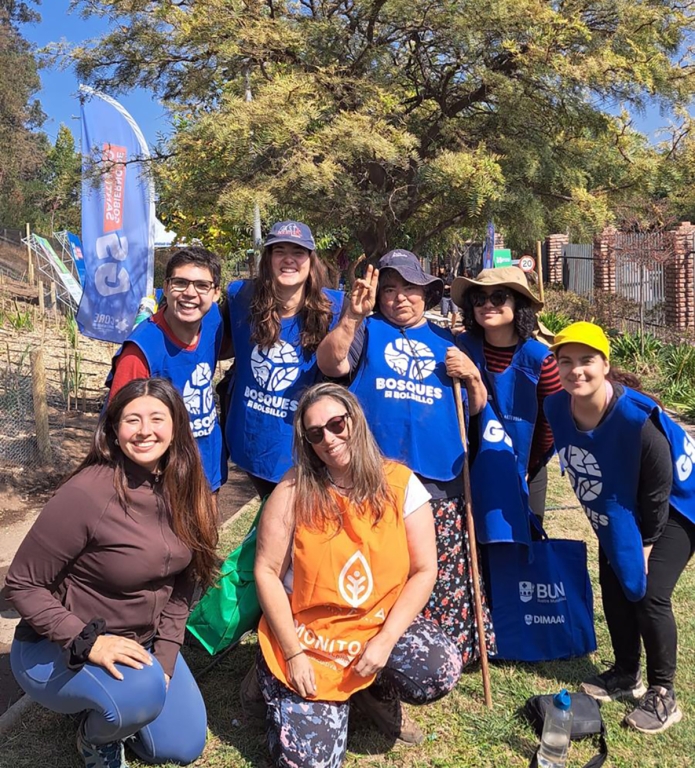 Rustay accompanies PUC’s Climate and Justice Law Club to replant native trees in the community of Buin. This outing was one of several across Chile to replant endemic species in areas negatively impacted by wildfire or climate change.
W&L Connections in Chile
Rustay says her connection to Washington and Lee was forged early. Her father, Allen Rustay, is a member of the Class of 1993, and Rustay says she got to see the alumni network in action growing up in Houston.
“I was lucky to grow up around a really tight-knit W&L community,” she says, “and to see those people look out for each other. When I was thinking about where I wanted to go to school, I couldn’t help but think, ‘I want a community that looks like that.’”
She found an unexpected extension of that community upon arriving in Santiago through Valentina Lozano ’25, originally from Medellín, Colombia, whom she’d met once prior to her arrival. When Rustay landed in Chile, Lozano, then working with the United Nations, reached out immediately.
“I’m literally on the other side of the world, and I still run into a W&L person,” Rustay says. “And she has gone out of her way to make sure I feel at home in a country that is definitely not my home. What a blessing that is.”
That warmth, she says, is also reflective of Chilean culture.
“If you had to encapsulate Chilean culture in one word, it would be ‘joy,’” Rustay says. She points to her “phenomenal” host mom, Mary Díaz, and to local customs that mirror W&L’s own Speaking Tradition: “saying hey” to everyone you know on the way to class.
“You end up having a five-minute conversation about nothing, because you’ve just seen one of your friends, and then suddenly you’re 10 minutes late for class because you got stopped by eight people on the way,” she says.
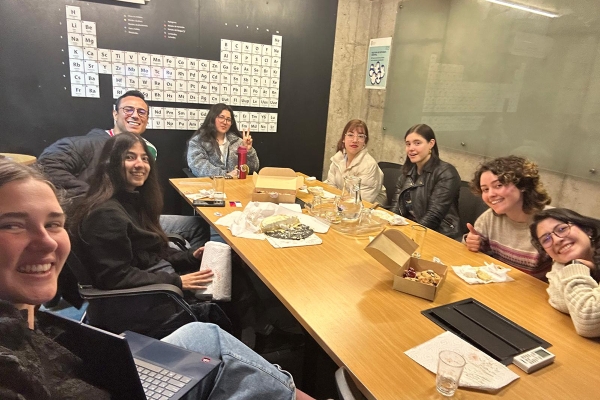 Rustay’s fellow students threw her a Texas-themed going-away party prior to her departure.
What’s next
Before embarking on her Chilean adventure, Rustay spent a summer working on Capitol Hill for U.S. Rep. Lizzie Fletcher of Texas. Her work primarily focused on energy policy and women’s health. She says these experiences have reshaped her career plans.
“On the policy side, I saw people like Representative Fletcher with legal backgrounds making a real, tangible difference,” she said. “I had seen the same thing with my work with the State Department, too.”
Rustay hopes to attend law school after graduation and is considering returning to PUC for its graduate law degree program. This path could allow her to practice in both the U.S. and Chile.
Her intended focus, mining and energy law, are both areas where her language skills will be an asset. Rustay points out that the same goals that drew her to learn, in particular, Indigenous languages have fueled her interest in a career in law.
“I wanted to learn how to represent voices that weren’t traditionally in the room,” she says. “That’s why I picked up all of the Indigenous languages, so that I could better represent those folks and their concerns.”
Rustay says that her study abroad gave her a glimpse of how she could use a strong educational background and language skills to help shape mining policy affecting the people and cultures she fondly appreciated during her time in Chile.
“It has just been such a gift and such a privilege to get to be there,” she says, “and to get involved with so many things. The fact that so many students and professors would be so welcoming to someone who’s not even from their country was such a gift.”
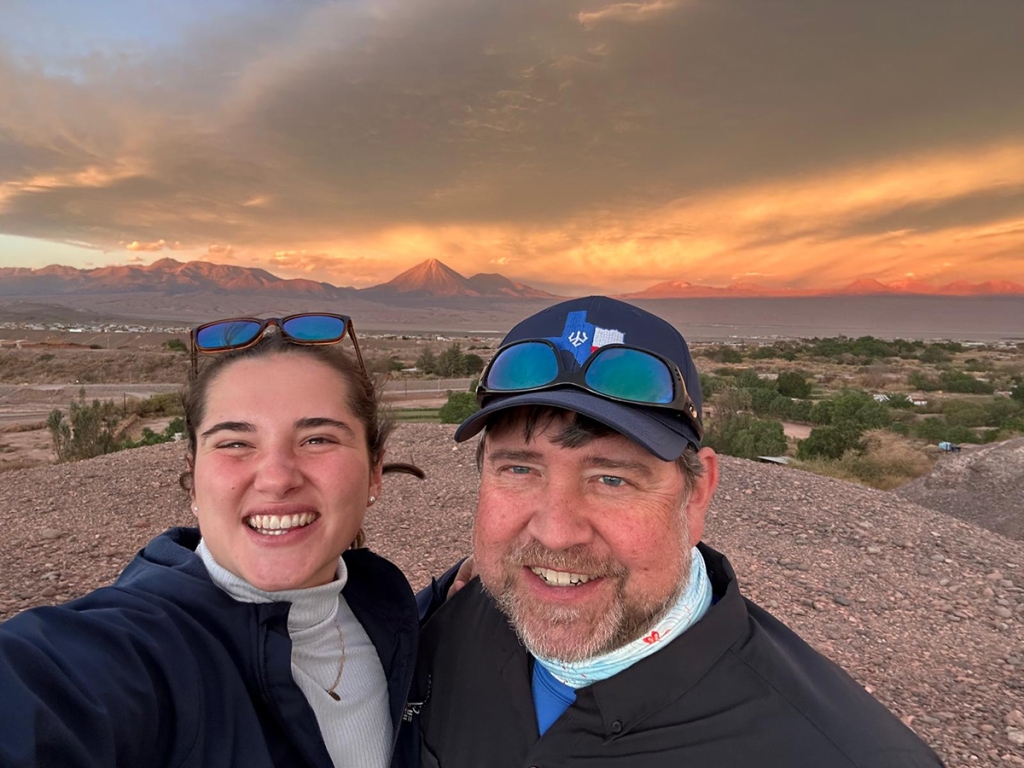 Rustay with her father, Allen Rustay ’93, at the Atacama Desert

You must be logged in to post a comment.