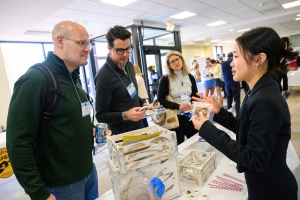
Campus Kitchen Looks Back on 20 Years of Growth Over the past two decades, Washington and Lee's Campus Kitchen has expanded opportunities for the surrounding community and W&L students to address food insecurity.
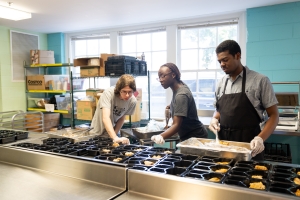
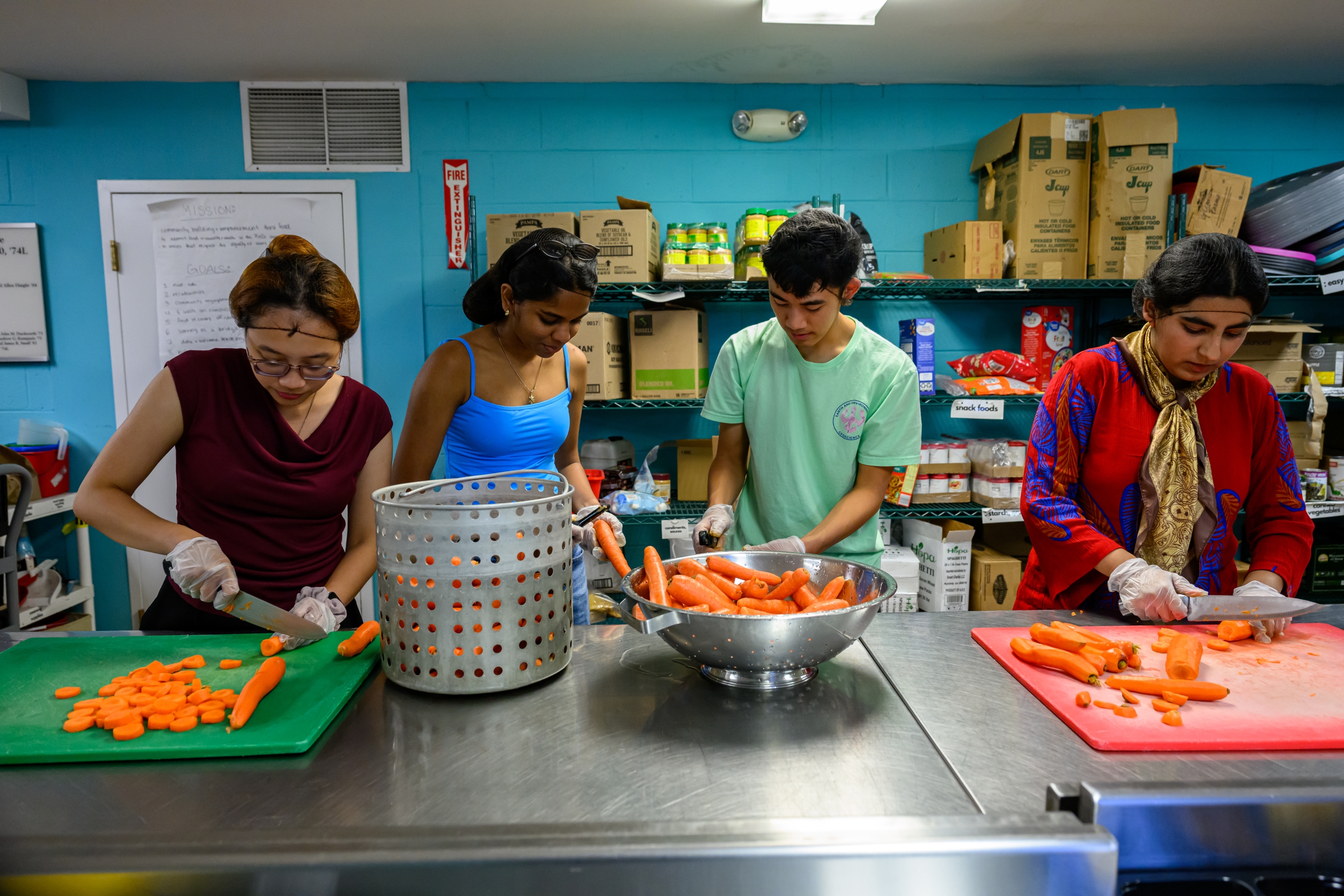 Campus Kitchen shift volunteers prep vegetables during their cooking shift.
“I’ve come to see Campus Kitchen as more than an outward-facing program that provides meals the community needs. It’s also a student learning experience that prepares students to make a positive impact wherever they go after graduation.”
~ Ryan Brink, assistant director of the Shepherd Program
Launched in 2006, Campus Kitchen is a student-led effort to combat food waste and hunger in Lexington and Rockbridge County by collecting surplus food from on-campus dining halls, community gardens, restaurants and grocery stores and transforming it into healthy meals. Multiple generations of W&L student volunteers have spent countless hours supporting Campus Kitchen and its programming, including delivering prepared meals and participating in its community nutritional education program.
The program’s leadership traces its roots to Ingrid Easton ’06. In high school, Easton helped start an organization called Cook for a Cause that sold baked goods to raise money for organizations in need within her local community, but she says that it took taking Poverty 101 with Shepherd Program for the Interdisciplinary Study of Poverty and Human Capability Founding Director Harlan Beckley to spark her passion for service.
“Shepherd showed me that your life can actually be service,” Easton says. “Seeing the fruit of what it looks like when people devote their lives to service really changed my whole perspective.”
Easton’s idea for W&L’s Campus Kitchen grew out of reading Robert Egger’s “Begging for Change,” which described the DC Central Kitchen’s model and the value of adapting an effective program rather than starting from scratch. Easton interned with both DC Central Kitchen and its affiliated program, the Campus Kitchen project, to learn how the model worked and to see how it could be implemented on W&L’s campus (DC Central Kitchen has since wrapped up direct operations of its Campus Kitchens national headquarters and encouraged chapters to join the Food Recovery Network, a larger movement dedicated to ending hunger and food waste). She met with campus administrators and Dining Services, answered questions about how the program would operate and worked to address concerns about sustainability. She had support from multiple mentors, including Beckley. Shortly before graduating, she asked the university to let her and a coalition of student leaders she had assembled run Campus Kitchen on campus for a few days as a trial to make a case for the program. The trial went well, and the rest is history.
Jenny Davidson ’08, associate director of the Shepherd Program, participated in some of Campus Kitchen’s first shifts as a student in the Bonner Program. She began what would be a 10-year role as the coordinator of Campus Kitchen shortly after graduation and helped launch Campus Kitchen’s Backpack Program in 2009, which provides breakfast, lunch and snack items to over 650 local children each weekend. The organization’s first van was purchased in 2010, which Davidson cites as a significant step forward.
“Our student leadership was able to flourish then,” Davidson says, “and expand our reach.”
In 2012, the kitchen found its permanent home in the basement of what was then called the Global Service House on Lee Avenue with the help of several donors and an extensive renovation. Over the years, Davidson steered the program through multiple stages of growth, including partnerships with area schools and eventually securing an AmeriCorps grant that allowed for an AmeriCorps Vista staff member to begin the mobile food pantry program.
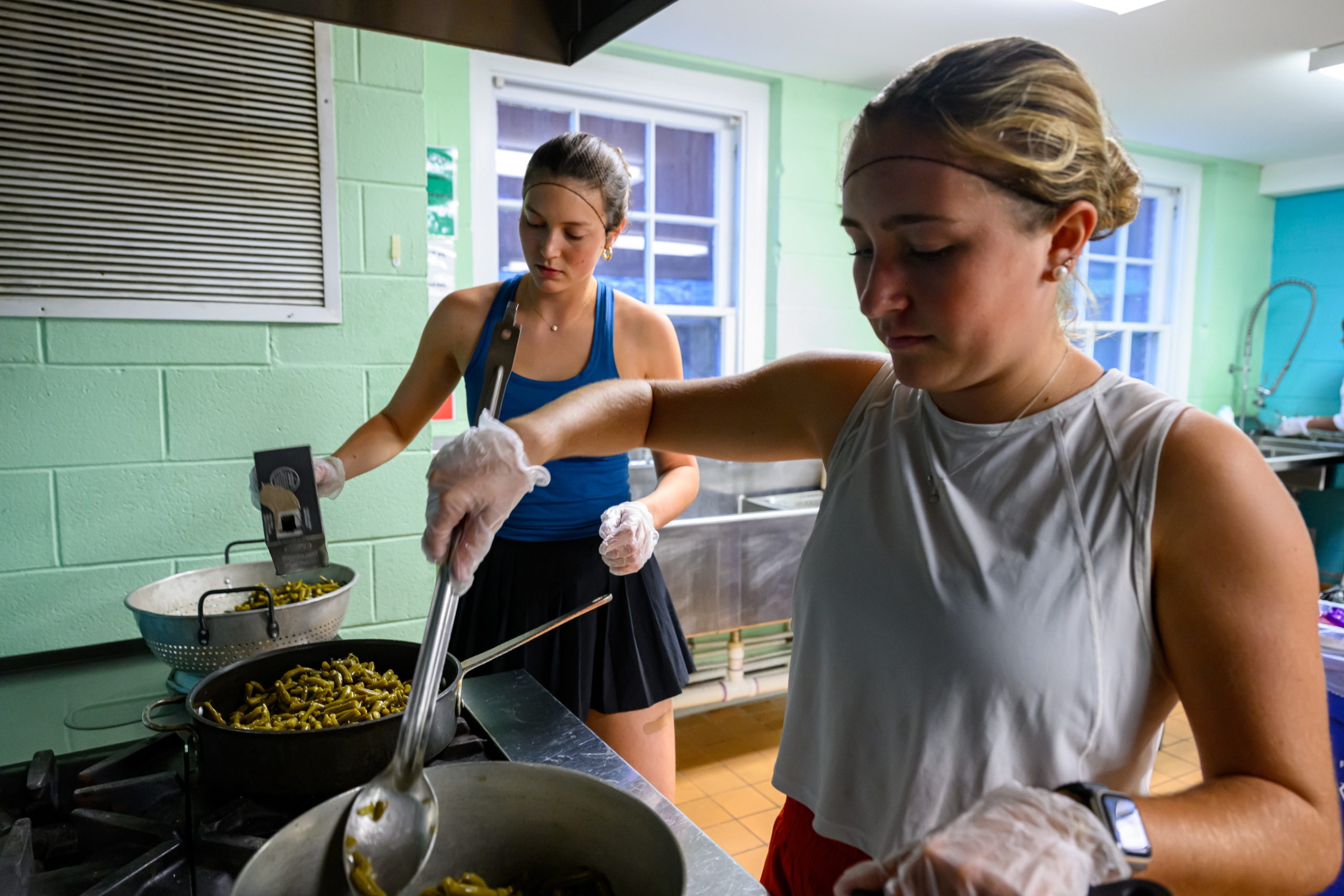 Campus Kitchen volunteers have spent more than 75,000 hours completing kitchen shifts over the course of its 20 years on campus.
Ryan Brink ’18 also got involved with the Shepherd Program as a Bonner student and spent three summers with Campus Kitchen as an intern during his time on campus. Like Davidson, he returned to campus to assume the role of leading Campus Kitchen shortly after his graduation in 2018. Brink, Campus Kitchen coordinator and assistant director of the Shepherd Program, says it has been rewarding to see the program grow since he first arrived on campus in 2014.
“When I was a student, the leadership team had about five to seven students per class year, and they took on a lot of hours and responsibility,” Brink says. “Now, there are about 35 to 40 students on the team — roughly 10 to 15 per class year. Some still work seven to 12 hours a week, while many work three to four hours and lead specific shifts.”
Brink has also seen the kitchen’s facilities and programming expand. Campus Kitchen recently received a $45,000 grant from the Blue Ridge Area Food Bank to replace a walk-in refrigerator and freezer. Its 2026-2027 Just Food series, announced in September, features lectures and screenings exploring the intersections of food access, poverty and public health that invite the campus and external community to engage with the topics. The organization looks to its 15th annual Souper Bowl fundraiser to continue supporting the CKWL Backpack Program. A recent partnership with the Connolly Center for Entrepreneurship invites student entrepreneurs to use the organization’s commercial kitchen space for their projects. And, as part of W&L’s Full Circle Food Initiative, a collaboration between the Office of Sustainability and Energy Education, Campus Kitchen, W&L Dining Services and University Facilities designed to address food waste on campus, the kitchen received a grant to support the purchase of a refrigerated vehicle to expand its food recovery and delivery capacity.
One of the most significant changes to the kitchen’s organizational structure in recent years is the addition of a new first-year cohort called Hunger Fighters. Incoming students interested in exploring food insecurity through service and educational programming apply the summer before arriving on campus. The group meets throughout the year and frequently participates in Campus Kitchen shifts; Brink says the program has become a pathway into Campus Kitchen’s leadership team.
“We see this, as well as the Good Nabors program, as an on-ramp to Shepherd more broadly, but we do also find that many students participating in Hunger Fighters wind up applying to leadership positions with Campus Kitchen in the spring of their first year,” Brink says.
Hannah Puckett ’23 says Hunger Fighters gave her the necessary experience to excel on Campus Kitchen’s leadership team throughout her time at W&L. She served for two summers as a Campus Kitchen intern and joined the executive leadership team her sophomore year and credits joining Hunger Fighters as a first-year student with accelerating her involvement with the organization.
“There are so many logistical and leadership skills involved in running a shift and managing volunteers,” says Puckett, who is now obtaining her master’s in clinical mental health counseling at Wake Forest University, “so doing those weekly shifts with Campus Kitchen leaders was really a process of ‘we’re learning as we go.’”
Campus Kitchen has continued to expand its offerings to the surrounding community through its recent SNAP initiative, designed to raise awareness about the federal SNAP program and increase enrollment. Following a review process of both Campus Kitchen’s services and food insecurity in the local area during the 2024-2025 school year, Campus Kitchen identified an enrollment gap in SNAP within Rockbridge County.
“As SNAP has been shown to be successful in addressing and preventing food insecurity, we decided this was a gap we would be interested in addressing,” says Gibson Ward ’27, an economics and sociology double major with a minor in poverty and human capabilities, who currently serves on Campus Kitchen’s leadership team. As a Campus Kitchen summer intern during summer 2025, Ward aided in this research process by interviewing local organizations. Campus Kitchen officially created the SNAP Outreach Committee in the spring of 2026, which began researching how to address the enrollment gap.
“The SNAP Outreach Committee took our research from the prior summer into the 2025-2026 academic year by doing test runs of SNAP outreach with several community partners such as Rockbridge Area Relief Association and Rockbridge Connect and Nourish,” he says. “This year, we have begun to include outreach shifts on our semester shift schedules and hope to train fellow CK leaders on being SNAP Outreach advocates to ensure the program continues after most of us graduate.”
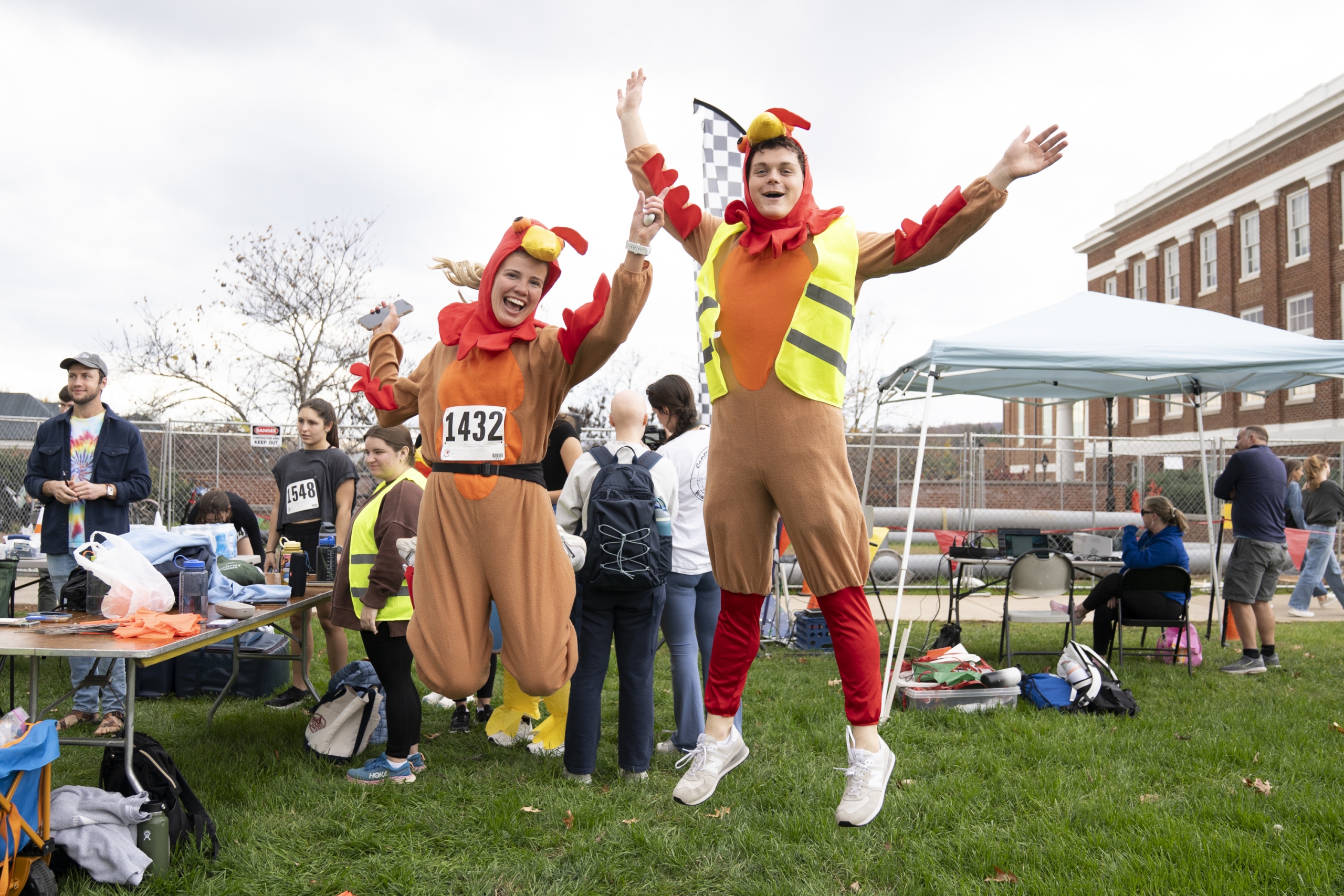 Students celebrating at last year’s Pumpkin Pieve-K fundraiser.
Students interested in getting involved with Campus Kitchen are encouraged to bring a variety of talents and lenses to their contributions to the organization. Matthew Steuerman ’27 serves as Campus Kitchen’s co-treasurer and has been a member of Campus Kitchen’s Finance & Fundraising Committee since 2024. The business administration major is excited for the committee’s expansion this year and the opportunities it creates for generating new revenue and momentum for the organization. In collaboration with Brink, Steuerman and his team are responsible for requesting annual budget allocations from the Executive Committee, applying for grants, planning and executing fundraisers and managing the organization’s budget throughout the year.
“Last year, we moved from a projected deficit of more than $15,000 to a $6,000 surplus,” Steuerman says. “I can say that I helped accomplish this, but I couldn’t have done it without Austin Winslow ’26, Evan Clark ’26, Gibson Ward ’27 and, of course, Ryan Brink. We accomplished this by applying for more grants, becoming more creative with fundraisers — we like to call them “low-lift, high-yield” fundraisers — and expanding our Souper Bowl and Pumpkin Pieve-K fundraisers. We did all of this in the midst of rising food costs that greatly impact our mobile food pantry and individual meal delivery programs.”
This year’s Pumpkin Pieve-K fundraiser will serve as the final event for the Social Impact Summit and Shepherd Affinity Weekend, an opportunity for Shepherd alumni to connect with current students, reflect on their Shepherd experience and celebrate the program’s 30th anniversary, which also comprises the 25th anniversary of the Bonner Program in addition to the 20th anniversary of Campus Kitchen. Brink says the hunger-fighting program has evolved into something that extends well beyond the borders of campus.
“I’ve come to see Campus Kitchen as more than an outward-facing program that provides meals the community needs,” he says. “It’s also a student learning experience that prepares students to make a positive impact wherever they go after graduation.”
By The Numbers
Since its founding, Campus Kitchen has served 662,650 meals and has distributed 537,500 pounds of food through its mobile food pantry.
Volunteers have spent more than 75,000 hours completing kitchen shifts.
Campus Kitchen’s Backpack Program provides breakfast, lunch and snack items to over 650 local children each weekend.
The program has delivered over 8,000 hours of nutrition education.
112 students have participated in the Hunger Fighters cohort, and 231 students have served in Campus Kitchen leadership positions.
Related Stories
August 24, 2026
A Full-Circle Summer

You must be logged in to post a comment.